
Lecture
A utility function — is a function by means of which a consumer's preferences over a set of feasible alternatives can be represented. The numerical values of the function help to order the alternatives by degree of preference for the consumer. A greater value corresponds to greater preferability. In the modern ordinalist theory of utility the numbers themselves have no meaning — only the relations «greater than», «less than» and «equal to» matter.
Not every preference relation can be represented by means of a utility function. However, for the preferences used in economic models such a function exists. The existence of the function makes it possible to use mathematical analysis when solving optimization problems in economics. For example, when solving the consumer's problem . Without using a utility function, the solution of such a problem becomes difficult.
The set on which a binary preference relation X is defined can have a fairly complex structure, and therefore comparing its elements with each other can also turn out to be a difficult task. However, in many cases each element x e X can be assigned a certain numerical characteristic denoting its «utility».
A utility function is a measure of the relationship between the amounts of goods consumed and the level of utility:
U = U (y1, y2,…, y n);
where U – is the utility of the bundle of goods,
and y1, y2,…, y n- are the amounts of goods consumed.
A utility function is a very convenient auxiliary tool that opens up the possibility of using optimization theory when solving the consumer's problem. Without using a utility function, the solution of such a problem may, from a mathematical point of view, be difficult. Despite certain limitations of the approach, the utility function is an integral part of most modern economic models
Let a set of feasible alternatives  be given, on which a preference relation
  is defined. Then a real-valued function
  is called a utility function if the following condition holds :

A greater value of the utility function means a greater preferability of the alternative in the sense of the preference that this function represents. From a mathematical point of view, a utility function is a way of scalar ranking.
Let on the set X a preference relation (>). A utility function is defined as a function u : X -> R, defined on X in such a way that for arbitrary elements x, y e X the following relations hold: x is preferred to y (x> y) if and only if u(x) > u(y).
In this case, it is said that the utility function u generates a preference relation on X and one often writes x y.
Since the set of real numbers R is ordered, comparing the numerical characteristics of objects makes it possible to compare the objects themselves as well. Thus, for example, in long-jump competitions the utility of a jump is determined by its distance.
An example of determining the value of a utility function. Suppose it is necessary to decide which student in the study group described in example (*) will take part in the mathematics olympiad. Let us introduce a utility function u, assigning to each student their average grade obtained in mathematical subjects over all years of study. Such a function generates a preference relation on the set of students G as follows: student g1 is preferred to student g2, if the grade of student gl is higher than the grade of student g2. Suppose the average grade of Ivanov is 3.8, of Petrov — 5, of Semenov — 5. Then Petrov will be more preferred for participation in the olympiad than Ivanov. At the same time, by this criterion it makes no difference whom to choose — Petrov or Semenov. Another criterion is needed to choose among these students.
If at least one utility function exists, then infinitely many such functions exist, since the composition of u with any increasing function g, defined on the range of values of the function u, i.e., g(u(x)), will also be a utility function generating the same preference relation on X. At the same time, some functions may be more convenient in terms of their properties — for example, they may be linear, differentiable, or possess other suitable properties.
It should be noted that the concept of utility is not applicable to arbitrary binary relations. Such a function cannot be constructed for binary relations that are not acyclic, such as the relation = «relatives», described in example (*). Moreover, if the concept of indifference for the DM, as mentioned in the previous section, does not possess the property of transitivity, then in such cases too a utility function cannot be constructed.
Modern microeconomics relies on the ordinalist approach to modeling consumer behavior and choice. According to this approach, the numerical values of the utility function play no role; only the order «greater-less» matters. If the value of the utility function for one of the alternatives is higher, then that alternative is more preferable for the consumer. In this case, the difference of the values or the ratio of their division carries no information . The opposite is the cardinalist approach, in the use of which numerical values, on the contrary, carry information about utility. The cardinalist approach implicitly presupposes the existence of a standard of utility, i.e., a universal unit with which comparisons can be made. It was precisely this understanding of utility that was used by Jeremy Bentham, the founder of the philosophy of utilitarianism .
Modern economists proceed from the assumption that ideas about utility are subjective, and therefore their direct comparison is impossible. Therefore, the concept of Pareto efficiency is used to assess the joint welfare of consumers. An exception is quasilinear preferences. They presuppose the existence of a countable good (Engl. numeraire), which is an analogue of money. In that case, summation and other operations on utility become possible.
In order for preferences to be representable in the form of a utility function, it is necessary that the preference itself be rational, i.e., that it satisfy the axioms of completeness and transitivity.
Sufficient conditions depend on the set of feasible alternatives itself and on the properties of the preferences. If the set {\displaystyle X} is finite or countable, and the preference relation is rational, then there exists a utility function that represents these preferences.
If the set is uncountable, then it becomes additionally necessary to require continuity of the preferences. In this case, Debreu's theorem guarantees the existence of a utility function. Moreover, the utility function is continuous. Continuity is a necessary condition for the existence of a utility function representing a rational preference, but it is not sufficient. For example, the utility function  (the integer part of a number) represents preferences that are not continuous. The function itself is also discontinuous.
Additional conditions are often imposed on preferences in order to obtain functions with one property or another. Thus, one can require monotonicity, local non-satiation, and convexity. These properties of preferences are reflected in the properties of the utility function. For example, monotonicity of preferences leads to monotonicity of the function, while convexity of preferences makes the function quasiconcave.
For any rational and continuous preferences on  there exists a continuous utility function representing them .
Let a strictly increasing function  be given, and let } — be a utility function. Then the composition of the functions
  is also a utility function representing the same preference relation
  . Note that
  need not be continuous .
If the set is convex, then the utility function will be quasiconcave.
If the preferences satisfy the property of monotonicity (strict monotonicity), then the function will be monotonic (strictly monotonic).
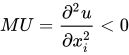
The property of diminishing marginal utility is a consequence of the concavity of the utility function. If the function is twice differentiable, this property means that the second partial derivative of such a function is negative.
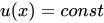
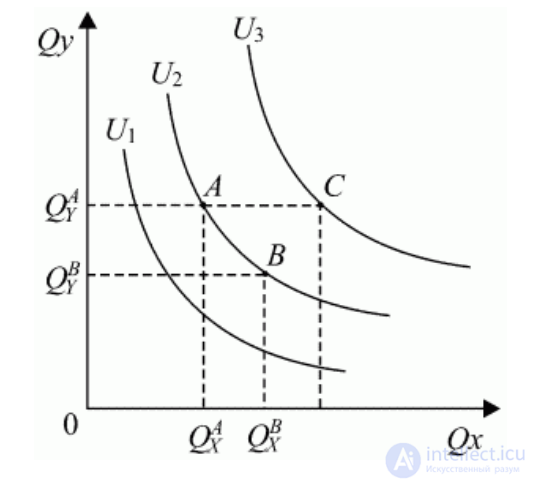
An indifference curve — is a level line (surface, hypersurface) of the utility function.
One of the most important utility functions is the CES function. The abbreviation CES (Engl. constant elasticity of substitution) denotes constant elasticity of substitution of alternatives. The function has the following form for the two-dimensional case.

For different values of the parameter {\displaystyle \rho } one can obtain special cases of the CES function.
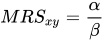
If  , then the function is linear and describes perfect substitutes. In this case, the marginal rate of substitution is equal to the ratio of the parameters
  .
.

If  , then one obtains the Leontief function, which describes perfect complements. The marginal rate of substitution in this case is infinite.

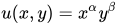
At  , one obtains the Cobb-Douglas function, if the additional condition
  is imposed.
Important examples of utility functions are functions with a constant absolute and relative measure of risk aversion. A function with a constant absolute measure of risk aversion (Engl. CARA — constant absolute risk aversion):
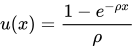
The absolute Arrow-Pratt measure for such a function is equal to: .
A function with a constant relative measure of risk aversion (Engl. CRRA — constant relative risk aversion):
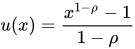
The relative Arrow-Pratt measure for such a function is equal to:  .
.
The Stone-Geary utility function is defined as follows.
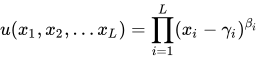
For  , the Stone-Geary utility function turns into the general-form Cobb-Douglas function. The Stone-Geary utility function underlies the linear expenditure system.
Average utility - is the ratio of total utility to the number of units of the good consumed
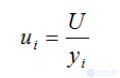
Marginal utility (MU) — is the increase in total utility from consuming one additional unit of the good.
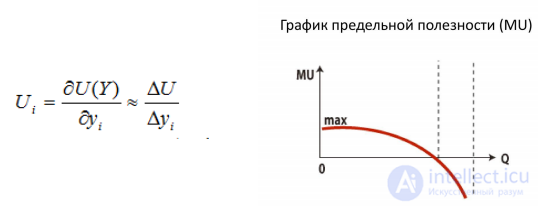
Elasticity coefficient - is a quantity equal to the ratio of marginal utility to average utility.
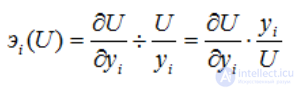
If the elasticity > 1, then the utility function is called elastic (with respect to yi);
if < 1, then the utility function is called inelastic (with respect to yi); if = 1, then the function is said to have unit elasticity (with respect to yi).
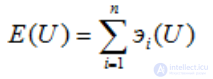
Coefficient of total elasticity of the function U:
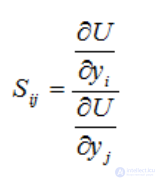
Marginal rate of substitution of goods i and j:
Example:
Suppose there are 5 bundles of goods: 
with the same utility, i.e.  .
.
Let the first type of good be clothing, and the second be food.
These points lie on the same indifference curve.
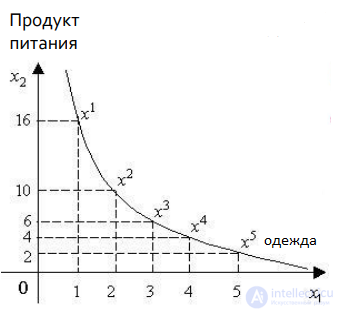
As follows from the graph, replacing bundle x1 with bundle x2 requires giving up 6 units of food in exchange for one unit of clothing; replacing x2 with x3
- giving up 4 units of food for the sake of one unit of clothing, etc.
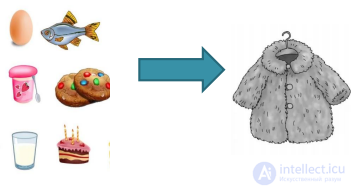
An indifference curve – is a line each point of which represents a combination of two goods that have the same total utility for consumption.
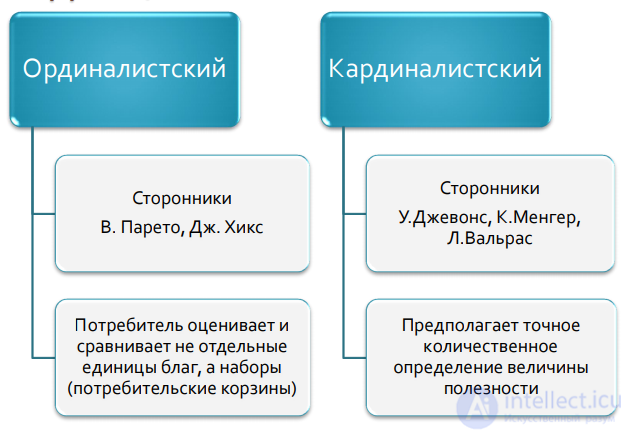
Ordinalist and Cardinalist
Cardinalist - Assumes an exact quantitative determination of the magnitude of utility
Ordinalist - The consumer evaluates and compares not individual units of goods, but bundles (consumer baskets)
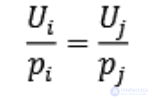
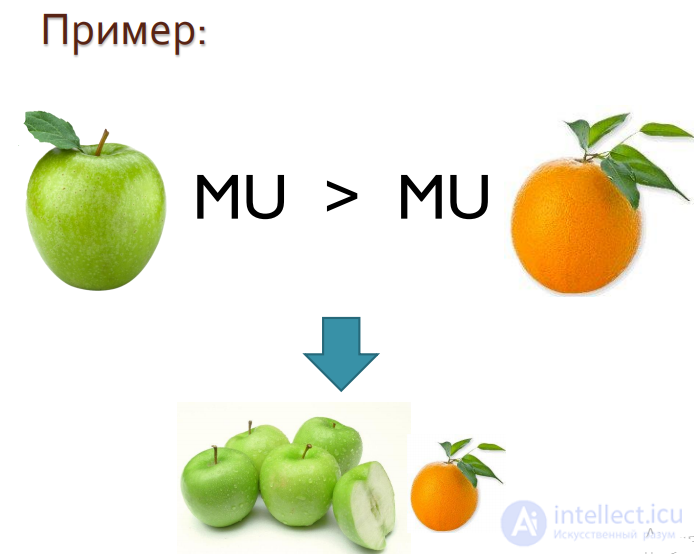
Gossen's Second Law: to obtain maximum utility, a consumer's income must be distributed in such a way that each last monetary unit spent on acquiring each type of product brings the same additional (marginal) utility
The problem of consumer choice
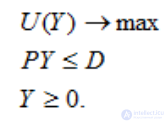
The problem of consumer choice (the problem of rational consumer behavior in the market) consists in choosing a consumption bundle that maximizes the consumer's utility function subject to a given budget constraint. The model of consumer behavior:
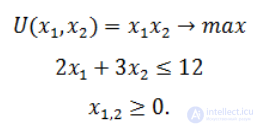
Find the optimal consumer bundle  with budget M = 12 and utility function U = x1+x2 at prices p1 = 2 and p2 = 3
Let us formulate the EMM (economic-mathematical model) of the problem:
To solve the problem, we use the Solver tool in Excel:


Comments