
Lecture
Since every probability distribution generates some random variable, we can say that every alternative x, chosen by the DM, generates a random variable ξx. Thus, one can compare not only the distributions themselves, but also the random variables they generate. A preference relation on the set of random variables can be constructed by means of utility functions or risk functions. The notion of a utility function for a decision-making problem under certainty was introduced in Section 7.3. In the case of a decision-making problem under uncertainty, this notion needs to be modified.
Definition
The utility U(ξ) of a random variable ξ, we shall call the mathematical expectation of the quantity u(ξ): 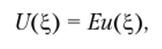
if such a mathematical expectation exists. Here u — is some non-decreasing function. The function u itself, which assigns to each random variable its mathematical expectation, is called the utility function.
Remark. Sometimes the function u is subjected to stricter constraints, for example, the property of concavity .
The utility function generates a preference relation on the set of distribution functions ξ as follows

i.e., the random variable ξ is no less preferred than the other if and only if U(ξ) > U(c).
Example of a utility function. Consider the function u(ξ) = 1 − exp(−2ξ), ξ > 0. Then for a random variable ξ having a uniform distribution on the interval [0, 1], the utility will be the number 
Note!
Since the utility function is defined for each alternative x ∈ X} it is a function of t. 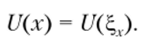
Note that stochastic dominance relations can also be defined by means of utility functions. Let F(t) and G(t) — be the distribution functions of the random variables ξ,x and ξ' respectively, where x, x' ∈ X. It can be shown , that if the expectations U(x) and U(x) for all non-decreasing functions u, then:
C <, T7if and only if U(C) < U(7) for all increasing functions u;
C <n T7 if and only if U(C) < U(P) for all non-decreasing strictly concave functions u.

Comments