
Lecture 11 min.
The trolley problem (or handcart problem) (English: Trolley problem) — a thought experiment in ethics, first formulated in 1967 by the English philosopher Philippa Foot . Lying outside the framework of standard philosophical questions, the trolley problem plays a major role in cognitive science and neuroethics.
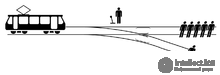
Foot’s thought experiment, now known as the "Trolley Problem," goes as follows:
Suppose that a judge or magistrate is confronted by a rioting mob demanding that the culprit for a certain crime be found, and threatening to take bloody revenge on a particular section of the community if he is not. The real culprit being unknown, the judge believes he can prevent the bloodshed only by framing an innocent person for the crime and having him executed. Alongside this example, take another, in which a pilot whose aircraft is about to crash decides whether to steer away from a more populated area toward a less populated one. To make the parallel as close as possible, it can rather be supposed that he is driving a runaway tram, which he can only switch from one track onto another; five people are working on one track and one on the other; whoever ends up on the track he takes will be killed. In the riot case the mob holds five hostages, so that in both examples the trade-off is assumed to mean the life of one person for the lives of five.
The concept of utilitarianism dictates that the switch must be diverted onto the other track. According to this concept, diverting the switch is not the only permissible action, but, from a moral standpoint, it is the best action (the other possibility being to do nothing)
A similar problem was proposed by the philosopher J. J. Thomson
As before, a trolley is hurtling down the tracks toward five people tied to the rails. You are standing on a bridge that passes over the tracks. You have the opportunity to stop the trolley by dropping something heavy in its path. Standing next to you is a fat man, and the only way to stop the trolley is to push him off the bridge onto the tracks. What do you do?
It should be noted that for a significant number of people, actively participating in this situation seems almost impossible. Most of those who would divert the switch in the first situation would not push a person under the trolley in the second. This feature became the impetus for a deeper study of the difference between the two situations.
The first clear difference is that in the first case the observer does not interact directly with the person: the death of the man on the side track is a side effect of switching the points. In the second case, however, aggression toward the fat man is an integral part of the plan to save the five. This argument was considered (and rejected) by Shelly Kagan in the book The Limits of Morality.
It should be noted that such a solution follows from the doctrine of double effect, which holds that, when necessary, one may perform actions that have negative side effects, but a deliberate act of aggression (even to achieve a positive outcome) is wrong.
A further development of this example involves a situation in which the fat man turns out to be a villain who put the five people in danger in the first place (tied them to the rails). In this case, pushing the fat man onto the tracks appears not only morally advantageous but obligatory.
The claim that it is wrong to use the death of one person to save five does not hold in this variant of the trolley problem:
As before, a trolley is hurtling down the tracks toward five people tied to them. As in the first case, you can divert it onto a side track. Tied to the side track is one fat man. However, past the man the side track loops around and rejoins the main track just before the point where the five are tied. Thus, if there were no fat man on the side track able to stop the trolley, diverting the switch would not save the five. What do you do?
The only difference between this situation and the original formulation is that an extra stretch of track has been added. This seems insignificant, especially given that the trolley would never travel over that stretch anyway. Thus, intuition suggests that the answer should be the same as in the original problem — the switch should be diverted. In this case, however, the death of one person is in fact part of the plan to save the five.
This formulation belongs to Peter Unger
As before, a trolley is hurtling down the tracks. You can remove it from the tracks by colliding with it using another trolley. In doing so, both trolleys will leave the tracks and fall off the embankment, landing on a lawn where a man is sleeping in a hammock. The man will be killed. What do you do?
Answers to this situation partly depend on whether the respondent is familiar with the original trolley problem. Unger noted in his research that people who have not encountered such a choice before are more likely to say that the proposed action (colliding with the other trolley) is wrong.
Unger therefore observes that the differing answers to this problem are based more on psychology than on ethics — in this new formulation, the only difference from the original scenarios is that the man on the lawn is not fully involved in the situation. Thus people think that killing the man on the lawn is «unfair play». Unger notes, however, that a lack of involvement in the situation has no bearing on its moral aspects.
The trolley problem was first investigated from the standpoint of cognitive science by J. Mikhail. He proposed that people's answers would hardly depend on their sex, age, cultural level, or education, since their decisions are based on an unconscious «moral grammar», which in some respects is analogous to the equally unconscious universal grammar underlying ordinary language.
In subsequent cross-cultural studies, clear counterexamples to this «universal moral grammar» hypothesis were found. Further evidence against the idea of a universal moral grammar was presented in a meta-analysis of 6,100 participants. It showed that women display stronger deontological tendencies in their decision-making than men, while men display only a slightly more utilitarian approach than women.
In order to study this problem from the standpoint of neuroethics, J. Greene and J. Cohen used functional magnetic resonance imaging methods. In their experiments, they analyzed people's answers to questions posed in the original formulation and in the «fat man» formulation. The researchers' hypothesis was that solving these problems would trigger both an emotional and a cognitive response, and that the two would come into conflict. The results of the study showed the following: in situations that evoke a vivid emotional response (the «fat man»), significant activity is observed in the parts of the brain associated with conflict resolution. At the same time, in more neutral situations (such as the original trolley problem), activity is observed in the area of the brain responsible for higher cognitive functions. Thus, the potential ethical insight in this situation revolves around a person's ability to make rational decisions of a moral nature.

Comments