
Lecture
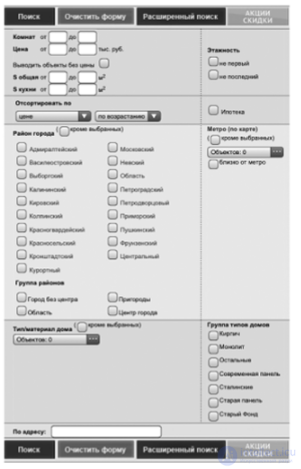
Fig. 8.1. Apartment search form on the website http://www.bn.ru
Decision-making problems often cannot be reduced to a choice based on a single criterion. In many cases it is necessary to take several aspects into account. When releasing a new product, a manufacturer wants to achieve maximum quality at minimum cost. When choosing a location for a new store, many economic and social factors must be considered: it is necessary to find the best location, the most convenient premises with the lowest possible rent, and also — to take other possible factors into account. A transport company is interested in finding ways to organize shipping with minimum cost and time. When choosing a car, a buyer, in addition to its price, evaluates safety, reliability, appearance, and ease of handling. For some, important characteristics will be payload capacity and fuel consumption, while for others — top speed and 0-to-100 km/h acceleration time. Manufacturers, when choosing raw materials and components for their products, strive to find the best quality at the lowest price.
When forming a well-grounded decision, it is necessary to take into account a multitude of substantive circumstances, each of which will constitute a certain criterion for evaluating the available options from its own point of view. The need to look at the existing problem from different points of view is the reason for the emergence of multicriteriality in decision-making problems.
Example of the multicriteriality of choice parameters. The apartment search form offered on the website http://www.bn.ru has the following appearance (Fig. 8.1).
The proposed form has 10 categories of search parameter selection. Each of these categories corresponds to different selection criteria. Some of the criteria are qualitative, for example, the district or the type of building. For such criteria, certain measurement scales are introduced. By setting constraints for each criterion, the buyer can first narrow down the set of real-estate market offers, and then choose the most suitable option.
Example of the multicriteriality of compliance parameters. On the website http://spb.rabota.ru, one can find, for example, a job posting for an IR specialist, i.e. a securities market specialist. Here, employers set the following requirements for candidates:
This list constitutes the set of criteria on the basis of which the company will evaluate candidates for the position they are applying for.
From the examples given, it is clear that it is impossible to choose a decision that would be the best according to all types of criteria. Criteria often pursue opposing goals. It is necessary to use special techniques that would solve the problem comprehensively.
Let each decision be characterized by some alternative x ∈ X. And suppose there are m individual criteria that make it possible to assess the quality of the alternative being chosen. Each criterion has its own criterial (objective) function f_i: X —? R, where R — is the set of real numbers, i = 1, 2,..., m. Then the number f_i(x) will be the estimate of alternative x ∈ X according to the i-th criterion (i = 1, 2,..., m).
We will denote the set of attainable vector estimates by Y = Im(f) ⊂ W (see the definition in Section 6.4). Then for each alternative x ∈ X we will have a vector estimate over all criteria f(x) = = (f1(x), f2(x), ..., fm(x)) ∈ Y ⊂ R^m, containing complete information about its value.
Note that estimates for different criteria of the same problem can be made on different scales. Estimates of decision options can be obtained by measuring parameters or by determining the values of material, technical-economic, or other indicators. When an estimate cannot be obtained by means of «physical» measurements, expert methods are used. For example, when assessing the level of customer service at a given company, one can consider criteria such as the time and quality of service for each client. Here, time will be assessed by direct measurement of service duration (or the deviation from the calculated value required to carry out a specific operation), while quality can be assessed using customer ratings given on a 5- or 10-point scale.
Formally, the problem of multicriteria optimization can be stated as follows: find such a set of alternatives x*9 that would provide the optimum values of all individual criteria
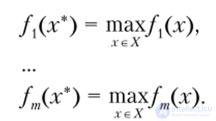
However, such a formulation of the problem is meaningless, since the objective functions attain their optima at different points. For example, it is impossible to maximize profit while simultaneously minimizing costs.
Example of comparing vector estimates (**). A certain store decided to conduct a survey to identify the best manufacturer of tea products. The survey involved 100 customers, who were asked to rate the products on a 5-point scale in terms of quality, external appeal, and price. After processing the data and calculating the average values, management obtained the following estimates:
Note that the second manufacturer turned out to be worse than the first manufacturer on all three evaluation criteria. However, it remains a problem how to identify the «winner» between manufacturers 1 and 3, since different criteria attain their best values for different alternatives. Thus, the problem arises of comparing the vector estimates of the available alternatives of the task.
Thus, solving a multi-criteria DMP comes down to the following stages.
Note!
In a multi-criteria DMP, each decision (alternative) is characterized by a set of criteria, therefore the preference models will be constructed not on the set X, but on the set Y — of attainable vector estimates.
1 The concept of a preference model and the ways of constructing preference relations were discussed in detail in Ch. 7.

Comments