
Lecture
Stevenson's Bottle Imp paradox is a logical paradox described in the tale by R. L. Stevenson «The Bottle Imp» (The Bottle Imp, 1891).
«The Bottle Imp» (also «The Devil's Bottle», «The Magic Bottle», English: The Bottle Imp) — a mystical story by R. L. Stevenson, written for a Samoan audience and telling of a deal with the devil that a man makes by buying a bottle that grants wishes. The story was first published in 1891, and later included in the collection of stories «Island Nights’ Entertainments».
The story has been adapted for film several times since 1917.
The hero, a resident of the Hawaiian Islands named Keawe, buys a bottle inhabited by a devil (an imp in the original). The conditions of buying the bottle are as follows: the devil will grant any wishes of the bottle's owner, but in return the owner must burn in hell after death, unless he manages to sell it during his lifetime, and moreover at a lower price than he bought it for, that is, at a loss to himself. There is no other way to get rid of the bottle: if thrown away, it mysteriously returns to its owner. Moreover, the granting of wishes brings misfortune to the loved ones of the bottle's owner: the hero wished to become rich — and soon after, his uncle and cousin died, leaving him a large inheritance.
A poor Hawaiian named Keawe buys from the owner of a beautiful house a bottle which, according to the man who sold it, allowed him to obtain both the house and wealth. A devil (an imp in the original) lives in the bottle and grants the wishes of the bottle's owner, but in return its last owner will go to hell after death unless he manages to sell it during his lifetime. The bottle can only be sold at a lower price than it was bought for, that is, at a loss to oneself. There is no other way to get rid of the bottle: if thrown away, it mysteriously returns to its owner. Moreover, the granting of wishes brings misfortune to the loved ones of the bottle's owner: returning home, Keawe, who wished to become rich, learns that his uncle and nephew have died, leaving him a large inheritance.
Keawe builds a beautiful house and leads a comfortable life, though he dreams of getting rid of the devilish bottle. Soon he sells the bottle to a friend who wants to obtain his own schooner by means of magic, and then resell the bottle. Some time later Keawe meets a young girl named Kokua on the shore, falls in love with her and asks her to marry him, and Kokua agrees. Returning home, he discovers signs of leprosy on his body. Keawe feels unable to leave Kokua, his home, and go into exile at the leper colony on the gloomy Molokai. He seeks out the friend to whom he sold the bottle. Through a chain of intermediate owners of the bottle he finds its current owner, a haole, and learns with horror that he bought it for two cents. However, Keawe has no choice and buys the bottle for one cent. He is cured of leprosy and marries Kokua, but realizes that he can no longer sell the bottle and now his soul is doomed to hell.
Keawe's wife, seeing his state, eventually gets the whole truth about the bottle out of him. It occurs to her to sell the bottle in French Tahiti, since centimes are used there, which are worth less than a cent (five or six centimes make a cent). They arrive in Papeete and try to sell the bottle, but arouse suspicion, and no one buys it. Kokua, secretly from her husband, persuades an old beggar to buy the bottle from her for four centimes, and then buys it back herself for three. Now it is her soul that is doomed to the torments of hell, but Keawe is saved. However, when Keawe learns of his wife's sacrifice, he cannot accept it, and likewise secretly offers to sell the bottle on his wife's behalf to a random drinking companion, a haole, an old boatswain. The boatswain thinks it is a joke, but then, having bought the bottle from Kokua for two centimes, becomes convinced that it really does grant wishes. Although Keawe tries to persuade him to sell him the bottle for one centime, the boatswain indignantly refuses, saying that he is going to hell anyway, and that such a bottle will be his best companion on that journey.
Thus, Keawe and Kokua turn out to be saved and return home.
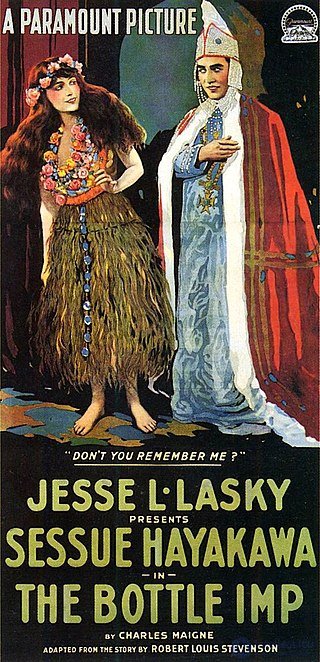
Poster for the 1917 film
The author creates a paradox in the tale: what is the lowest price for which the bottle can be sold? Obviously, if it is bought at a price accepted by convention as the minimum, for example one cent, it can no longer be sold at a loss. Therefore, it cannot be sold for one cent either, because any buyer, knowing all the terms of the deal and the consequences it entails, will refuse the purchase, because he will not be able to resell it. In the same way it is impossible to sell it for two, for three cents, or in fact for any finite sum, since your potential buyer will most likely express doubt about the advisability of such a deal, bearing in mind the possibility of a subsequent sale: he risks not finding a buyer for the bottle. On the other hand, if the price of the bottle is still sufficiently high, there is always a chance of finding a buyer for it. But with each sale the probability of finding such a buyer becomes ever smaller, and the smaller it is, the greater the loss at which the bottle is sold.
In the tale there are attempts to help the main character — the difference in exchange rates of different countries' currencies, the self-sacrifice of a loved one willing to buy back the bottle at an extremely low price at the expense of his own salvation, and ultimately a person's indifference to the consequences for his soul (for he is so sinful that he would burn in hell even without the bottle) — but they do not answer the question posed: what is the lowest price for which the bottle can be sold?
If this paradox is compared to the unexpected hanging paradox, it becomes clear that there is no answer to the question posed. For every buyer of the bottle except the last, the answer to this question will depend only on chance. It makes no sense to logically calculate one's chances of selling the bottle here, just as in the unexpected hanging paradox.

Comments