
Lecture
As was shown in the analysis of the factors that determine the specifics of the system under study (SUS) and influence other control parameters, the content of the DM's goal is influenced by the following factors (Fig. 3.7):
Below we shall determine which other factors, conditioned by the control process itself, determine the specific content of the DM's goal, and how, through that goal, they influence other control parameters.
One of the factors influencing the content of the DM's goal with respect to the SUS, and thereby influencing the goal and content of the corresponding managerial decision, is factor F-5 — the time horizon of the formulation of the DM's goal (see Fig. 3.7).
Definition
The time horizon of the formulation of the DM's goal with respect to the SUS is the period of operation of the controlled system under study within which the DM's goal is formulated.
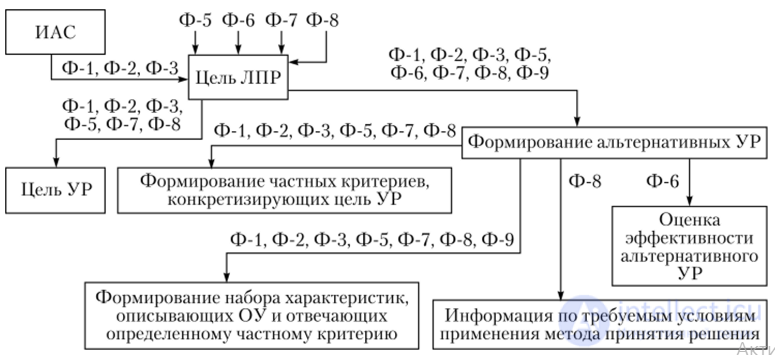
Fig. 3.7. Factors influencing the DM's goal and other control parameters
Since the DM's goal must be realized on the basis of a managerial decision, and the goal of the managerial decision must coincide with the goal of the decision maker, both the goal and the content of the managerial decision must take into account the state of the SUS over the entire chosen time horizon of the formulation of the DM's goal.
Definition
The period of operation of the system under study, taking which into account the managerial decision is developed, is called the planning horizon of the managerial decision.
An example of the influence of the horizon of formulation of the DM's goal on the content of the DM's goal itself with respect to the controlled system under study and, thereby, on the content of the corresponding managerial decision.
In an old house there is a dilapidated door in the backyard that has not been used for a long time. Through it, cold air enters the house in autumn and winter. What is to be done?
Situation 1. We regard the dilapidated door only as a source of cold. The DM's interest is getting rid of the cold. The DM has no other interests connected with this door. Therefore, the decision made at the present moment is to remove the door altogether (it is not used) and seal up the resulting opening. In this case the planning horizon is zero, and the decision is made for the current moment.
Situation 2. If the time horizon of the formulation of the DM's goal is extended, say, to three years, this may change the situation regarding the decision on the door. Suppose it becomes known that a reconstruction of the yard territories is planned, under which small garden plots will be allotted. Access to such a plot will be possible through the old door. Within the 3-year time horizon of the formulation of the DM's goal, the DM's interests will now be as follows: to preserve this door for the future, for the possibility of going out into the garden. The decision adopted with respect to the object under study (the door), taking into account the new content of the DM's interests, is to repair the door, and in such a way that it can be used in the future for going out into the garden.
Since the DM's goal determines the goal of the managerial decision, the time horizon of the formulation of the DM's goal determines the planning horizon of the managerial decision being formed. This same planning horizon is also used in constructing alternative managerial decisions, from among which the final decision is chosen.
Please note!
The goal of the decision maker with respect to the SUS (the control object) is influenced by factor F-6 — the correspondence of the DM's interests regarding the controlled system (control object) with the goals of the creation and (or) functioning of the controlled system (see Fig. 3.7). The DM's interests with respect to the control object, which is a concretization of the SUS, may or may not coincide with the goals of the creation and (or) functioning of the controlled system.
If the DM's interests coincide with the goal of the creation and (or) functioning of the system under study, the goal of the managerial decision also coincides with the goal of the creation and (or) functioning of the system.
The fact of coincidence or non-coincidence of the DM's goals with respect to the system and the goals of the creation and (or) functioning of the SUS itself influences the assessment of the effectiveness of the managerial decision aimed at achieving the DM's goal. When the goal of the decision maker with respect to the controlled system coincides with the goal of the SUS, the assessment of the effectiveness of the managerial decision will show its effectiveness both with regard to the realization of the DM's goal with respect to the system and the goal of the creation and (or) functioning of the system itself.
If, however, the DM's interests do not coincide with the goal of the creation and (or) functioning of the SUS, the goal of the managerial decision also does not coincide with the goal of the creation and (or) functioning of the system. In this case, the assessment of the effectiveness of the managerial decision will show its effectiveness with regard to the realization of the DM's goal with respect to the system, but will not reflect its effectiveness with respect to the goal of the creation and (or) functioning of the system itself.
A variant of contradiction between the DM's interests and the goals of the creation and (or) functioning of the SUS itself is possible; however, most often the DM is interested in preserving the SUS and (or) in such development of it as ensures the realization of both its goals and the DM's goals simultaneously.
Please note!
The goal of the managerial decision always coincides with the goal of the DM with respect to the system under study.
The correspondence between the DM's goal and the goal of the system under study itself influences the content of the managerial decision and the assessment of its effectiveness.
Since the managerial decision that meets the DM's goal is the result of its selection from among the alternative decisions, an effectiveness assessment must be carried out for each of them, and its result must be taken into account when choosing the final, resulting option.
Please note!
The next factor influencing the content of the DM's goal is the presence of subjects (outside the MSS and within the MSS itself) who have their own interests with respect to the managed system under study (the control object) (see Fig. 3.7).
In cases where, with respect to the MSS, in addition to the DM's interests there are interests of other subjects (who are elements of the system or located outside it), these (the interests of other subjects) can be in various relationships with the DM's interests regarding the MSS. The interests of other subjects with respect to the MSS may coincide with the interests and goal of the DM, may have the same direction as them, or may contradict the DM's interests.
The presence, in addition to the DM, of other subjects with interests that touch upon the DM's interests is most often characteristic of complex control objects that are specifications of the MSS.
An example of a control object specifying the national armed forces system is a military base that needs to be built. To implement the project of its construction, a managerial decision must be formed that meets the DM's goal with respect to this object — the construction of the military base. The decision maker regarding the construction of the military base could be the Chairman of the Government of the Russian Federation. In addition to the DM, other subjects can be identified who also have certain interests with respect to the military base. These could be the military department, road-building companies, trade organizations, catering organizations, the forestry service of the territory where the military base is planned to be built, territorial health authorities, the regional water resources protection service, and the regional forest resources protection service.
In the general case, the relationship between the interests of all subjects with respect to the control object can be quite diverse (Fig. 3.8):
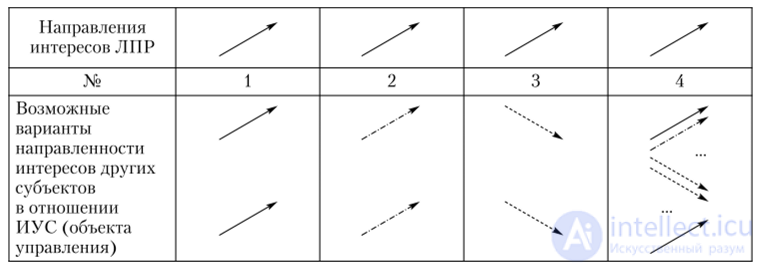
Fig. 3.8. Variants of the direction of interests of subjects interested
in the control object:
with the interests of the DM;..........*- a hatched arrow indicates the interests of another subject,
contradictory to the interests of the DM
In the example presented above, situation 4 takes place. Indeed, the interests of the military department coincide with the government's (the DM's) interest in creating the military base (the military department forms group 1 of the other subjects). Unidirectional with the DM's interests are the interests of the road-building company, trade organizations, and catering organizations — they are not interested in the military base itself, but its construction will give them all an additional volume of work (the named subjects form group 2 of the other subjects). Contradictory to the DM's interests are the interests of the forestry service of the territory where the construction of the military base is planned, the interests of the territorial health authorities, the interests of the regional water resources protection service, and the regional forest resources protection service (the named subjects form group 3 of the other subjects). All the named subjects are not interested in the construction of the military base for the following reasons. Before the construction of the military base, the forestry service used this territory as a nursery for growing coniferous tree species. The health authorities had previously been promised that a sanatorium would be built on this territory. The regional water resources protection service and the regional forest resources protection service assume that the construction of the military base will damage both water and forest resources.
Note!
The direction of the interests of other subjects (besides the DM) interested in the control object may coincide with or contradict the direction of the DM's interests.
The presence, besides the DM, of other subjects with interests regarding the MSS (the control object) can be taken into account in formulating the DM's own goal with respect to the control object, in the corresponding overall goal of the managerial decision, and also when forming alternative managerial decisions, from among which the final decision that meets the realization of the DM's goal is selected. The presence of other subjects when forming alternative managerial decisions can be taken into account in formulating the partial criteria that specify the overall goal of the managerial decision, and in selecting the characteristics of the control object that correspond to each of them.
Note!
The DM's behavior in taking into account the interests of other subjects with respect to the control object can also vary. A decision on the managerial decision with respect to the managed object, made on the basis of the interests of the subjects interested in the control object, can be made by the DM:
This can be demonstrated using the presented example as follows:
Please note!
The DM may take the interests of other subjects with respect to the system under study into account in different ways.
The possible presence of several subjects interested in the object of management, of different variants of the direction of their interests, as well as the different behavior of the DM in taking into account the interests of the interested subjects, justify the necessity of considering the problem of reconciling the interests of subjects with respect to the managed object.
Definition
By the complete reconciliation of the interests of all subjects interested in the system under study (in the object of management), carried out by the decision maker, is meant the process of:
The result of the complete reconciliation of interests with respect to the managed system under study, carried out by the DM, are new formulations of the DM's goal, the goal of the MD and its content. The complete reconciliation of the interests of all subjects with respect to the object of management should be aimed at achieving the DM's goals with respect to the system under study (the object of management), at increasing the efficiency of the activity of other subjects interested in the object of management, and at resolving problems for subjects that initially had interests conflicting with those of the DM. Naturally, the DM does not always take into account all the interests of other subjects with respect to the managed system under study. In this case, one can speak of a partial or incomplete reconciliation of interests, which, in turn, is also reflected in the new formulation of the DM's and the MD's goals and in the content of the MD.
Please note!
Example of reconciling interests and its effect on the efficiency of the activity of other subjects.
Suppose that the DM makes the decision on the complete reconciliation of the interests (unidirectional and conflicting) of all subjects with respect to the object of management, i.e., with respect to the project for building the military base. This means that although the initial goal of the managerial decision was the construction of the military base (the object of management is the project for its construction), in the case of complete reconciliation of the interests of the subjects with respect to the object of management, both the goal and the MD itself must additionally presuppose the solution of the following tasks:
The solution of the tasks identified based on the study of the unidirectional and conflicting interests of other subjects with respect to the object of management affects the efficiency of the functioning of the subjects as follows.
Taking into account the interests of the road company, trade organizations and catering organizations, and bringing them into the implementation of the project by pooling efforts, will reduce the total costs of the project that would otherwise, in the aggregate, have had to be borne by the subject of management (the DM) and the other named subjects, had they not reconciled their interests. At the same time, by bringing in the named subjects, an increase will take place at the DM's level in both the economic efficiency of the project being implemented and the socio-economic efficiency of this project (the implementation of the project will additionally include the creation of the corresponding social infrastructure). Similarly, by pooling efforts, an increase will take place in the economic efficiency of the activity of the other subjects, besides the DM, that have interests with respect to the object of management that are unidirectional with those of the DM.
Regarding subjects who initially have interests conflicting with the interests of the DM, the following may be noted. Reconciling conflicting interests through the development of appropriate measures, even if it does not increase the social effectiveness of these measures (a nursery for growing coniferous tree species existed before, but later it will appear on a new site; the promised sanatorium will be built, but on a new site; the issues of protecting water and forest resources have been and will continue to be addressed as before), will at least not decrease it. As for the impact on the economic efficiency of developing and implementing a managerial decision that includes the costs of carrying out measures aimed at reconciling conflicting interests, in the general case it (the implementation of the measures) may reduce economic efficiency, since additional funds may be needed to carry out the whole set of the measures named.
It is precisely for this reason that in this case the priorities of the DM must be taken into account: what is more important to him — reconciling conflicting interests in order to increase social effectiveness even at the expense of
reducing the economic efficiency of implementing the managerial decision, or simply the economic efficiency of the individual decision being implemented.
Please note!
When finally formulating the goal of the DM, as well as the goal and content of the decision, the degree of reconciliation of interests must be taken into account.
As already noted above, the procedure for making the final decision based on the scheme of its life cycle presupposes its formation on the basis of constructing and analyzing alternative managerial decisions.
Therefore, when constructing the particular criteria that specify the overall goal of the decision, determined by the goal of the DM, and when forming the corresponding alternative decisions used to select the final decision, different variants of reconciling the interests of all subjects concerned with the management object may be considered.
Please note!
Different degrees of reconciliation of interests may be taken into account when forming alternative managerial decisions used in selecting the final, ultimate variant of the decision.
Therefore, the variant of reconciling the interests of other subjects with the interests of the DM regarding the system under study may be taken into account in the formulation of the particular criterion implementing the goal of the decision, coinciding with the goal of the DM, as well as in the content of the set of characteristics describing the management object and corresponding to the chosen particular criterion. It can also be ensured through the use of a particular decision-making method. The processes of reconciling interests, formulating the goal of the managerial decision, selecting characteristics and choosing the decision-making method can be combined, for example, through the application of particular economic-mathematical and instrumental decision-making methods.
Note that the ways of taking into account the interests of other subjects regarding the system under study may differ from one another, for example, when determining the DM's goal with respect to the management object and the overall goal of the decision implementing that goal, and when forming alternative managerial decisions - when constructing the particular criteria that specify the overall goal of the decision, when determining the set of characteristics describing the management object, and when choosing the decision-making method.
Please note!
The problem of reconciling interests must be handled either by the DM himself or on his behalf. This is because when choosing a managerial decision with respect to the management object, his interests must be taken into account first and foremost. This means that the DM independently determines the content of factor F-8 (the variant of taking into account the interests of other subjects with respect to the system under study) when forming the DM's goal with respect to the system under study and the goal of the corresponding decision. The DM also independently determines the content of this factor when forming alternative managerial decisions — when formulating the particular criteria that specify the overall goal of the decision, when determining the set of corresponding characteristics describing the system under study (the management object), and when choosing the decision-making method.
Please note!
The content of factor F-8 is determined by the DM. Moreover, it may differ when formulating the DM's goal with respect to the system under study (the management object) and the overall goal of the decision, as well as when forming alternative managerial decisions.
Since, in accordance with the procedure for constructing an individual decision on the basis of its life cycle, the final decision is selected from among the alternatives, the final formulation of the decision being adopted will in the general case practically not coincide with the initial formulation of the goal of the decision, which coincides with the goal of the DM with respect to the system under study. However, it will correspond to it, i.e., it will not contradict it, since the particular criterion associated with the chosen final decision specifies the initial goal of the decision.
The task of implementing the DM's goal with respect to the system under study presupposes a certain influence on the system under study (the management object).
As already noted above, in the general case the management object is the system under study, which is described by a set of particular characteristics (data) describing its state, i.e., describing the elements that form the system under study and their interrelationships. It is precisely for this reason that the specific management object becomes the set of characteristics that describe the system and require changing in order to implement the DM's goal with respect to the system under study:

Of the whole set of characteristics (data) describing the system under study, the DM is interested in those that are related to his goals with respect to the managed system under study. In the case where the values of these characteristics do not correspond to the achievement of the DM's goal, the DM's task is to form a managerial decision that corresponds to his goal. Nevertheless, it is clear that changing only the characteristics already chosen to describe the system will not always enable the DM to achieve his goals. In certain cases, it is necessary to revise the very set of characteristics describing the system, and only then to change their values in order to achieve the DM's goal.
Achieving the DM's goal solely on the basis of changing certain characteristics describing the managed system under study realizes the following variant of action on the managed system — «change of the state of the system». Achieving the DM's goal by way of refining the set of characteristics describing the system under study and, if necessary, further changing their values, realizes another variant of action on the managed system — «transformation of the system». This implies the following dependency of the control parameters:

Note that the variant of action on the managed system under study «change of the state of the system» corresponds to the variant of representing the control object as a set of known characteristics of the system under study, which, in order to achieve the DM's goal, require only a change in their values. The variant of action on the managed system under study «transformation of the system» corresponds to the variant of representing the control object as a refined set of characteristics, possibly also requiring a change in their values in order to achieve the DM's goal.
The DM's goal with respect to the system under study determines the goal of the managerial decision and the set of characteristics that describe the control object and correspond to the goals of the person and the MD. However, a specific feature of forming a decision on the basis of the scheme of its life cycle, which realizes the DM's goal, is that it is the final variant selected from among the alternatives. In doing so, each alternative decision presupposes the consideration of a certain set of characteristics of the system under study (the control object) that corresponds to one or another alternative particular criterion realizing the overall goal of the MD.
Any particular criterion that concretizes the goal of the MD presupposes the use of a certain set of characteristics describing the control object and corresponding to this criterion. Therefore, depending on whether achieving the particular criterion presupposes a change in the values of an already known set of characteristics, or whether it presupposes a refinement of this set of characteristics and, if necessary, a change in their values, one can speak of different variants of the DM's action on the system under study through a separately considered alternative MD — a change of the state of the system or its transformation.
The decision as to how the goal of a particular criterion will be achieved — on the basis of changing the values of the set of characteristics corresponding to it, or on the basis of a refined set of characteristics and, if necessary, changing their values — is determined by the selected particular criterion and is made by the DM. This means that the content of factor F-9 (the variant of the set of characteristics describing the object) is formed by the DM himself, depending on the content of the particular criterion that concretizes the overall goal of the MD.
Note that the variant of action on the system under study (through changing its state or through its transformation), determined by the DM's goal and the goal of the MD, which coincides with the DM's goal, may differ from the finally chosen variant of action on the system under study. This is explained by the fact that the final specific MD is chosen from among the alternatives, and in constructing these alternative MDs the variants of action on the system can be quite varied.
Pay attention!
The decision on the variant of action on the system under study (on the control object), i.e., the decision on the variant of the set of characteristics describing the control object for each of the particular criteria concretizing the overall goal of the MD, is determined by the content of the particular alternative criterion that concretizes the overall goal of the managerial decision, and is made by the DM.
Pay attention!
When forming alternative managerial decisions, the value of factor F-9 is determined by the content of the particular criterion that concretizes the overall goal of the MD, which coincides with the goal of the DM.

Comments