
Lecture
In such problems, the state of the environment remains unchanged (i.e., the set of environment states ,9 consists of a single element) and does not affect the decision being made. Here the DM has complete information about the regularities governing the behavior of the controlled system under consideration. Thus, since ,9 consists of a single element, every outcome z ∈ Y depends only on the chosen alternative x ∈ X and can be represented in a simpler form, namely:
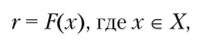
where the realization function F: X → Y.
The objective function, just like the realization function, depends only on the available alternatives x ∈ X in the set of feasible decisions
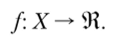
The decision in such problems is made on the basis of the behavior of the objective function. The alternative chosen as optimal or best is x0 ∈ X, at which the objective function attains its extremum (maximum or minimum)

Problems of this type can be divided into two types: variational problems and mathematical-programming problems. Variational problems are solved by methods of mathematical analysis and the calculus of variations, which make it possible to find the extrema of a differentiable function f. Mathematical programming includes the following types of problems: linear programming problems; quadratic programming problems; convex programming problems; discrete programming problems.

Comments