
Lecture
The formalization of the definition of the DM's preferences is the specification of a choice function, whose definition and properties were presented in Section 7.1. The choice function C can be specified either directly by the DM, or by means of some decision rule.
In many problems the DM can directly describe his choice of the best options from some given subset of alternatives.
Example of a way of specifying a choice function. When choosing some product in a store, say juice, a given buyer may identify for himself the two best producers of domestic juices, the best producer of imported juices, and, among juices of a specific kind, say apple juice, the one he likes best of all.
In this situation the problem is solved locally, and the DMP in this case consists in the global selection of the best options from the overall set of alternatives.
Another way of specifying a choice function is to apply some decision rule.
Definition
Decision rule is the name given to a criterion (or strategy) that allows the DM to split the set of alternatives X into two disjoint subsets: "good" and "bad" alternatives.
As a result of applying some decision rule, the set of alternatives X is split into two disjoint subsets X = X1 ∪ X2, where X1 = C(X) — the set of "good" alternatives, and X2 — the set of "bad" (unsuitable) alternatives from the DM's standpoint. In other words, the decision rule constructs the choice function C as follows:
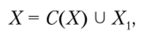
where 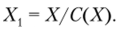
The choice of the appropriate rule depends on the problem posed, as well as on the properties of the sets of alternatives and outcomes.
Let us consider several approaches to constructing choice functions corresponding to different decision rules.
1. Scalar optimization. The choice of the most preferred alternatives is carried out according to a scalar quality criterion of the alternative, given by means of an objective functionf:X—> ℜ. Then the subset of “best” alternatives C'(X) will contain those elements x ∈ X, at which the quality criterion attains its optimum — maximum or minimum:

Another case of choosing the most preferred options is the specification of some threshold value c* for the objective function:

2. Conditional-extremal optimization. In this case, an objective function f: X → ℜ and a set of functions f1, ..., fn: X → ℜ. The choice is carried out by methods of mathematical programming. The most preferred will be those elements x' ∈ X, at which the objective function f(x) attains its optimum — maximum or minimum:

subject to satisfying additional functional constraints fi(x) < 0, i = 1, 2, ..., n:

or

3. Dominance defined by a given binary relation R. In this case, the alternatives chosen are those that are preferable to all other alternatives of the set X with respect to the strict or non-strict preference relation R:

4. The restriction principle, defined by a binary relation R and a given subset of alternatives A ⊆ X. In this case, the alternatives chosen are those that are preferable to all alternatives from some given subset of alternatives A ⊆ X with respect to the strict or non-strict preference relation:

where R — some given preference relation.
Note!
The utility function can serve as the objective function when using the scalar-optimization method for constructing a decision rule u. Then the decision rule can be constructed as follows

And since the utility function defines a binary relation on the set of alternatives, this same rule leads to the construction of dominance defined by a given binary relation. Thus, in this case these two principles for constructing a decision rule are equivalent.
The list of decision rules given above is far from complete. The choice of a suitable rule is determined by the specific problem.

Comments