
Lecture
In the general case, the interaction between the control system and the managed socio-economic system1 is determined by the following relationship:

In order to create a decision support system for the managed system under study, the following subject is considered as the control system — the decision maker. The impact of the control system, represented by the DM, on the managed system, carried out on the basis of a managerial decision, determines the relationship between the control system and the managed system (Fig. 3.1).

Fig. 3.1. Diagram of the impact of the control system, represented by the DM, on the managed system
Note!
From the standpoint of the systems approach, a managerial decision is an impact of the control system on the managed system.
The goal of managing any system is the realization of the DM's goal with respect to it. And since the impact on the system is carried out through a specific managerial decision, its goal coincides with the DM's goal:
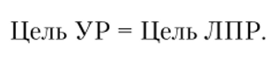
Since the control object «the managed system under study» (MSS) is made more specific as the control object «the set of variable characteristics describing the MSS», the relationship presented can be transformed, as shown in Fig. 3.2.

Fig. 3.2. Transformed diagram of the impact of the control system, represented by the DM, on the managed system under study
1 This textbook mainly considers socio-economic systems.
Below we will consider the factors that determine the main parameters of control and influence the managerial decision, which (influence) can be taken into account when forming the decision and choosing the corresponding decision-making method (DMM).
However, before proceeding to a specific presentation of these issues, let us dwell in more detail on the content and connection of Stage 1 «Defining the goal of the decision and specifying the criteria that implement it» and Stage 2 «Developing the managerial decision» of the simplified life-cycle model of an individual managerial decision.
The content of Stage 1 involves formulating the goal of the decision and specifying it in the form of certain partial criteria. Based on the identified partial criteria, the content of Stage 2 involves forming alternative managerial decisions. To construct them, in addition to the partial criteria, a set of characteristics describing the system (the control object) and corresponding to each selected partial criterion is additionally used, as well as information related to the necessary initial data, and information on the conditions for applying various decision-making methods (Fig. 3.3).
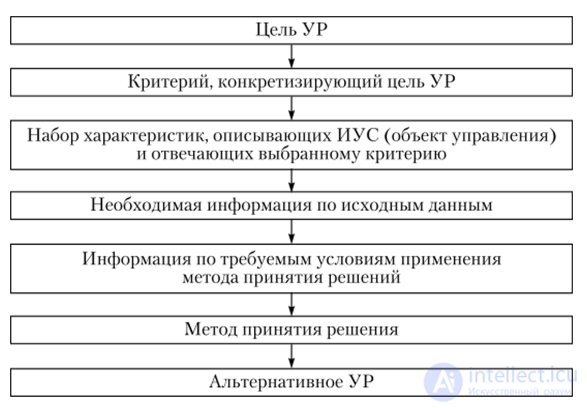
Fig. 3.3. Relationship of the parameters describing the process of constructing an individual managerial decision
This relationship will be taken into account when considering the factors that determine the main parameters of control and influence the decision.

Comments