
Lecture
Following the hierarchy of decision-making levels, information support systems also have corresponding levels of information division and use: vertically — the strategic level (top managers), the functional-operational level (middle managers), the informational-tactical level (IT specialists), and the operational-tactical level (functional specialists). Horizontally, the corresponding information support is defined for each functional area', marketing and sales, planning, production, finance, accounting, human resources, etc. (Fig. 4.4).
Please note!
IS of the goal-setting strategic level are intended for use by top managers in order to gain advantages for the organization's activity in the competitive struggle on economic markets. They provide, in the most general and comprehensible form, such results of global studies of the organization's internal state and of the influence of the external environment over the long term as production and fi-
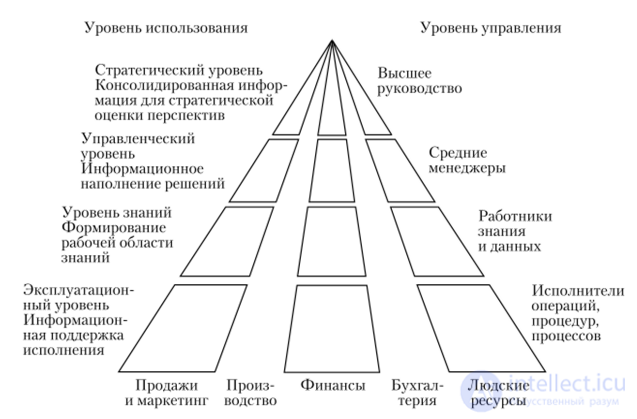
Fig. 4.4. Correspondence of IS levels to organizational management levels1
-nancial trends, trends of upturns and downturns, changes in product range and employment levels, etc.
IS of the operational level of functional regulation are developed to support the monitoring, controlling and administrative actions of middle managers. Systems at this level provide information on the quality of operation of the managed objects and the management system, on the demand for connections and the load on business processes, and also promptly generate periodic reports based on approved templates. They are intended for working with less formalized data than at the lower operational level, in order to develop, on that basis, less structured decisions for which the information requirements are not fully specified and which presuppose the involvement of new data that cannot be obtained from tactical-level systems.
IS of the tactical level of information support are intended for information technology specialists, for the analysis of current information, and for the processing, storage and presentation of data. The purpose of such systems is to integrate new data, information and knowledge into the current and future activity of the organization.
IS of the tactical level of operational execution are intended for the performers who support the elementary actions of the organization — such as sales, payments, accounting, carrying out transactions, operational financial decisions, operations management, and regulation of material and product flows in production, etc. At this well-automated level of organizational, technological and production processes, accessible, timely and accurate information circulates.
Information systems are also naturally distributed by functional areas. Each of the basic organizational functions — sales and marketing, production, finance, accounting, and human resources — is, as a rule, served by its own de-
1 Granichin O., Kiyaev V. Information technology in enterprise management [Electronic resource]. Moscow: Intuit, 2014. URL: http://www.intuit.ru/studies/courses/13833/1230/ lecture/24063 (date accessed: 03.08.2015).
dicated system, and in large organizations each principal function may have its own local information subsystems.
In this projection, IS are sometimes divided into functional and supporting parts'. The supporting part includes:
The functional part implements the purpose of the IS. It contains the model of organizational management, which takes into account the interrelations of all its constituent levels, and here the transformation takes place of strategic goals and management tasks into functions, of functions into algorithms, and of algorithms into concrete regulating actions on the managed object in accordance with the assigned function. These actions are carried out in subsystems identified at each decision-making level in accordance with the basic functions of the organization (Table 4.1).
Table 4.1
Example of the basic functions of an organization's information system2
|
Subsystems of marketing |
Production subsystems |
Financial and accounting subsystems |
Personnel and qualification subsystems |
Subsystems of top managers |
|
Market research, segmentation, sales forecasting |
Planning of work volumes, development of calendar schedules |
Management of the order portfolio and securities |
Analysis and forecasting of labor resource needs |
Elements of strategic planning. Responding to changes in the external environment |
|
Subsystems of marketing |
Production subsystems |
Financial and accounting subsystems |
Personnel and qualification subsystems |
Subsystems of top managers |
|
Management of procurement and sales |
Operational monitoring and control of production processes |
Management of credit policy |
Personnel records, records of appointments and transfers |
Analysis of strategic and managerial situations |
|
Recommendations on changing the product range |
Analysis of equipment performance and renewal needs |
Development of the financial plan |
Maintaining current and archival personnel records |
Identification and resolution of tactical problems |
|
Analysis of market conditions and pricing recommendations |
Participation in forming orders to suppliers |
Financial analysis, forecasting. Monitoring of budget execution |
Planning of skills upgrading for personnel |
Support for the process of developing strategic decisions |
|
Order accounting, recommendations on advertising activity |
Management of inventories and resources |
Accounting, settlements and payments |
Monitoring of personnel training |
Monitoring of the firm's activity |

Comments