
Lecture
The Technique for Order of Preference by Similarity to Ideal Solution ( TOPSIS ) is a multi-criteria decision analysis method that was originally developed by Ching-Lai Hwang and Yoon in 1981 with further developments by Yoon in 1987 . and by Hwang, Lai and Liu in 1993. TOPSIS is based on the concept that the chosen alternative should have the shortest geometric distance from the positive ideal solution (PIS) and the longest geometric distance from the negative ideal solution (NIS). In 2021, a dedicated book was published in the fuzzy context
This is a compensatory aggregation method that compares a set of alternatives by normalizing scores for each criterion and calculating the geometric distance between each alternative and the ideal alternative, which is the best score on each criterion. Criteria weights in the TOPSIS method can be calculated using an ordinal priority approach, the analytic hierarchy process, etc. The assumption of TOPSIS is that the criteria increase or decrease monotonically. Normalization is usually required, since parameters or criteria often have incommensurable dimensions in multi-criteria problems. Compensatory methods, such as TOPSIS, allow trade-offs between criteria, where a poor result on one criterion can be offset by a good result on another criterion. This provides a more realistic form of modeling than non-compensatory methods, which include or exclude alternative solutions based on hard threshold values. An example of application at nuclear power plants is given in
The TOPSIS process is carried out as follows:
Step 1
Create an evaluation matrix consisting of m alternatives and n criteria, with the intersection of each alternative and criterion given as  , so that we have the matrix
  .
.
Step 2
The matrix is then normalized to form the matrix
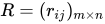 , using the normalization method

Step 3
Calculate the weighted normalized decision matrix

where 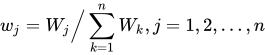 such that∑i"="1nzhi"="1
 , and
, and  is the original weight assigned to the indicator
Step 4
Determine the worst option  and the best alternative
  :
:


where,
D  are associated with criteria having a positive impact, and
 are associated with criteria having a negative impact.
Step 5
Calculate the L 2 -distance between the target alternativei and the worst stateAzh

and the distance between the alternativeiand the best stateAb

whererizh andrib
 are the L 2 -normalized distances from the target alternativeito the worst and best conditions respectively.
Step 6
Calculate the similarity to the worst condition:

 if and only if the alternative solution has the best condition; and
 if and only if the alternative solution has the worst condition.
Step 7
Rank the alternatives by 
Two normalization methods that have been used to deal with incommensurable criteria dimensions are linear normalization and vector normalization.
Linear normalization can be calculated as in step 2 of the TOPSIS process above. Vector normalization was included in the original development of the TOPSIS method and is calculated using the following formula:
When using vector normalization, nonlinear distances between indicators and ratios along a single dimension should produce smoother trade-offs.
Support for political decision-making, Support for business decision-making

Comments