
Lecture
A decision-making problem under uncertainty – is the problem of choosing an optimal strategy whose outcome, besides the strategies of the operating side and a number of fixed factors (deterministic and stochastic), depends on uncertain factors that are beyond the control of the operating side and are unknown to it at the moment the decision is made.
As a result of the influence of uncertain factors, each specific strategy (decision) corresponds not to a single outcome but to a set of outcomes. The specific realization of the outcome for each decision is determined by the specific realization of the uncertain factors.
Let us consider the difference between fixed stochastic factors and uncertain factors. Both types of factors lead to a spread in the possible outcomes when the same decision is implemented repeatedly. In this respect they resemble one another and differ from deterministic factors. The difference is that, with respect to fixed stochastic factors, the DM (decision maker) has the full body of statistical information – this information is sufficient to determine the probabilities of occurrence of the possible outcomes and to make a decision on choosing the optimal «on average» decision. With respect to uncertain factors, the DM has no such information.
In what follows we will consider the DMP (decision-making problem) under uncertainty without taking fixed stochastic factors into account.
With respect to the probabilities of realization of the various outcomes, two cases are possible (Fig. 4.1):
the probabilities of the possible outcomes have no physical meaning – then we are dealing with uncertain factors of a non-stochastic nature;
the probabilities of the possible outcomes have physical meaning, but are either unknown to the DM, or are known with insufficient accuracy for decision-making – then we are dealing with uncertain factors of a stochastic nature.
Uncertain factors of a non-stochastic nature can be divided into two groups.
The first group consists of factors of strategic uncertainty – uncertain factors that arise because several operating sides take part in the operation. Each side is forced to make decisions under conditions in which the future actions of the other participants in the operation are unknown to it.
The second group consists of factors of conceptual uncertainty – uncertain factors that accompany the making of especially complex decisions with long-term or far-reaching consequences. In this case there may be vague, unformalized goals present (this applies, unfortunately, to a number of economic problems).
Decision-making problems under conditions of strategic uncertainty (or under conditions of a conflict situation) can be subdivided into single-level and multilevel problems.
In single-level decision-making problems the participants are not bound by any form of subordination; they take part in a single operation and are interested in one or another of its outcomes.
Multilevel decision-making problems arise in complex control systems and have a hierarchical structure.
Single-level conflict DMPs can be antagonistic and non-antagonistic. In antagonistic problems the interests of two sides pursuing directly opposite goals collide.
Among the uncertain factors of stochastic nature are natural uncertainties.
Natural uncertainties – uncertain factors that arise because of insufficient knowledge of «nature».
In decision theory the term «nature» is understood to mean the entire set of circumstances under which a decision has to be made. These may be unknown characteristics of processes associated with the course of the operation or with the external conditions under which the operation is carried out.
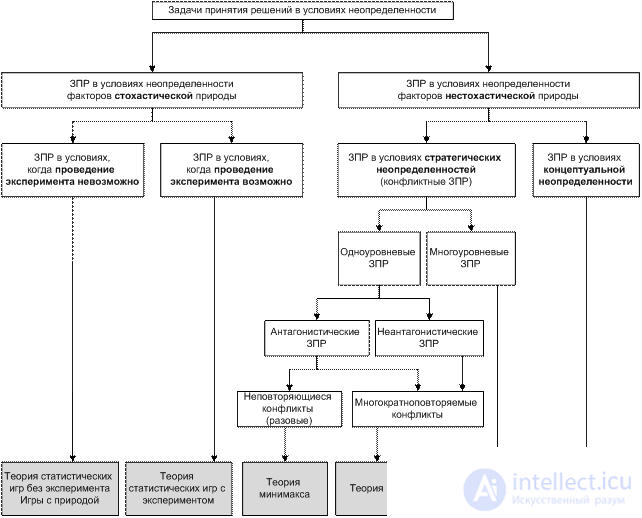
Fig. 4.1. Classification of DMPs under uncertainty
Figure 4.1 shows a «tree» of decision-making problems under uncertainty. The «leaves» of the tree explain which scientific fields, to one degree or another, remove uncertainty of the type indicated. In this manual we will dwell in more detail on DMPs under uncertainty of factors of a stochastic nature. When conducting an experiment is possible, we suggest considering the logical-probabilistic method (LPM); when conducting an experiment is not possible, the apparatus of game theory against nature will help to reduce the uncertainty.

Comments