
Lecture
Definition
It is said that on an arbitrary set X a binary relation <ρ (or >Xy or V) is defined, if some subset φ of the Cartesian product of the set X with itself is defined, i.e. φ ⊂ X × X. In this case, it is said that the elements x'y x" ∈ X are in the binary relation φ, if (x x") ∈ φ, which is written as follows: x'φx", or x' >xx", or x' Vx".
Note!
Binary relation φ on the set X — is a set whose elements are ordered pairs of elements of it on X, and if this set contains the pair e φ, then instead of such a notation one often simply writes x' yx” or
x*>xx"1.
Examples of binary relations.
Let us define, for further use in the textbook material, the following four binary relations >, >, >, φ on ℝm:

• a y b, if at least one of the following conditions is satisfied:
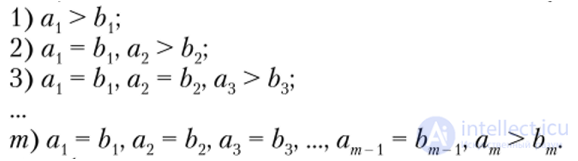
These binary relations, defined on the vector space ℝm, are respectively called:
1 Vernikov B. M. Binary relations [Electronic resource]. URL: http://kadm.imkn.urfu.ru/ filesZalggeom02.pdf (accessed: 04.08.2015).
The name of the last relation is explained by the fact that it is precisely in such lexicographic order that all the words of the Russian language are recorded in any dictionary .
Let us highlight several important types of binary relations.
Definition
Let a binary relation φ be defined on an arbitrary set X, then we will call it:
reflexive, if for any x e X we have xφx; irreflexive, if for any x e X we do not have x<φx; symmetric, if for any x', x" e X from the fact that x'φx", it follows that x"φx';
antisymmetric, if for any x x" e X from the fact that x' φx" and x" φx', it follows that this is one and the same element of the set X, i.e., x' = x" e X; asymmetric, if for any x x" e X from the fact that it holds that x' φx", it always follows that the relation can never hold x" φx' transitive, if for any x', x"' e X from the fact that x' φx" and x" φx"', follows
it follows that x'φx'";
weakly connected, if for any x', x" either x' φx", o
r x"φx'.
In this case, if a binary relation is simultaneously reflexive, symmetric, and transitive, then it is called the equivalence relation (or indifference relation).
It is easy to verify that the examples of binary relations given above have, for example, the following properties:
Note!
When considering any multi-criteria DMP with a set of feasible solutions X and a strict preference relation defined on it >x this relation will always be a binary relation on the set X, which is asymmetric and irreflexive.
Here the vector criterion f = (f,,f2, X —* Rm makes it possible to introduce a corresponding preference relation on the set of possible estimates Y = = Im(f) cz Rw as follows: x', x" e X: x' >x x" => y' = f(x') >y y” = =f(x") e Ya R"', which makes it possible to more clearly analyze the DM's preferences not only in the set of feasible solutions X, but also the comparison of vectors in the criterion space R"'.
It is important that if the vector criterion f is a bijection, then the converse statement is also true. Namely, if, for example, in the criterion space Rm we choose the strict order relation > for at least one of the vector's coordinates, then this rule, in turn, defines (induces) on the set of feasible solutions X its own strict preference relation as follows: if y' = f(x'), y" = f(x") e Ya R': y' > y” => x' >xx' which makes it possible to more clearly and considerably more simply justify and carry out the choice of the optimal (or best) managerial decision from the DM's point of view.
The relationship between the strict preference relation >x in a DMP and the vector estimates in the criterion space will be examined in more detail in Ch. 9 when considering the Pareto axioms.
Note!
The general formulation of a DMP with multiple criteria under conditions of certainty includes:

Note that this description of the general formulation of a multi-criteria DMP is given in terms of finding the set of optimal (or best) managerial decisions, from the standpoint of the DM's goals, out of the set of feasible solutions X. At the same time, the presence of the vector criterion f, as shown above, makes it fairly easy to reformulate our multi-criteria DMP in terms of vectors from the criterion space R'" and the set of vector estimates Y = Im(f) c Rm1.
Note!
The mathematical model of DMP solutions, which takes into account the state of the external environment and the specification of criterial (evaluative) functions, will be examined in more general form below, in the final part of this section.
The mathematical model of decision-making in a multi-criteria DMP that takes into account the state of the external environment represents a formalization of the corresponding decision-making problem (DMP). Given the importance of this material, let us dwell in more detail on the key stages of constructing such a model. The search for a solution begins with the enumeration of possible (feasible) decision options and their outcomes, after which each outcome is evaluated and analyzed. To construct the model, the following three sets must be specified:
X — the set of feasible alternatives (actions, managerial decisions, strategies, options, plans, from which the DM may choose only one element);
S — the set of possible states of the environment, of which one and only one state can be realized;
R — the set of possible results or outcomes, obtained as a result of implementing the adopted managerial decision (events having, if nothing additional is specified, a completely arbitrary structure).
It is always assumed that the set X contains at least two alternatives — otherwise the need for decision-making disappears.
The decision maker chooses one of the possible alternatives, and each outcome (result) depends both on the chosen alternative and on the state of the environment. Thus, each outcome r e R can be repre-
sented as the result of the action of a certain mapping E from the direct product of two sets (i.e., from the set of ordered pairs of elements of two sets) into the set of possible results (outcomes) R, i.e. 
Definition
The mapping E: S'xX- ? R is called the realization function or the choice function of a managerial decision or action.
Note!
The set of objects (S, X, R, E> constitutes the realization structure of the decision-making problem.
realization contains not one element. In the general case, a criterion always implies some analysis of a given set. The elements of the set being analyzed are, in the context of the criterial approach, customarily called alternatives, and this may create a certain confusion with the notion of an «alternative» as an element of the set X in a decision-making problem. To avoid this confusion, we shall (as far as possible), depending on the context, use the phrases respectively: «criterion alternatives» and «managerial-decision alternatives», «action alternatives», «strategy alternatives». Note that initially no prior structure is assumed on the set of criterion alternatives.
Definition
Criterion, defined on a set called the set of alternatives of the criterion, we call a pair: attribute and rule, allowing the given set to be split (according to the given attribute by means of the given rule) into two disjoint and mutually complementary subsets, to which two different logical values are assigned: {TRUE, FALSE} or the corresponding indicator values {1,0}.
A criterion must always be accompanied by a criterial (evaluation) function, on the basis of which the rule producing the partition is implemented. The criterial function must always act from the criterial set into some linearly ordered set. In the case where this linearly ordered set is a subset of the real numbers ℝ, one speaks of an evaluation function.
Remark. In philosophy, the criteria of the truth of knowledge are singled out in particular. Logical and empirical criteria of truth are distinguished. Thus it is said: «Practice is the criterion of truth», meaning empirical criteria. Along with empirical criteria, theoretical criteria are also considered. The criterion of truth of a mathematical theorem is the rigor of its proof.
In the context of our introduced formalism, i.e. of the realization structure (S, Xy R, F)y, and the order of importance of the problems being solved, the set of alternatives of the criterion will primarily be the element of the structure (X) - the set of alternatives of managerial decisions, and secondarily (S) - the set of states of the environment, or more precisely, the set of probability distributions on the set of states of the environment.
Empirical criteria include statistical hypothesis-testing criteria. It is precisely in this case that the set of alternatives of the criterion is the set of probability distributions defined on the set of states of the environment.
The action of the criterion already manifests itself at the stage of forming the realization structure. Thus, speaking of «admissible» strategies (alternatives), we screen out all «inadmissible» strategies according to some criterion «standing behind the scenes». In order to assess the «correctness» of the action taken or the decision made, the DM needs to have a criterion for comparing managerial decisions. Since, taken by itself, apart from the outcome, the MD means nothing, and decisions are compared by the results (outcomes) to which they lead, there arises a need to have a criterion
(criteria) for comparing outcomes. In this case, the set of alternatives of the criterion becomes Y — the set of results (outcomes). For such a criterion, the attribute will be the preferability (or acceptability) of one or another outcome, and the rule will be the following introduced strict preference relation on the set Y.
Strict preference y1 > y2 means that outcome y is more preferred than y2, and non-strict preference y1 ≥ y2 means that outcome y1 is not less preferred than outcome y2.
If the DM can assess the effectiveness (terms of the same meaning: «utility», «value») of each outcome y ∈ Y by some number φ(y) from the set of real numbers ℝ, then the evaluation structure of the decision-making problem is given in the form of the pair (Y, (φ), where the function 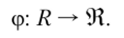
Definition
The function φ is called the evaluation (criterial) preference function, defined on the set Y of all possible results (outcomes) that can be obtained by implementing managerial decisions from the given set X — of admissible decisions.
Having introduced the concept of the criterial function, we now define, on its basis, the operation of comparing two results y1 y2 ∈ Y according to the following preference attribute

It is said that the (evaluation) function φ generates a (partial) order relation on the set of realizations Y. Since the criterial function makes it possible to compute the numerical value of the preference relation, it obviously follows, on the basis of the strict order relation on the set of real numbers ℝ, that a rule arises giving preferences according to this criterion and, as a consequence, allowing the set of results to be split (into two subsets, as required by the partition in the definition of the criterion, but not only in that way) in accordance with the preference attribute.
Remark. Note that the set of values of the evaluation function can influence the formation of the realization structure of the DMP itself. It may happen that the set of admissible actions (alternatives) X does not yield a single acceptable value of the evaluation function. For example, you go to a cafe to have lunch and find that, within your budget, you cannot get an acceptable full meal.
Example: specifying the evaluation structure of a DMP. One of the simplest, yet basic, ways of specifying the evaluation structure of a decision-making problem consists simply in partitioning the set of outcomes Y into two disjoint subsets: Y = Y* and Y{ Y* ∩ Y0 = 0, where Y° — the class of «bad» (unacceptable, inadmissible) outcomes, and Y* — the class of «good» (acceptable, admissible) outcomes. The evaluation function φ is not initially specified here, but is generated by the partition itself and is an indicator function defined on the subsets of the partition: 0, if «bad», and 1, if «good». Here, too, the evaluation function can be assigned the logical values {TRUE, FALSE}. In this case, the attribute of the criterion for comparing two outcomes will be the following relation

The rule of the criterion, which here yields the partition of the criterial set of alternatives, is implemented in advance, «behind the scenes», based, possibly, on the individual conception of the DM regarding a «good» and a «bad» outcome. Note here that, in this model of the evaluation structure, outcomes belonging to one of the sets are assumed to be incomparable among themselves (equivalent or indifferent from the DM's point of view).
Example: the following method of constructing an evaluative structure with a logical evaluative function uses a certain «initial» evaluative function φ, already realized «in the frame». The partition of the set of outcomes R into two classes here is carried out in the following way, which is an example of the application of a criterion, where the set of criterion alternatives will be the set of results, and the criterial function will be the function φ. One should specify some threshold (critical) value c* e RK for the function φ. Then we obtain the following partition of the set R = = R° U R* into two disjoint subsets

Here the value of the comparison attribute r will be the value taken by φ(r), and the rule generating the partition R = R° U R*, will be the rule of comparison with the critical value c* e R.
A more general case will be the choice of some (open) subset of real numbers X0 a R, which is customarily called critical, defining a partition of the set of outcomes as follows

Note that criteria of this type are used, for example, in problems of testing statistical hypotheses when constructing goodness-of-fit criteria.
Example: a company published a job posting for business informatics specialists aged 20 to 50. Then the critical set of «good» outcomes for candidates will be the interval of their age — [20, 50]-
The logical values of the sets {R°, R*} can be swapped depending on preferences.
Definition
The objective function f of a given DMP shall be understood as the successive application of the realization function and the evaluative function (the composition, superposition of the corresponding functions)

The real number f(s, x) e R reflects utility (value, effectiveness) of the outcome that results in the situation when the DM chooses the managerial alternative x € X} and the environment assumes some state s e S. Note that in economics (and indeed in politics) one can often encounter a situation where the choice of utility affects the state of the environment. «Utility» of fur, for example, leads to a permanent decrease in the corresponding animals in forests and, in the best case, — to the emergence of farms for their artificial breeding. Utility gives rise to demand -» —*• demand gives rise to supply —*? supply changes the state of the environment.
In the case when the DM seeks to increase the value of the function f, choosing a managerial alternative, it is said that f shows value, effectiveness or gain. Otherwise, when the DM seeks to decrease the values of f, this expresses losses, defeat, damage, risks.
Note that the evaluative structure of a DMP is subjective in nature: the evaluation of outcomes is carried out from the point of view of the decision maker. The most common approach is to specify the evaluative structure in the form of the evaluative function φ or the objective function f.
Depending on the information that the DM has, when making a decision, regarding the state of the external environment, several basic types of decision-making problems are distinguished. Let us give their classification according to this attribute.

Comments