
Lecture
Definition
Information systems (IS) — are systems designed for collecting, storing and processing information, based on a computer environment for processing, storing and accessing data with a level of storage reliability and access efficiency appropriate to the field of application.
Information systems are oriented toward end users, for whom they are merely a means of supporting their professional activity. That is why they have a simple «friendly» interface that provides the user with all the functions necessary for their work, but does not allow them to disrupt the functioning of the system.
The fields of application of information systems are broad and diverse: business, industry, finance, government structures, education, medicine, transport, etc. However, all these systems are united by one fundamental circumstance: in order to support decision-making, management needs reliable information about various aspects of the organization's activity and about the state of the external environment. The quality of managing the organization, the efficiency of planning its activity, and the development of the organization under rapidly changing economic conditions all depend on this. In this respect, the critically important functions are the clarity, reliability and timeliness of presenting information, the ability to analyze current and archival data, and the speed of obtaining new knowledge. The field of application of a specific information system ultimately determines its functions and structure, as well as the tasks it solves.
Given the above, the structure and functional purpose of an information system must correspond to the structure and functions of the organization, the goals of management and of the decisions being made, as well as the capabilities of the information technologies employed. The main elements of any organization are its structure and management bodies, standard procedures (precisely defined rules for performing tasks in various situations), and corporate culture (ethical principles, types of behavior, the information culture of personnel). Therefore, building an information system begins with an analysis of the organization's management structure.
Pay attention!
Managing an organization is understood as ensuring the achievement of a goal through the implementation of managerial functions of various levels — organizational, planning, accounting, analytical, control, etc.
Any organization is a complex organism consisting of a large number of heterogeneous objects and processes, having management bodies of various levels that coordinate the work by making managerial decisions. For the coordinated functioning of an organization, the simplest three-level system of strategic, operational and tactical management is usually applied, corresponding to the classical1 conceptual model of the organizational-managerial structure of a company, known as Majaro's pyramid2 (Fig. 4.1). In Fig. 4.1, the organization is divided vertically into three levels of decision-making: the upper strategic, the middle operational and the lower tactical level, each of which has its own supporting information system, and horizontally — into functional areas: sales, production, finance, accounting, personnel, etc.
The levels of decision-making are characterized by the complexity of the tasks being solved, the corresponding set of functions and the type of information support. As the level rises, both the degree of competence and responsibility of the DM and the time required to implement the decisions made increase.
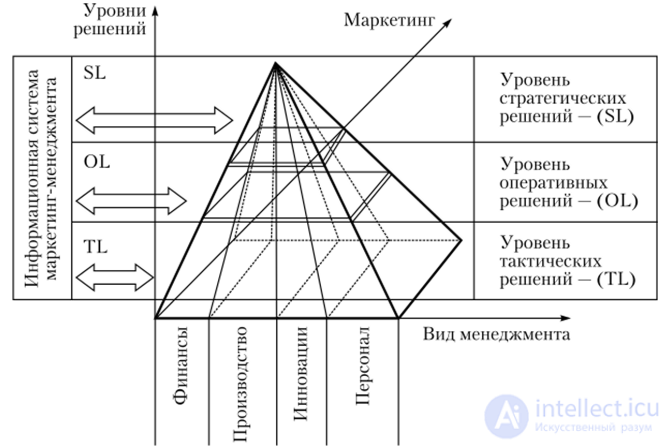
Fig. 4.1. Majaro's IS-pyramid3
Pay attention!
The strategic level of goal management ensures the decisions necessary for achieving the long-term strategic goals of the whole organization. The DM's responsibility is very high, and decisions rely equally on the results of analysis using mathematical tools and information systems, and on professional intuition. The operational level of function regulation ensures the operational decisions necessary for implementing the process of achieving strategic goals across functional areas with minimal deviations, which requires analyzing a significant volume of heterogeneous information coming in from other levels. This requires a certain amount of time to comprehend it, gather missing data, obtain feedback on previously made decisions, and so on.
The tactical level of operation execution ensures a rapid response to changes in the current situation and the making of decisions for performing repeatedly recurring standard operations within the regulatory actions of the middle level. The volume of operations performed (mainly due to solving accounting tasks) is fairly large, while the time for making managerial decisions is minimal.
Due to the increasing complexity of information and management technologies, one more tactical level — the level of providing information for decision-making, or the knowledge level, has recently been distinguished. Here, the processing of data on the state of the organization and external conditions takes place, along with the collection, processing, storage and provision of information, and finally, the acquisition and accumulation of knowledge to support decision-making in the form appropriate to each level and each functional area.

Comments