
Lecture
The goal of this stage is to develop a managerial decision, and its content is a set of specific actions aimed at forming the MD.
The actions necessary for developing the MD include:
This involves analyzing the possibilities, selecting and evaluating ways (alternatives) of achieving the goal of the MD formulated at the first stage of the life cycle. As already noted, the goal of the MD can be specified by an entire set of criteria characterizing its attainment. Usually there are several ways (variants) of achieving the goal of the MD being developed, each of which can determine its own content of the MD, aimed at realizing its goal.
In the general case, alternative decision-making methods may be applied to construct a managerial decision that satisfies a particular criterion (Fig. 1.4).
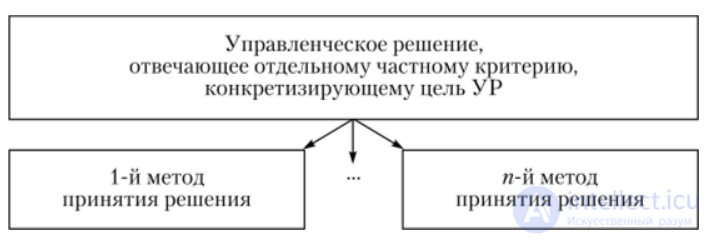
Fig. 1.4. Alternative decision-making methods satisfying a particular
criterion that specifies the goal of the managerial decision
Therefore, the following are used to generate variants of the managerial decision:
Please note!
The generation of variants of managerial decisions is based on the data from stage 1 on the possible criteria realizing the goal of the MD, and the sets of information corresponding to these criteria.
For each of the possible criteria for achieving the goal of the MD, an alternative managerial decision is developed on the basis of applying a particular decision-making method that takes into account the features of the required and available information used for the corresponding method.
Solving the problem of generating variants of the managerial decision, taking into account the results of steps 2 and 3, determines step 4 of the procedure for constructing the MD based on its life cycle (Fig. 1.5): step 4. Generating alternative MDs.
The possible criteria for achieving the goal of the MD formed at stage 1, the available information describing the state of the system under study, as well as the possible decision-making methods corresponding to them, determine the class of alternative managerial decisions satisfying the achievement of the goal of the MD. The correspondence of the content of each of these alternative managerial decisions to the goal of the MD is ensured by the fact that it satisfies the specific criterion selected for achieving the goal of the MD.
Once the set of alternative managerial decisions has been obtained, the question arises — which of them will be preferable, and which alternative MDs can immediately be discarded as impractical? Additional actions, described below, are required to answer these questions.
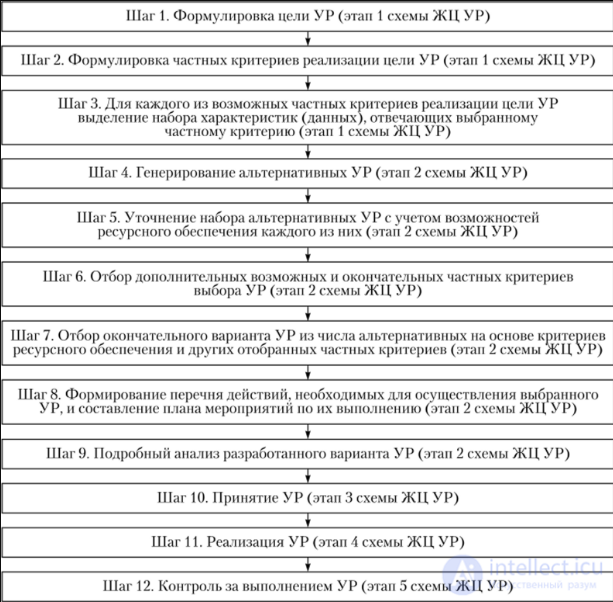
Fig. 1.5. Procedure for constructing a managerial decision based on its life cycle
This involves analyzing the resource support possibilities for implementing alternative variants of the managerial decision and selecting, on the basis of its results, those that can be provided with resources. Checking the acceptability of the managerial decision alternatives against this criterion is a top priority and mandatory, since it is precisely resource constraints that primarily determine the possibilities of selecting a specific variant of the MD. The result of analyzing the resource support possibilities can immediately narrow the number of alternative variants of the MD and single out a group of only the acceptable ones. Note that checking the resource support possibilities for implementing one or another alternative variant of the managerial decision can be built in as a constraint when generating alternative managerial decisions. This is very often done when economic-mathematical and instrumental decision-making methods are used in generating variants of alternative MDs.
The actions of item 2.2 determine the content of step 5 of the detailed procedure for constructing a managerial decision based on its life cycle (see Fig. 1.5): step 5. Refining the set of alternative MDs taking into account the resource support possibilities for each of them.
2.3. Selection of additional possible and final criteria for choosing the managerial decision. These actions are necessary because, in addition to the resource support criterion, other criteria may also be taken into account. In this case, the final choice of criteria remains with the DM, who makes it taking into account the opinion of the professionals and specialists involved.
The refined criteria for selecting the managerial decision may lead to a narrowing of the number of alternative managerial decisions or to the search for additional new ones. Here, again, it is assumed that relevant information can be used for this purpose (searching for additional alternative variants), along with the application of certain economic-mathematical and instrumental methods.
The actions of item 2.3 determine the content of step 6 of the detailed procedure for constructing a managerial decision based on its life cycle (see Fig. 1.5): step 6. Selection of additional possible and final particular criteria for choosing the MD.
Given the selection criteria refined above, it can become the result of applying economic-mathematical and instrumental methods, but it must be approved, adopted and confirmed by the DM.
Note that the remaining actions of the life-cycle scheme are related precisely to this selected variant of the managerial decision, which is subsequently referred to as the selected MD.
The actions of item 2.4 determine the content of step 7 of the detailed procedure for constructing a managerial decision based on its life cycle (see Fig. 1.5): step 7.
Selection of the final variant of the MD from among the alternatives based on the resource support criteria and other selected criteria.
What actions are needed to implement the managerial decision selected for realization, and in what order is it best to carry them out, given that many of them may be complex (composite) and interrelated? Resolving this question can become an independent problem in its own right, for the solution of which professionals may be brought in.
Note that, in order to form an extended (more precise) list of actions needed to implement the selected managerial decision and to draw up the corresponding action plan, account may also be taken of actions related to the implementation of stages 3—5 of the MD life cycle (the stages of adoption, implementation of the MD and its monitoring). This is usually the case when carrying out stages 3—5 is fairly complex from an organizational standpoint and (or) requires substantial additional resources.
The actions of Item 2.5 define the content of Step 8 of the detailed procedure for constructing a managerial decision on the basis of its life cycle (see Fig. 1.5): Step 8. Forming the list of actions needed to implement the selected MD and drawing up a plan of measures for carrying them out.
. It includes a repeated assessment of the resources needed to implement the selected variant of the managerial decision, and is carried out irrespective of the fact that such an analysis has already been performed initially (Item 2.2). This is done in order to clarify once again — whether the developed action plan and its resource provision ensure the achievement of the managerial decision's goal that was formulated at Stage 1? Are the resource expenditures acceptable? Are there any considerations for improving the developed variant of the managerial decision that arose during its development? Is there a need to return to the beginning of Stage 2 or even to Stage 1?
The actions of Item 2.6 define the content of Step 9 of the detailed procedure for constructing a managerial decision on the basis of its life cycle (see Fig. 1.5): Step 9. Detailed analysis of the developed variant of the MD.
Please note!
The result of Stage 2 of the MD life cycle scheme is a variant of the MD that has been selected from the set of alternative MD variants, taking into account the resource possibilities of its implementation and other selection criteria, and which is submitted to the DM for approval and endorsement.
In choosing the final managerial decision, the DM must be guided by the following principle — only the decision that ensures acceptable or optimal effectiveness should be adopted.
But it should be noted that if a managerial decision is adopted within a long-term perspective, when it is very difficult to realistically assess its effectiveness, the DM must be guided by the following - the MD must ensure the development of the system in the direction that best corresponds to the achievement of the DM's strategic goal.
Please note!
The strategy by which a person adopts a managerial decision can be of any kind:

Comments