
Lecture
A thought is an action of the mind, reason, intellect. A thought (concept, understanding, meaning, idea) is the main result of the process of thinking, of a person's cognitive activity. A thought can refer to ideas or combinations of ideas arising as a result of thinking, of the act or process of generating thoughts. Although thought is a fundamental human activity familiar to everyone, there is no generally accepted view of what a thought is and how it is created. Thoughts are the result or product of spontaneous acts of thinking.
Thinking is a person's cognitive activity. From the standpoint of Marxism, it is a mediated and generalized way of reflecting reality. The result of thinking is a thought (concept, meaning, idea, hypothesis). Thinking is contrasted with the "lower" ways of grasping the world in the form of sensation or perception, which are characteristic of animals as well. Many philosophers have called thinking the essential property of man. Thus Descartes asserted: "I think, therefore I am." Pascal called man a thinking reed.
A pre-thought appears in consciousness before a thought is formed (this process lasts a shorter time than the formation of the thought itself or of speech or action), and consists of the potentially possible choices of what will be generated later.
A hyperthought refers to a heightened merging of several thoughts into one, or to heightened thinking activity, or to an accelerated process of forming and processing thoughts. Such a state of mental activity can arise in various contexts, including stressful situations, creative moments, periods of hyperactivity, and so on.
However, to provide an exact definition or explanation of the term "hyperthoughts," one must turn to more up-to-date sources or scientific works, which may contain more detailed information about this concept, if it exists.
There are several theories that explain the emergence and functioning of thoughts. These theories represent different approaches to the study of cognitive processes and mental functions. Here are some of them:
Associative theory: This theory holds that thoughts arise on the basis of associations between ideas, images and concepts. When we see, hear or think about something, connections arise with other related ideas or concepts, which leads to the formation of new thoughts.
Semantic network theory: According to this theory, our thoughts are organized into networks of semantic connections, in which meaningful concepts are linked to each other. When one thought arises, related thoughts arise with it, which affects our thinking and associations.
Dual-process theory: This theory suggests that thoughts can be divided into two main categories: analytical (logical) thinking and intuitive (emotional) thinking. Both kinds of thinking work in parallel and interact with each other.
Cognitive schema theory: According to this theory, we have cognitive schemas or structures that help organize and interpret information. When we encounter new information, it is analyzed and interpreted on the basis of our cognitive schemas.
Decision-making theory: This theory focuses on how we make decisions in various situations. It includes the analysis of processes of risk assessment, comparison of alternatives and choice of the best option.
Working memory theory: This theory explains how we temporarily store and process information in consciousness in order to solve problems and perform cognitive tasks.
Creativity theory: Creative thoughts are explained through the formation of new associations, the rethinking of familiar notions and the generation of original ideas.
These are only some of the theories that help explain the emergence and functioning of thoughts. Studying these theories helps us better understand how our mind works and how we perceive, process and interpret information from the surrounding world.
The term "study of thoughts" can have different meanings in different contexts. In the general sense, "study of thoughts" means the analysis and investigation of human thought processes and mental states with the aim of better understanding their nature and functioning.
In psychology and cognitive science, the "study of thoughts" is usually associated with research on cognitive functions such as perception, attention, memory, thinking, problem solving and decision making. This research can be conducted both at the level of individual behavior and thinking and at the collective level, within group processes.
The study of thoughts can involve various research methods and techniques, such as psychological experiments, neurophysiological measurements, questionnaires and observation. Various models and theories are often used in the study of thoughts, for example information-processing models, decision-making theory or the theory of cognitive structures.
In the context of meditation and spiritual practice, the "study of thoughts" can refer to the mindful observation of one's thoughts, emotions and states of mind without judgment or interference. This can help improve self-understanding, reduce stress and learn to manage one's mental processes better.
It is important to note that the study of thoughts is a multifaceted and complex process, and understanding it may depend on the context in which the term is used.
The study of thoughts has many practical and theoretical purposes that are important for various fields of science, practice and personal development. Here are several reasons why the study of thoughts is important:
Understanding human behavior: The study of thoughts makes it possible to better understand how a person perceives and processes information, makes decisions and interacts with the surrounding world. This helps clarify the causes of human behavior and motivation.
Development of psychological theories: Research on thinking and cognitive processes contributes to the creation and development of psychological theories that help explain various aspects of human mental functioning.
Increasing productivity and efficiency: The study of thought processes can be useful in business and management. Understanding how people make decisions and solve problems helps optimize work processes and increase productivity.
Improving education: The study of thought processes makes it possible to develop more effective teaching methods and educational programs that take into account the characteristics of how students perceive and process information.
Psychological help and therapy: Knowledge of thought processes helps psychologists and psychotherapists understand the problems and difficulties their patients face, and develop more effective strategies for treatment and support.
Development of self-understanding: Studying one's own thoughts and emotions can help people better understand themselves, their values, beliefs and motivations. This contributes to personal development and growth.
Application in science and technology: Knowledge of cognitive processes is important in the context of developing artificial intelligence and creating technologies that interact with people.
The study of thoughts is a multifaceted and interesting field of research that finds application in various areas of human activity, contributing to progress and to the improvement of people's lives.
The study of thoughts is a complex and interdisciplinary process, so various methodologies and approaches are used to carry it out. Here are several methodologies for studying thoughts:
Psychological experiments: In psychology, controlled experiments are often used to study thinking and cognitive processes. Participants are given special tasks so that researchers can observe and record how they solve problems, make decisions and process information.
Neurophysiological methods: The use of neurophysiological methods allows researchers to study brain activity while various tasks, including tasks related to thinking, are being performed. This includes methods such as electroencephalography (EEG) and functional magnetic resonance imaging (fMRI).
Cognitive interviews: Researchers can conduct cognitive interviews to gain a deeper understanding of participants' thought processes. In this method, participants speak their thoughts aloud, commenting on their actions and the decisions they make.
Questionnaires: The use of questionnaires and surveys makes it possible to collect data on participants' thinking and beliefs. This can be useful for studying the level of knowledge, perception and attitude toward particular topics.
Cognitive modeling: Cognitive models make it possible to create formal mathematical or computer models that describe the processes of thinking and decision making. These models are used to test hypotheses and predict behavior.
Qualitative research: Qualitative methods, such as focus groups and in-depth interviews, make it possible to obtain detailed descriptions of participants' thinking and opinions.
Observation and behavioral research: Observing behavior and analyzing people's actions also make it possible to understand their thinking and decision making in various situations.
It is important to approach the study of thoughts comprehensively, using various methodologies and tools, in order to obtain a fuller and more all-round picture of cognitive processes and their influence on people's behavior.
Thoughtnetics is a technology for creating and studying thoughts. Thoughts are created by means of concentration on thinking.
The instructions for using thoughtnetics consist of the following steps:
Creativity requires a free flow of thoughts and the ability to think unconventionally, which is often associated with processes of association, rethinking and combining different ideas into a new image or concept. In this process, thoughts become the raw material for creative expression.
The preconscious can play an important role in the creative process, since unconscious connections and associations that stimulate creative ideas and inspiration may be hidden in it. Creative thoughts and sudden ideas often arise "from the depths of the mind," without a clear conscious cause.
Research also shows that some of the most creative solutions and ideas appear in moments of relaxation or even in sleep, when the mind is in a state of freer flow, which is associated with preconscious processes.
In general, thoughts, the preconscious and creativity are closely interrelated. The process of creation often begins with thoughts, which may be prompted and influenced by the preconscious, and the result is a unique creative work or solution that reflects the author's individual thinking and inner world.
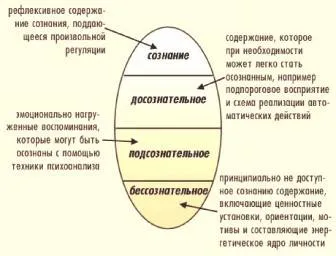
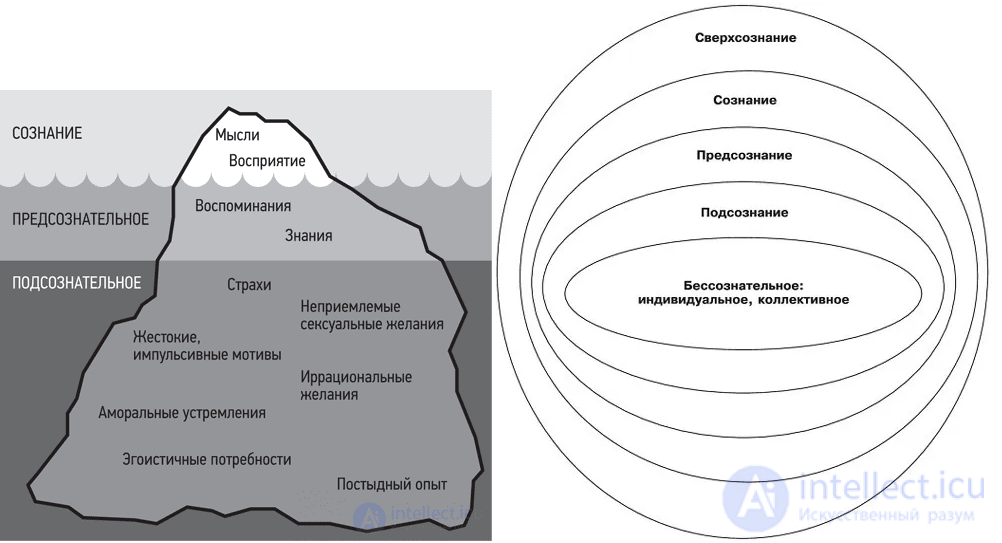
Carl Jung uses a figurative comparison, likening the collective unconscious to the sea, which is the source of every wave. Similarly, the collective unconscious is the foundation of every individual psyche. Between individual people there are constant processes of "psychic penetration." The collective unconscious is expressed through archetypes, ancient psychic images that are directly reflected in myths.
The subconscious includes notions, desires and aspirations that were received by the psyche in the form of signals but were not admitted into the sphere of consciousness or have left it. Images of the subconscious can be recalled to memory even if they seemed to have been forgotten long ago.
The preconscious is an intermediate state between the unconscious and consciousness. It exists in the form of a "stream of consciousness," a spontaneous flow of thoughts, images and associations. The preconscious also includes a variety of emotions.
Consciousness is a higher level of the psyche, including such functions as imagination, thinking, will, memory and fantasy.
The superconscious includes psychic formations that a person can form through his own efforts. These superabilities can manifest themselves in the conscious regulation of physiological states (for example, walking on hot coals), and so on. The levels of the psyche are related to its complexity, and the boundaries between them are not always rigidly defined, since the human psyche functions as a single whole.

Comments