
Lecture
Mary's Room is a thought experiment in the philosophy of mind, proposed by Frank Jackson in the article «Epiphenomenal Qualia» (1982) and expanded upon in the article «What Mary Didn’t Know» (1986). This experiment is an argument against physicalism — the view that everything in the universe, including the mental, is exclusively physical in nature.
Jackson's thought experiment was not an entirely new idea; similar arguments had been put forward by other philosophers before him. For instance, C. D. Broad, in his 1925 work, proposed imagining an archangel endowed with unlimited mathematical and logical abilities who could directly observe the atomic structure of substances. Such an archangel would be able to predict the chemical properties of any substance: for example, he could predict that ammonia is a colorless gas soluble in water. However, according to Broad, he would not be able to predict what its smell would be like for a human, even knowing how it would affect the receptors in the nose and which neurons would be involved in the human brain .
Herbert Feigl expressed a similar idea in his 1958 work. Feigl described Martians who study human behavior but to whom all the feelings and sensations of Earthlings are foreign. The Martians could predict people's reactions to jokes or their behavior at a wake, but they could not know what Earthlings actually feel in these situations. In other words, they could never obtain information about such qualia as empathy .
In 1974, Thomas Nagel, in his paper «What Is It Like to Be a Bat?», argued that some facts can only be known through subjective experience. Nagel gives the example of echolocation in bats: although we can know all the objective data about how echolocation works, and which sense organs and neural connections are involved in these animals' use of echolocation, Nagel believes we can never understand what it is like — to perceive reality through echolocation .
Implications. The experiment was published in 1982 in the article «Epiphenomenal Qualia» in the journal «The Philosophical Quarterly (English) ». In this article, Jackson invites the reader to imagine a scientist, a researcher of color, named Mary. Mary studied the neurophysiology of color her whole life while confined to a black-and-white room, viewing everything through a black-and-white monitor. In doing so, Mary learned everything about color so thoroughly that she knows all the information that can possibly be obtained about it. She knows the wavelengths of all colors, knows exactly which neurons transmit the signal from the retina to the brain, and what happens in the brain itself during this process. Jackson asks what would happen if we were to release Mary from her black-and-white room into the real world — would she learn anything new? .
In other words, a new quale would have formed in her mind, one that had never existed before, and she would have to express this somehow through certain outward manifestations — the question is, which ones?.
There are two implications depending on whether Mary learns anything upon experiencing color for the first time: the existence of qualia, and the argument against physicalism.
The argument is that if Mary learns something new from the direct experience of perceiving color, then physicalism is false. In particular, this argument criticizes the physicalist claim that physical explanations of mental states are complete. Mary may know everything about the science of color perception, but can she know what the experience of red is like if she has never seen red? Jackson believes that Mary does learn something new the first time she experiences color, and thus physicalism is false.
It should also be understood that in Jackson's article, physicalism is taken to mean the epistemological doctrine that all knowledge is knowledge of physical facts, rather than the metaphysical doctrine that everything has a physical nature.
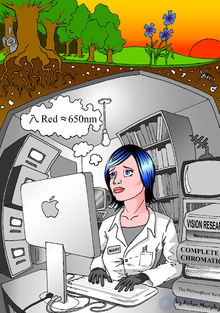
Mary studies color

Mary stepped beyond the boundaries of her perception and learned about the color red. What happened in her mind at that moment?

Mary, from the black-and-white world, marvels at the new subjective sensations that arose in her after she stepped out into the world of color.
Vilayanur Ramachandran and Edward Hubbard believe that when she sees a red apple for the first time, there are three possible scenarios:
They explain: «Which of these scenarios will actually occur? We believe we can get the answer from a color-blind synesthete. Like the hypothetical Mary, a color-blind synesthete cannot distinguish certain shades due to impaired receptors. However, when he looks at numbers, his synesthesia allows him to perceive colors he has never seen in the real world. He calls them „Martian colors“. The fact that his color-processing cells in the brain can be activated may help us answer this philosophical question: we believe the same thing would happen with Mary» .
Daniel Dennett believes that Mary would learn nothing new if she left her black-and-white room. Dennett argues that if Mary truly knew everything about color, her knowledge would also include a deep understanding of how people experience the «qualia» of color. Moreover, such knowledge would include the functional ability to distinguish red from other colors. Thus, Mary would already know exactly what to expect before she ever left the room. Dennett believes that functional knowledge is identical to experience, and that there is no such thing as ineffable qualia .

Comments