
Lecture
Это окончание невероятной информации про твердотельный диск.
...
128TB
The 64GB drive lives in my netbook, while the 128GB drive served for exactly one year as the system drive in my main PC.

Now it has become a secondary drive, having given way to the Hyper-X.
Have you read reviews, comparisons, and feedback before buying an SSD? So have I! Based on personal experience and a good price/quality ratio at the time, I got the aforementioned Kingston Hyper-X 3K, which was specifically positioned for those who want to go faster.
Please don't take the mention of this or any other drives as a purchase recommendation from me. These are just examples.
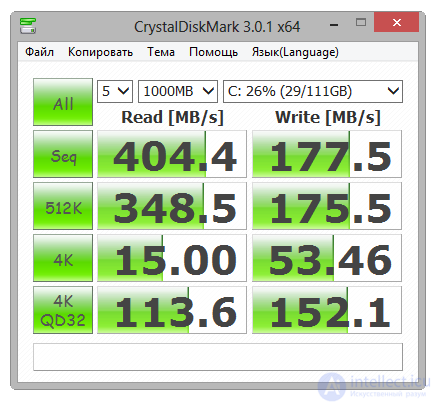
Besides higher speed, it also has greater endurance (at the time this article was published, the following data was listed at this link):
In other words, for the 120GB drive, the company guarantees an average write volume of 60GB per day over the three-year SSD support period.
Let's compare this SSD with other solid-state drives that also use synchronous Intel 25nm MLC NAND memory. The Intel 330 drive (with exactly the same memory and controller as in the HyperX 3K) appeared in the summer of 2012, and its service life is stated as follows:
The SSD will have a minimum of three years of useful life under typical client workloads with up to 20 GB of host writes per day.
20GB per day is about 22TB over the three-year warranty period, although it's unclear whether this depends on the drive's capacity. Interestingly, Kingston is more optimistic in its assessment of Intel's flash memory than the NAND manufacturer itself :)
The Intel 520 has the same SandForce-2281 controller, and its flash memory is also made using the 25nm process. However, the company rates it at 5,000 rewrite cycles, whereas for the Intel 330 it's rated at 3,000 cycles. Hence the two additional years of warranty for the Intel 520.
The SSD will have a minimum of five years of useful life under typical client workloads with up to 20 GB of host writes per day.
In other words, Intel guarantees this drive an endurance of 36TB. The comparison between the Intel 520 and 330 nicely demonstrates the difference in endurance between 5K and 3K NAND through the eyes of its manufacturer.
OCZ currently positions the Vector as its flagship drive for enthusiasts. It has the same memory on board as the Intel 520. So it's no surprise that both drives are rated for the same service life, and stated in virtually the same words at that.
Rated for 20GB/day of host writes for 5 years under typical client workloads.
Either way, virtually all SSD manufacturers have long been willing to guarantee a free drive replacement if you write 20-60GB to it per day.
Given that the write-amplification increase applied by the controller is an unknown, variable quantity, we can only rely on the S.M.A.R.T. data reported by the drive. A great many utilities are able to display it — from proprietary ones to universal tools like CrystalDiskInfo and SSD Life.
The only problem is that it's not possible to extract the necessary information from every SSD. For example, with Kingston this capability is only available on newer models, while Samsung drives hide these figures altogether.
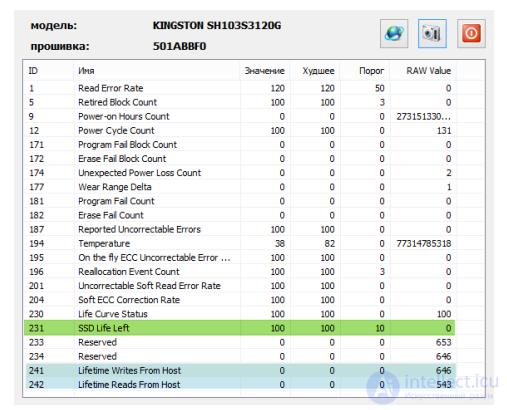
This is the information about my Hyper-X after three months of operation. ID 241 — Lifetime Writes From Hosts — represents the cumulative volume of data written, in gigabytes. It turns out I write about 7GB per day to the drive. By the way, ID 231 indicates the remaining drive endurance as a percentage.
I put my PC, which has 8GB of memory, into hibernation at least once a day. Not to mention that, in addition to everyday work, I also run my main virtual machine on this drive.
If we trust the stated endurance of 76.8TB, at this rate this drive should last me 30 years.
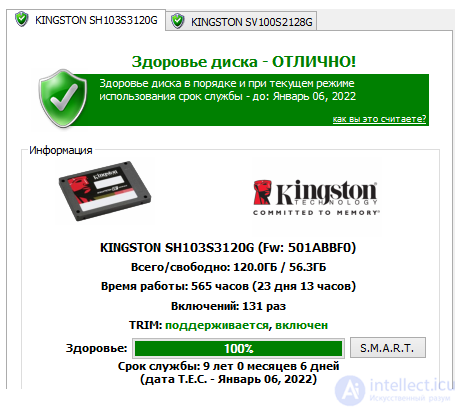
SSD Life is less optimistic — "only" 9 years.
Memory controller — A USB storage device controller has only a small microcontroller with a small amount of built-in ROM and RAM. An SSD controller is much more complex. The controller is an embedded processor that executes firmware-level code and is one of the most important factors in an SSD's performance. Some of the functions performed by the controller include:
- Error-correcting code (ECC)
- Wear leveling
- Bad block mapping
- Read and write caching
- Garbage collection
- Encryption
In a hybrid SSD, the controller will also manage a small traditional hard drive.
The main manufacturers of NAND flash memory are: Micron/Intel, SK Hynix, Toshiba/SanDisk, and Samsung. As of 2014, Toshiba/SanDisk and Samsung together held about 35-37% of the market. Micron/Intel supplied 17%, and Hynix another 10%. The total NAND market is estimated at roughly 20-25 billion US dollars, with 40 to 60 billion gigabytes produced annually, a quarter of which is embedded eMMC memory. In 2013, memory was mostly manufactured using process nodes in the 20-30nm range; in 2014, 19nm memory began gaining popularity. Less than 2% of the market was occupied by 3D NAND memory from Samsung, while other manufacturers planned to begin producing 3D NAND from mid-2015.
Only less than 5% of the NAND memory supplied in 2012-2014 had single-bit cells (SLC), 75% was two-bit memory (MLC), and 15-25% was three-bit memory (TLC, mainly from Samsung and Toshiba/SanDisk, and from mid-2014-2015 from other manufacturers as well).
The main manufacturers of NAND flash controllers are: Marvell, LSI-SandForce, as well as the NAND memory manufacturers themselves. For eMMC, controllers (eMCP) are made by: Samsung, SanDisk, SK Hynix, Toshiba, Micron, Phison, SMI, and Skymedi.
Consumer solid-state drives demonstrate sufficient reliability to be trusted with storing user data. An experiment showing there is no real reason to worry about their endurance running out was conducted some time ago by the site TechReport (https://techreport.com/review/27436/the-ssd-endurance-experiment-two-freaking-petabytes/). They ran a test that showed that, despite all doubts, SSD endurance has already grown to the point where it need not be a concern at all. The experiment essentially confirmed that most consumer drive models can withstand writing on the order of 1 petabyte of information before failing, and particularly successful models, like the Samsung 840 Pro, remain alive even after processing 2 petabytes of data. Such write volumes are practically unattainable under ordinary personal computer use, so a solid-state drive's lifespan simply cannot come to an end before it becomes obsolete and is replaced with a newer model.
However, this testing failed to convince the skeptics. The fact is that it was conducted in 2013-2014, when the solid-state drives in use were built on planar MLC NAND manufactured using a 25nm process. Such memory can withstand around 3,000-5,000 program-erase cycles before degrading. Today, mass-market SSD models have moved to flash memory with three-bit cells, and modern planar processes use a 15-16nm resolution along with flash memory with a fundamentally new three-dimensional structure. Either of these factors could fundamentally change the reliability picture, and combined, modern flash memory promises only about 500-1500 rewrite cycles. Does this mean that as memory gets worse, drives are getting worse too, and we need to start worrying about their reliability all over again?
Most likely – no. The thing is that alongside the changes in semiconductor technology, there is a continuous improvement of the controllers that manage flash memory. More advanced algorithms are being implemented in them, designed to compensate for the changes occurring in NAND. And, as manufacturers promise, current SSD models are at least no less reliable than their predecessors. But there is still objective ground for doubt. Indeed, on a psychological level, drives based on the old 25nm MLC NAND with 3,000 rewrite cycles look far more solid than modern SSD models with 15/16nm TLC NAND, which, all else being equal, can guarantee only 500 rewrite cycles. The increasingly popular TLC 3D NAND is not particularly reassuring either – although it is manufactured using larger process nodes, it is subject to stronger mutual influence between cells.
Given all this, we decided to conduct our own experiment that would let us determine what endurance the current models of drives, based on the most common types of flash memory in use today, can guarantee.
⇡#The finite lifespan of drives built on flash memory has long surprised no one. Everyone has long grown accustomed to the fact that one of the characteristics of NAND memory is a guaranteed number of rewrite cycles, beyond which cells may begin to distort information or simply fail. This is explained by the very operating principle of such memory, which is based on trapping electrons and storing charge inside a floating gate. Changing the state of cells occurs by applying relatively high voltages to the floating gate, thanks to which electrons overcome the thin dielectric layer in one direction or the other and become trapped in the cell.
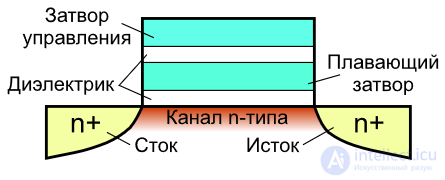
Semiconductor structure of a NAND cell
However, such movement of electrons is akin to a breakdown – it gradually wears down the insulating material, and eventually this leads to disruption of the entire semiconductor structure. There is also a second problem that causes a gradual degradation of cell characteristics – when tunneling occurs, electrons can become stuck in the dielectric layer, hindering correct recognition of the charge stored in the floating gate. All this means that the moment when flash memory cells stop working normally is inevitable. New process technologies only aggravate the problem: as production nodes shrink, the dielectric layer becomes thinner, which reduces its resistance to negative effects.
However, it would not be entirely correct to say that there is a direct relationship between the endurance of flash memory cells and the lifespan of modern SSDs. The operation of a solid-state drive is not a straightforward matter of writing and reading data in flash memory cells. The thing is that NAND memory has a fairly complex organization, and interacting with it requires special approaches. Cells are grouped into pages, and pages into blocks. Data can only be written to clean pages, but in order to clear a page, the entire block must be erased. This means that writing, and even worse, modifying data, turns into a complex multi-step process that includes reading the page, modifying it, and rewriting it to free space that must first be cleared. Moreover, preparing free space is a separate headache in itself, requiring "garbage collection" – forming and clearing blocks out of pages that have already been used but have become outdated.
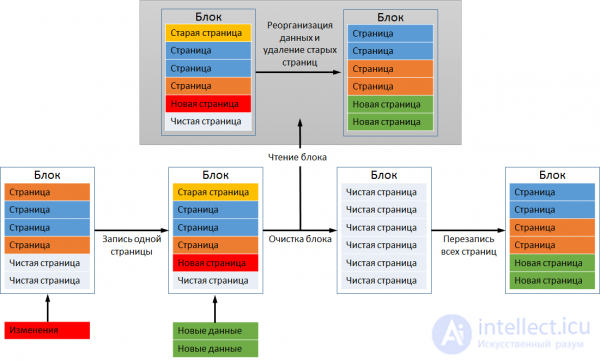
Diagram of how flash memory in a solid-state drive operates
As a result, the actual volume of writes to flash memory can differ significantly from the volume of operations initiated by the user. For example, changing even a single byte can entail not only writing an entire page, but even the need to rewrite several pages at once in order to free up a clean block beforehand.
The ratio between the volume of writes performed by the user and the actual load on flash memory is called the write amplification factor. This factor is almost always greater than one, and in some cases, considerably so. However, modern controllers, through operation buffering and other intelligent approaches, have learned to effectively reduce write amplification. Technologies useful for extending cell lifespan, such as SLC caching and wear leveling, have become widespread. On one hand, they convert a small portion of memory into a gentler SLC mode and use it to consolidate small, scattered operations. On the other hand, they make the load on the memory array more even, preventing excessive repeated rewrites of the same area. As a result, saving the same amount of user data to two different drives can, from the perspective of the flash memory array, cause a completely different load – it all depends on the algorithms employed by the controller and firmware in each specific case.
There is also another aspect: garbage collection and TRIM technologies, which, in order to improve performance, proactively prepare clean blocks of flash memory pages and can therefore move data from place to place without any user involvement, make an additional and quite significant contribution to the wear of the NAND array. But the specific implementation of these technologies also largely depends on the controller, so differences in how SSDs manage their own flash memory resource can be substantial here as well.
Ultimately, all this means that the practical reliability of two different drives with the same flash memory can differ quite noticeably solely due to different internal algorithms and optimizations. Therefore, when talking about the endurance of a modern SSD, one must understand that this parameter is determined not only, and not so much, by the endurance of the memory cells themselves, but by how carefully the controller treats them.
The algorithms behind SSD controllers are constantly being improved. Developers not only strive to optimize the volume of write operations to flash memory, but also work on implementing more efficient methods of digital signal processing and read error correction. In addition, some of them resort to allocating a substantial reserve area on the SSD, which further reduces the load on the NAND cells. All of this also affects endurance. Thus, SSD manufacturers have a great many levers at their disposal for influencing the ultimate endurance their product will demonstrate, and the endurance of the flash memory is just one parameter in this equation. This is precisely why conducting endurance tests on modern SSDs is so interesting: despite the widespread adoption of NAND memory with relatively low endurance, current models do not necessarily have to be less reliable than their predecessors. Progress in controllers and the methods they use is quite capable of compensating for the fragility of modern flash memory. And this is exactly what makes studying current consumer SSDs so interesting. Compared to SSDs of previous generations, only one thing remains unchanged: the lifespan of solid-state drives is, in any case, finite. But how it has changed in recent years is precisely what our testing is meant to show.
⇡#
In order to test the endurance and reliability of SSDs, it is necessary to continuously rewrite data on the drives, attempting to establish the limit of their endurance in practice. However, simple linear writing does not entirely serve the goals of testing. In the previous section, we discussed how modern drives have a whole bouquet of technologies aimed at reducing the write amplification factor, and, moreover, they perform garbage collection and wear leveling procedures differently, and also respond differently to the operating system's TRIM command. That is precisely why the most correct approach is to interact with the SSD through the file system, approximately replicating the profile of real-world operations. Only in this case can we obtain a result that ordinary users can regard as a benchmark.
Therefore, in an endurance test it is better to use drives formatted with the NTFS file system, on which two types of files are continuously and alternately created: small ones – with a random size from 1 to 128 KB, and large ones – with a random size from 128 KB to 10 MB. During the test, these randomly-filled files multiply until less than 12 GB of free space remains on the drive, at which point all created files are deleted, a short pause is made, and the process repeats again. In addition, a third type of file – a permanent one – is simultaneously present on the drives under test. Such files, with a total volume of 16 GB, do not participate in the erase-rewrite process, but are used to verify the correct operation of the drives and the stable readability of the stored information: each time the SSD fill cycle completes, we check the checksum of these files and compare it against a reference value calculated in advance.
The test scenario described is carried out by the special program Anvil's Storage Utilities version 1.1.0, and monitoring of drive status is performed using the CrystalDiskInfo utility version 7.0.2. The test system is a computer with an ASUS B150M Pro Gaming motherboard, a Core i5-6600 processor with an integrated Intel HD Graphics 530 graphics core, and 8 GB of DDR4-2133 SDRAM. Drives with a SATA interface are connected to the SATA 6 Gbit/s controller built into the motherboard's chipset and operate in AHCI mode. The Intel Rapid Storage Technology (RST) 14.8.0.1042 driver is used.
Часть 1 Types of SSD Solid-State Drives, Their Parameters, NAND/NOR and SLC/MLC/QLC, Write Endurance, Reliability
Часть 2 How Much Data Gets Written to the Drive - Types

Comments