
Lecture
DIAC (from the English abbreviation DIAC: DIode for Alternating Current) is a two-terminal trigger element of solid-state electronics, representing a structure of several semiconductor layers with alternating (p-, n-) doping types and possessing a symmetrical, about the origin, S-shaped current-voltage characteristic. It can be regarded as a bidirectional diode thyristor or as a triac without a gate lead. It has largely superseded diacs' predecessor, the four-layer diode (diнistor), except in the field of power electronics.

symbol
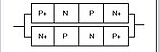
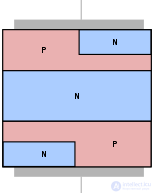
A DIAC usually consists of two antiparallel-integrated four-layer p-n-p-n systems, where one part of the device is active for each polarity of the external voltage, though other designs also exist, for example a five-layer (p-n-p-n-p) structure across the whole area. Because of the symmetry, the terms "anode" and "cathode" are not used for diodes of this class.
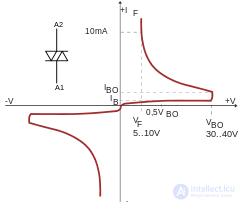
The switching mechanism of a DIAC is the same as that of a four-layer diode. As soon as the current supplied by the external source, increasing from zero, reaches a threshold value, the resistance of the reverse-biased p-n junctions ceases to be determined by their barrier properties and instead becomes governed by the high concentration of charge carriers injected by the current flowing through them; as a result the resistance becomes very low and the voltage across the whole structure drops. The figure shows the device's true characteristic together with the practical values of the critical parameters ; if the device is driven by voltage rather than by current, hysteresis will be observed on the measured characteristic.
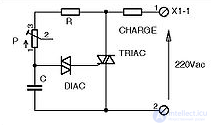
In circuit design, DIACs are mainly used to trigger other switching elements, such as triacs. Among the specific devices that use such components are the voltage converters in "compact fluorescent lamps" (fluorescent lamps with a switching-power-supply-type ballast built into the base).

SIDAC is another member of the thyristor family. Also called SYDAC (silicon alternating current switch), a bidirectional thyristor switching diode, or, more simply, a bidirectional thyristor diode, it is technically defined as a voltage-triggered bilateral switch. Its operation is similar to that of a DIAC, but a SIDAC is always a five-layer device with a low voltage drop in its fixed conducting state, and behaves more like a voltage-triggered trigger device without a gate. As a rule, SIDACs have a higher switching voltage and current-handling capability than DIACs, so they can be used directly for switching rather than merely for triggering another switching device. The silicon alternating-current diode (SIDAC) is a less widely used device, electrically similar to a DIAC but generally having a higher breakover voltage and greater current-handling capacity.
Functionally, a SIDAC is similar to a spark gap, but it cannot reach the same high temperature levels. A SIDAC remains non-conducting until the applied voltage reaches or exceeds its rated breakover voltage. After entering this conducting state, passing through a region of negative dynamic resistance, the SIDAC continues to conduct, regardless of voltage, until the applied current drops below its rated holding current. At that point the SIDAC returns to its initial non-conducting state, ready to begin the cycle again.
Something unusual for most electronic devices, the SIDAC is relegated to special-purpose device status. However, where the number of parts must be kept low, simple relaxation oscillators are needed, and where voltages are too low for a practical spark gap to work, the SIDAC is an indispensable component.
Similar devices, although generally not functionally interchangeable with SIDACs, are the thyristor surge protective devices (TSPDs) sold under trademarks such as Trisil from STMicroelectronics and SIDACtor, as well as its predecessor Surgector from Littelfuse. They are designed to withstand large pulse currents in order to suppress overvoltage transients. In many applications this function is now performed by metal-oxide varistors (MOVs), particularly for catching voltage transients on the power line.

Comments