
Lecture
A Peltier element is a thermoelectric converter whose operating principle is based on the Peltier effect — the appearance of a temperature difference when an electric current flows. In English-language literature, Peltier elements are designated TEC (Thermoelectric Cooler).
The effect that is the reverse of the Peltier effect is called the Seebeck effect.
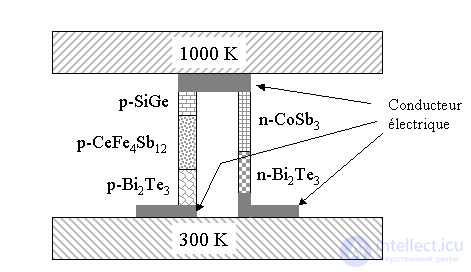
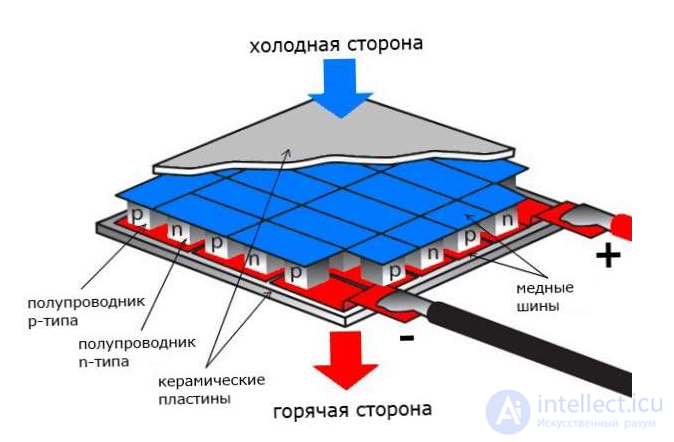
A structural example of a Peltier element. Metal electrodes and p-type and n-type semiconductors are alternately connected in a π-shape between the upper and lower thermal-radiation plates.
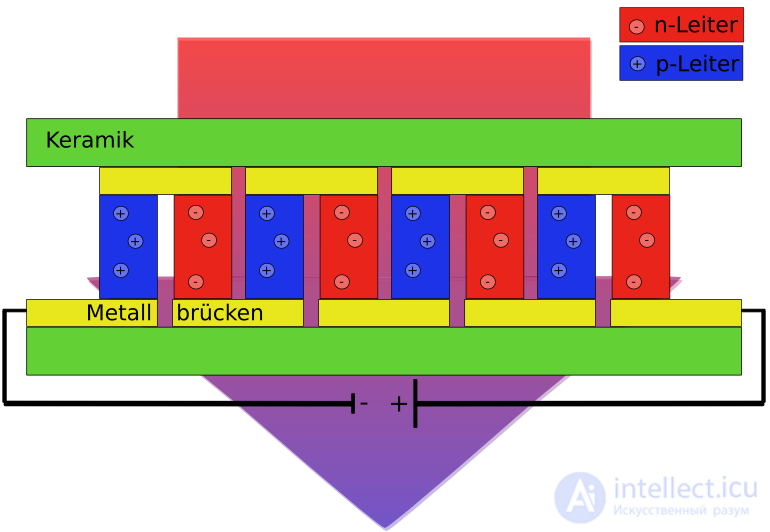
A schematic drawing of a Peltier element
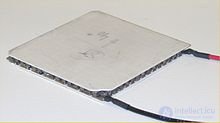
External appearance of a Peltier element. When current flows, heat is transferred from one side to the other.
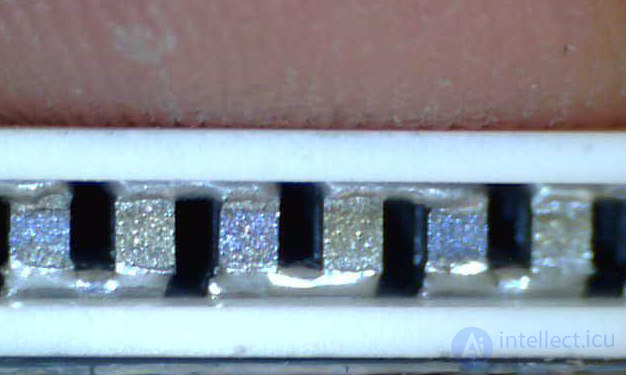
Side view of a Peltier element. Electric current flows through the cube-shaped semiconductors between the top and bottom parts.
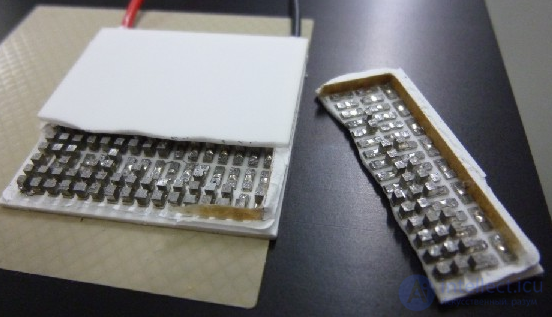
An opened element
The operation of Peltier elements is based on the contact between two semiconductor materials with different electron energy levels in the conduction band. When current flows through the contact between such materials, an electron must gain energy to move into the higher-energy conduction band of the other semiconductor. Absorption of this energy cools the contact point of the semiconductors. When current flows in the opposite direction, the contact point of the semiconductors heats up, in addition to the usual ohmic heating effect.
At a metal-to-metal contact, the Peltier effect is so small that it is imperceptible against the background of ohmic heating and thermal-conduction phenomena. For this reason, practical applications use a contact between two semiconductors.
A Peltier element consists of one or more pairs of small semiconductor parallelepipeds — one n-type and one p-type in each pair (usually bismuth telluride Bi2Te3 and a SiGe solid solution) — which are connected in pairs by metal bridges. The metal bridges simultaneously serve as thermal contacts and are insulated by a non-conductive film or a ceramic plate. The pairs of parallelepipeds are connected so that a series connection of many pairs of semiconductors with different conductivity types is formed, such that one sequence of connections (n->p) is on top, and the opposite sequence (p->n) is on the bottom. Electric current flows sequentially through all the parallelepipeds. Depending on the direction of the current, the top contacts cool down and the bottom ones heat up — or vice versa. In this way, the electric current transfers heat from one side of the Peltier element to the opposite side and creates a temperature difference.
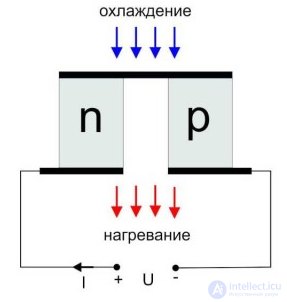
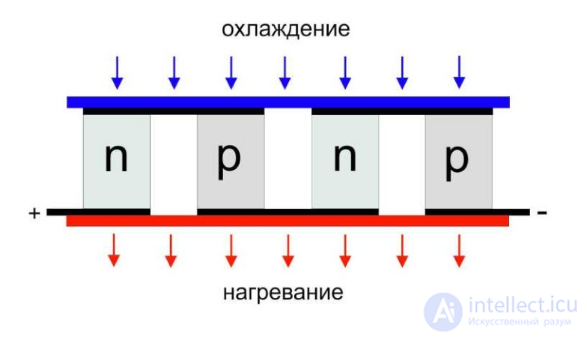
If the heating side of the Peltier element is cooled, for example with a heat sink and a fan, the temperature of the cold side becomes even lower. In single-stage elements, depending on the type of element and the magnitude of the current, the temperature difference can reach approximately 70 °C.
The advantages of a Peltier element are its small size, the absence of any moving parts, and the absence of gases or liquids. Reversing the direction of the current allows either cooling or heating — this makes it possible to maintain a set temperature whether the ambient temperature is above or below that set temperature. Another advantage is the absence of noise.
The disadvantage of a Peltier element is its lower efficiency compared with compressor-based freon refrigeration units, which leads to high power consumption in order to achieve a noticeable temperature difference. Despite this, work is underway to improve thermal efficiency, and Peltier elements have found wide application in engineering, since temperatures below 0 °C can be achieved without any additional equipment.
The main problem in building high-efficiency Peltier elements is that the free electrons in a material simultaneously carry both electric current and heat. However, the material for a Peltier element must simultaneously possess two mutually exclusive properties — it must conduct electric current well but conduct heat poorly.
In banks of Peltier elements it is possible to achieve a greater temperature difference, but the cooling power will be lower. To stabilize the temperature it is better to use a switching power supply, since this improves the efficiency of the system. It is also advisable to smooth out current ripple — this increases the efficiency of the Peltier element's operation and may extend its service life. Likewise, the operation of a Peltier element will be inefficient if an attempt is made to stabilize the temperature using pulse-width modulation of the current.
Peltier modules are finicky devices. Their use is subject to a number of requirements, failure to observe which leads to: degradation of the module or its failure, and reduced system efficiency.
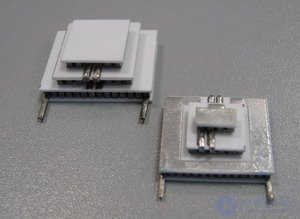 Multistage modules are used in deep-cooling systems, refrigerators with a large temperature drop, and cooling systems for scientific, research, and special-purpose instruments. They are also used for cooling IR photodetectors, X-ray detectors, and other sensors.
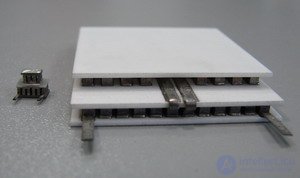 Technological features
For the upper stages of multistage modules we use an optimized thermoelectric material, which makes it possible to obtain a larger ?T with fewer stages. This makes it possible to manufacture multistage modules with optimal weight and dimensional characteristics and low power consumption.
We also offer our customers thermoelectric modules installed in, or directly integrated into, standard TO packages (TO3, TO8, etc.), HHL, DIL, butterfly, or special enclosures.
| TEM | thermoelectric module |
| TGM | thermoelectric generator module |
| DTmax | maximum achievable temperature difference between the sides of a thermoelectric module |
| Imax | maximum electric current through a thermoelectric module, corresponding to the mode of maximum temperature difference |
| Umax | maximum electric voltage at the contacts of a thermoelectric module, corresponding to the mode of maximum temperature difference |
| Qmax | maximum cooling capacity (refrigeration power) of a thermoelectric module. Determined at the maximum current through the thermoelectric module and zero temperature difference between its sides |
| Rac | electrical resistance of a thermoelectric module, measured with an alternating current at a frequency of 1 kHz |
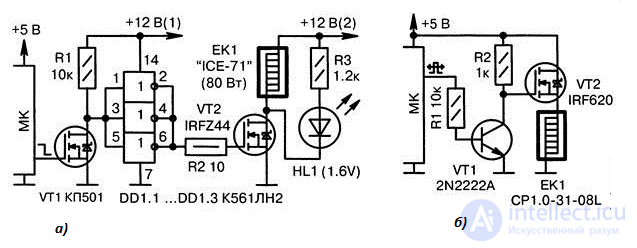
Fig. 1. Circuits for connecting heating elements to a microcontroller:
a) cooling of objects with the EK1 Peltier module made by "Kryotherm" (dimensions 40x40x3.4 mm). LED HL1 indicates the "Freeze/Defrost" state. Transistor K77 is connected to the MCU directly, without resistors, since element EK1 is quite sluggish and the interference that could theoretically turn on transistor VT1 during an MCU restart has little effect on it;
b) connection of a low-voltage Peltier element from Melcor to an MCU. Parameters of EK1: power 5.3 W, operating current 2.5 A at a voltage of 3.75 V, maximum temperature difference between the "cold" and "hot" surfaces of 67°C, overall dimensions 15x15x4 mm.
Peltier elements can be used anywhere cooling with a small temperature difference is required, or where there are no economic constraints. Thermoelectric elements are used, for example, in cold boxes where the use of a refrigeration machine is prohibited for space reasons or would not be worthwhile, since the required cooling power is small. The temperature difference between the inside and the outside simply arises in an uncontrolled way. The efficiency is low. Peltier elements are used in situations where cooling with a small temperature difference is needed, or where the energy efficiency of the cooler is unimportant. For example, Peltier elements are used in PCR thermal cyclers, small automotive refrigerators, and cooled banquet carts used in catering, since the use of a compressor-based refrigeration unit is impossible or impractical in these cases due to size constraints, and, moreover, the required cooling power is small.
In addition, Peltier elements are used to cool charge-coupled devices in digital cameras. This achieves a noticeable reduction in thermal noise during long exposures (for example, in astrophotography). Multistage Peltier elements are used to cool radiation receivers in infrared sensors.
Peltier elements are also often used to cool and temperature-stabilize diode lasers in order to stabilize the wavelength of the emitted radiation.
In devices with low cooling power, Peltier elements are often used as a second or third cooling stage. This makes it possible to achieve temperatures 30-40 degrees lower than with conventional compression coolers alone (down to -80 °C for single-stage refrigerators and down to -120 °C for two-stage ones).
Some enthusiasts use a Peltier module for cooling processors when extreme cooling without nitrogen is needed. Before nitrogen cooling, this was exactly the method used.
"Peltier generator" (the more correct term would be "Seebeck generator," but the inaccurate name has stuck) is a module for generating electricity — a thermoelectric generator module, abbreviated GM, TGM. This thermogenerator consists of two main parts:
Peltier elements are used to cool particularly long-wavelength or sensitive CCD sensors. This significantly reduces image noise during long exposures (for example, in astrophotography). Multistage Peltier elements are used to cool radiation receivers in infrared sensors.
Peltier elements are also increasingly used in laboratory measuring instruments for which temperature is an important parameter, such as density meters, viscometers, rheometers, or refractometers.
In hygrometers with cooled mirrors, one or more Peltier elements connected in series usually cool the mirror down to -100 °C. This takes advantage of the fact that the cooling capacity of Peltier elements can be quickly regulated electrically.
Diode lasers are often cooled and temperature-stabilized using Peltier elements in order to maintain a constant emission wavelength and/or efficiency. The downstream optical elements of diode and other lasers are often temperature-stabilized with Peltier elements.
Peltier elements can be used both for cooling and — by reversing the direction of the current — for heating.
Peltier elements are sometimes used as part of CPU coolers. A Peltier element allows the processor to cool down to temperatures below that inside the case, which either allows the processor to be overclocked without compromising stability, or extends the processor's service life. The element is mounted on the bottom of a heat sink with a fan and is powered by a power supply of the required capacity. However, to date such solutions have not proven successful because of their additional power consumption — the electrical energy used is released inside the case as waste heat.
Photodiodes, for example those used in scintillator readout, can be cooled by Peltier elements due to their small area, thereby reducing noise and dark current.
Peltier elements are used in diffusion cloud chambers to maintain the temperature difference between the bottom and the lid.
In thermal cyclers, which today are part of standard equipment in molecular biology, Peltier elements are used for rapid heating and cooling of samples, which is necessary, for example, in the polymerase chain reaction.
Peltier elements are sometimes used in small air dehumidifiers. Here, humid air passes through the cooling element, and the water it contains condenses as it cools and is then collected in a collection container.

Comments