
Lecture
Resistor symbols can differ depending on the standard (European or American) and the type of resistor. Here are the main symbols:
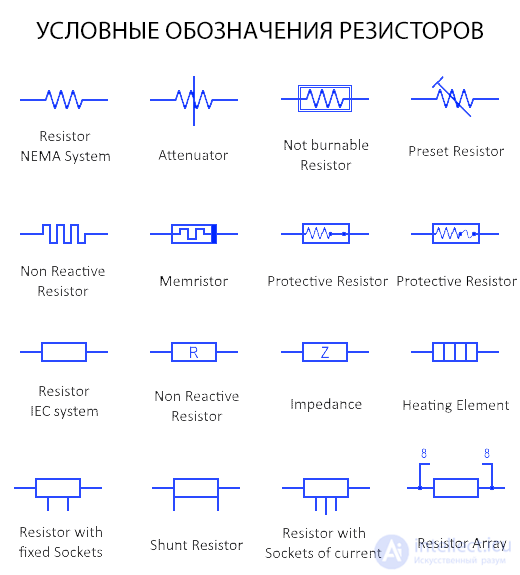
Resistor (NEMA and IEC systems)
This is the symbol for a fixed resistor. Both of these symbols denote a fixed resistor under the NEMA and IEC standard systems.
Attenuator
An attenuator works the opposite way to an amplifier. It reduces the power of a signal without distorting it. It dissipates the signal's power in its own network of resistors. The attenuator symbol is shown above.
Preset Resistor
This is a variable resistor whose resistance is adjusted during manufacturing or circuit design. It does not change during normal use of the circuit. The resistance of a preset resistor is changed using a screwdriver.
Non-Reactive Resistor
These resistors, also known as non-inductive resistors, have pure resistance. An ordinary wire-wound resistor has inductance due to the magnetic field produced by its winding. Non-reactive resistors have a special winding design that cancels out the magnetic fields.
Impedance
Impedance is a complex quantity consisting of a real part and an imaginary part. The real part represents resistance, and the imaginary part represents reactance.
Heating Element
This component converts electrical energy into heat. The passage of current through the heating element generates thermal energy due to its resistance.
Protective Resistor
Both of these symbols represent a protective resistor. It works as a current-limiting resistor, and if the current exceeds a certain limit, it burns out, opening the circuit.
Memristor
The memristor, also known as a memory resistor, is a hypothetical non-volatile memory component whose resistance depends on the current that has flowed through it in the past. It remembers its last known resistance value when it is turned off/on.
Shunt Resistor
A shunt resistor (also known as a current shunt) is a resistor with a low and precise resistance value used to measure the current flowing through it. The current is measured by the voltage drop across it. In this way, it acts as a current sensor.
Resistor Array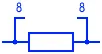
A resistor array is a combination of several resistors in a single package. It contains a number of individual resistors, indicated by a number in the symbol, for example, 8 in this case. The resistors are not connected to each other except at one side, which is connected to VCC for pull-up or GND for pull-down. They are used to save space and reduce placement cost.
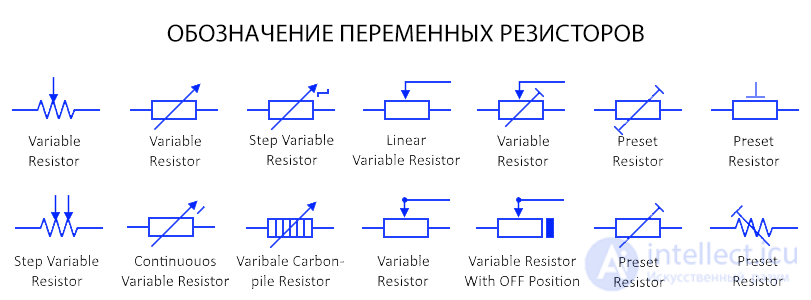
Variable Resistor
A variable resistor, also known as a potentiometer or rheostat, has variable resistance. It has three terminals. Two of them have a fixed resistance, while the third terminal moves along the resistive track or wire to increase or decrease the resistance. They are used to increase or decrease the current in a circuit during its normal operation.
Continuously Variable Resistor
This type of variable resistor has continuous resistance, meaning that sliding or rotating the contact produces a continuous resistance value. It can achieve an infinite number of resistance values within a range from minimum to maximum.
Stepped Variable Resistor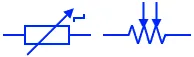
The resistance of this type of variable resistor increases or decreases in steps. The contacts do not slide smoothly but jump between steps. Each step change increases or decreases the resistance by a fixed amount.
Carbon Rod Variable Resistor
This type of variable resistor consists of carbon discs clamped between two metal plates. Increasing or decreasing the pressure between these metal plates increases the resistance of the device.
Variable Resistor with ON/OFF Switch
This type of variable resistor has a built-in switch that opens or closes the contact between two terminals.
Preset Resistor
A preset resistor is a variable resistor that is used only during circuit setup and adjustment. It is not used during normal operation of the circuit. Its construction is not as rugged as that of variable resistors (potentiometers, etc.).
Photoresistor / Light-Dependent Resistor (LDR)
This is a light-dependent resistor, meaning its resistance depends on light intensity. The resistance of an LDR decreases as light intensity increases.
Thermistor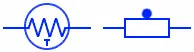
A thermistor, or thermal resistor, is a type of resistor whose resistance depends on the ambient temperature. It either decreases or increases with temperature depending on the type of thermistor.
NTC and PTC Thermistor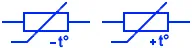
NTC stands for negative temperature coefficient, and PTC stands for positive temperature coefficient. The resistance of an NTC thermistor decreases as temperature rises and is denoted by the "–t°" sign. The resistance of a PTC thermistor increases as temperature rises and is denoted by the "+t°" sign.
Varistor (VDR)
A varistor, or VDR (voltage-dependent resistor), is a type of resistor whose resistance depends on the applied voltage. Its resistance changes as the applied voltage changes. These symbols (some old and some new) represent a varistor.
Iron-Hydrogen Resistor
This is a resistor with a positive temperature coefficient, made from an iron wire inside a hydrogen-filled bulb. Its resistance increases with temperature, caused by an increase in current. The increase in resistance prevents further increase in current. Thus, they are used in stabilizing circuits.
Magnetoresistor
A magnetoresistor, or MDR (magnetically dependent resistor), is a type of resistor whose resistance depends on an external magnetic field. Its resistance changes as the magnetic field strength changes and is used as a magnetic sensor to measure a magnetic field.
Resistance Thermometer, or RTD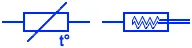
A resistance temperature detector (RTD) is a temperature sensor whose electrical resistance changes with temperature. The material used in an RTD has a very precise relationship between resistance and temperature. It can be measured by applying a constant current and measuring the voltage drop across the resistor.

Comments