
Lecture
Here are the basic conventional graphical symbols for thyristors, triacs, and diacs:
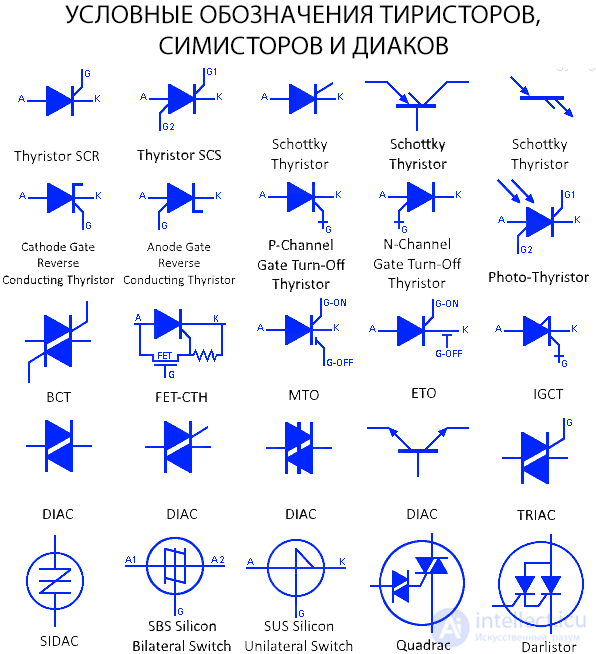
These symbols help visualize how components operate in electrical circuits and provide insight into their functionality.
SCR Thyristor

SCR stands for Silicon Controlled Rectifier, a 4-layer PNPN semiconductor device. It has three terminals: anode, cathode, and gate. Like a diode, it is a unidirectional device, but with a gate control input for triggering the SCR. It begins to conduct when the line voltage exceeds the forward breakdown voltage or when current is applied to the gate.
SCS Thyristor

SCS stands for Silicon Controlled Switch. Like the SCR, it is a 4-layer PNPN device. It is also unidirectional, but unlike the SCR, it has an additional gate called the anode gate. The anode gate is used to stop conduction when a positive voltage is applied to it, while the cathode gate is used to initiate conduction.
Reverse Conducting Thyristor with Cathode Gate

This is the symbol for a reverse-conducting thyristor. It is simply an SCR with a diode connected in antiparallel to allow conduction under reverse bias. RCTs also conduct in the reverse direction and are used in compact designs where a reverse diode is needed or where inductive loads are present. The cathode gate is used to trigger current flow in the forward direction.
Reverse Conducting Thyristor with Anode Gate

This symbol represents a reverse conducting thyristor (RCT) with an anode gate. The anode gate is used to stop current conduction when sufficient current is applied to it. The RCT is used for reverse-direction conduction when there is an inductive load or a need for reverse diodes.
GTO Gate Turn-Off Thyristor with Cathode Gate

A gate turn-off thyristor is a type of thyristor capable of turning off when a negative voltage pulse is applied through the same gate. Otherwise, the turn-on conditions are the same as for a regular thyristor, but because of its non-latching nature, you need to maintain 1% of its turn-on pulse to keep it in the conducting state. The cathode-gate GTO begins conducting with a positive pulse and turns off with a negative pulse
GTO Gate Turn-Off Thyristor with Anode Gate

This is a gate turn-off thyristor, but with an anode gate. It is also turned on and off through the same gate lead. The anode gate allows the gate to stop conduction when a positive gate input signal is applied, and starts conduction with a negative gate input signal.
LASCR Phototristor

A photothyristor, or LASCR (Light Activated Silicon Controlled Rectifier), is a type of thyristor that switches into conduction mode when exposed to light. However, the gate works like a regular SCR gate but remains disconnected when used in photo applications.
BCT – Bidirectional Phase Control Thyristor

The BCT, or bidirectional control thyristor, consists of two SCRs connected in an anti-parallel combination and integrated into a single package. It has two separate gate terminals, one for each thyristor. There are no anode or cathode terminals, only main terminals. The gate controls the current flowing through the individual SCR.
FET-CTH (Field Effect Transistor Controlled Thyristor)
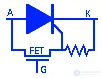
The FET-controlled thyristor consists of an SCR and a MOSFET in a single package. The MOSFET is used to trigger the SCR, but there is no turn-off capability. The MOSFET provides electrical isolation between the triggering circuit and the switching line.
MTO (MOSFET Turn-Off Thyristor)
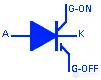
The MTO, or MOSFET Turn-Off thyristor, is a modified form of the GTO and consists of an SCR and a MOSFET. The MOSFET is used to stop current conduction. The MTO has two separate gate terminals, i.e., a turn-on gate and a turn-off gate. The GTO has a limitation in that its turn-off function requires a high-current pulse, whereas the MTO can turn off using only a voltage level.
ETO (Emitter Turn-Off Thyristor)
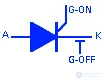
The ETO, or Emitter Turn-Off thyristor, is a fast-acting thyristor consisting of an N- and P-MOSFET and an SCR thyristor. The MOSFET is connected in series between the gate and the cathode terminal of the SCR thyristor. The MOSFET provides faster turn-off capability by removing residual carriers from the SCR thyristor.
IGCT Integrated Gate-Commutated Thyristor

The IGCT, or Integrated Gate-Commutated Thyristor, is a special type of thyristor used for high-voltage switching in industrial applications. It consists of a Gate-Commutated Thyristor (GCT) with a multilayer printed circuit board for the gate drive circuit. The IGCT has a very fast turn-off capability, as it uses a very fast-rising current pulse to drain the entire charge from its cathode.
DIAC

The name DIAC is derived from Diode AC switch. It is a bidirectional semiconductor device, similar to two diodes connected in an antiparallel combination. It can conduct current in both directions once the voltage rises above a certain breakdown voltage threshold. They are mainly used to trigger a TRIAC by connecting it in series to its gate.
TRIAC

The name TRIAC is derived from Triode for Alternating Current. It is a modified version of the SCR that can conduct and also control current in both directions. The gate input is used to trigger conduction in each direction. It can switch high AC current and voltage. They are used in dimmers, motor speed control, and so on.
SIDAC

SIDAC stands for Silicon Diode for Alternating Current; this device is similar to the DIAC, but has a relatively high breakdown voltage and current handling capability. It is a bidirectional semiconductor device consisting of 5 layers, designed to handle high voltage and current. Essentially, it is a triac without a gate.
SBS Silicon Bilateral Switch
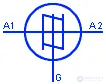
The SBS, or Silicon Bilateral Switch, is a triggering device used as a trigger element for a triac. It has the same electrical properties as the DIAC, but has lower switching voltages. It can conduct in both directions
SUS Silicon Unilateral Switch
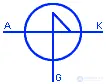
The SUS, or Silicon Unilateral Switch, is a semiconductor device used as a trigger element. It is used to trigger an SCR. It consists of an SCR with a Zener diode that determines the trigger voltage.
Quadrac
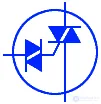
The Quadrac consists of a DIAC and a TRIAC built into a single package. The DIAC is used as a trigger element for the TRIAC within this package. Quadracs are used in compact electrical circuits, where they can save space and time by using a single package instead of discrete parts.
Darlistor
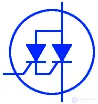
The darlistor is a fast, high-power thyristor with very high switching capabilities compared to a conventional thyristor. It can block high voltages and conduct large currents at very high frequencies, ranging from 50 Hz to 10 kHz.

Comments