
Lecture
A quadrac is a special type of thyristor that combines a "diac" and a "triac" in a single package. The diac is the triac's triggering device. Thyristors are four-layer (PNPN) semiconductor devices that act as switches, rectifiers, or voltage regulators in various applications. When a thyristor is triggered, it turns on and becomes a low-resistance current path. It remains in this state even after the trigger is removed, until the current drops below a certain level (or until it is turned off). Diacs are bidirectional diodes that switch AC voltage and trigger triacs or silicon-controlled rectifiers (SCRs). Except for a small leakage current, diac circuits do not conduct until the breakover voltage is reached. Triacs are three-terminal silicon devices that function as two thyristors connected in inverse parallel. They allow load current to flow during both halves of the AC supply voltage. By combining the functions of a diac and a triac, quadracs eliminate the need to purchase and assemble discrete parts.
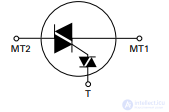
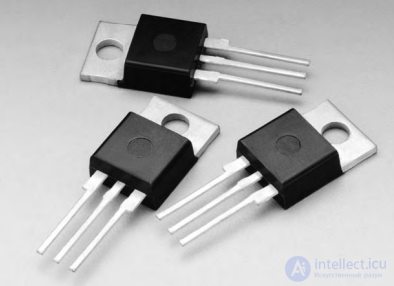
Schematic symbol
• No more than 8 mA max. current
• TO220AB package, UL recognized
• Junction temperature 110 °C
• di/dt performance 70 A/µs
• The quadrac version includes an integrated diac
• Provides full light control down to extremely low load conditions
• Minimum isolation of 2500 V AC between the mounting tab and the active terminals
• Increases the operating safety margin, requiring less heat sinking
• Provides robust performance typical of LED load operation
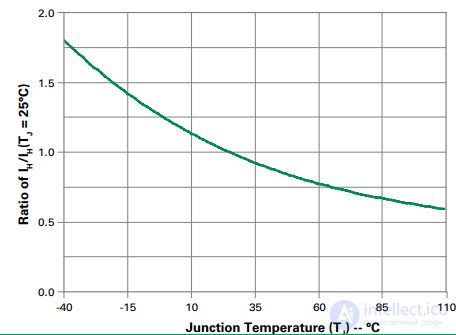
Figure 1: Normalized holding current versus junction temperature
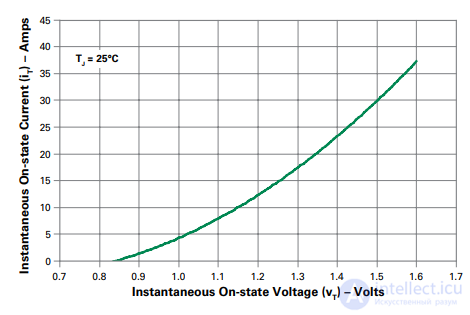
Figure 2: On-state current versus on-state voltage
(Typical)
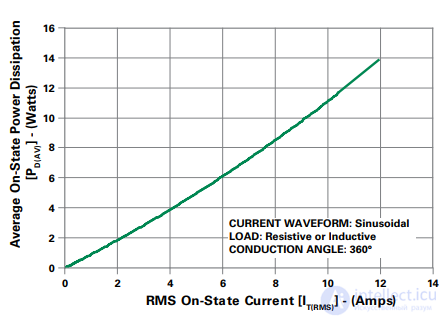
Figure 3: Power dissipation versus RMS on-state current
(Typical)
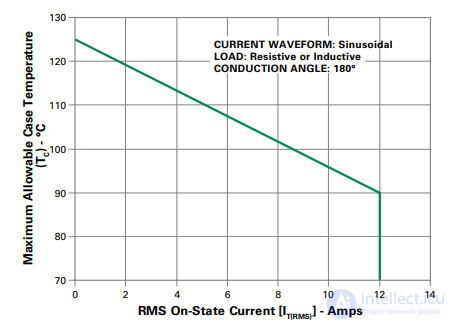
Figure 4: Maximum allowable case temperature
versus RMS on-state current
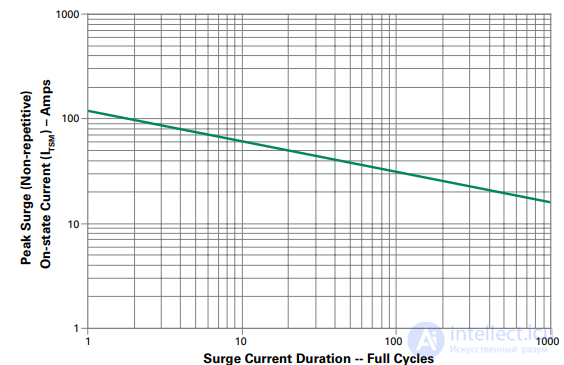
Figure 5: Peak surge on-state current versus number of cycles
Supply frequency: sinusoidal, 60 Hz
Load: resistive
RMS on-state current: [IT(RMS)]: maximum rated
value at a specified case temperature
Notes:
1. Gate control may be lost during and immediately following a surge current interval.
2. The overload must not be repeated until the junction temperature has returned to a steady-state rated value.
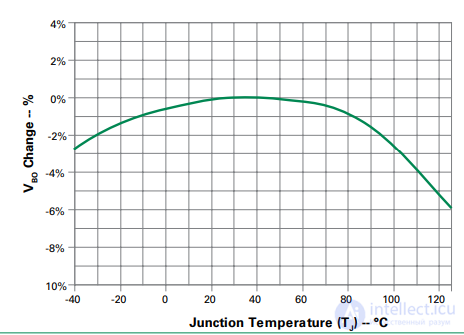
Figure 6: Variation of the DIAC VBO with junction temperature
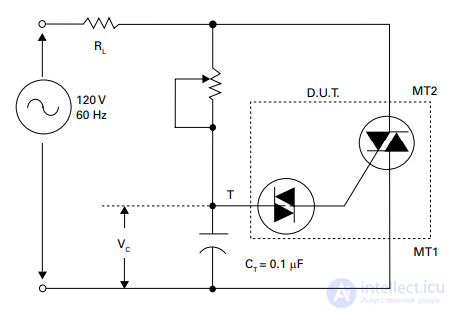
Figure 7: Test circuit
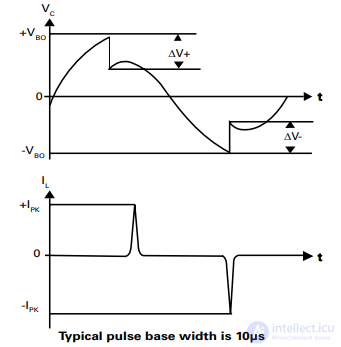
Figure 8: Test circuit waveform
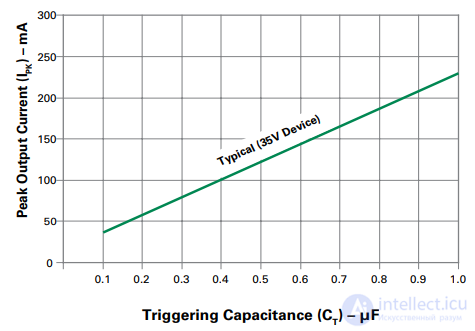
Figure 9: Peak output current versus trigger capacitance
(See Figure 7)
Quadracs are available in various types of integrated circuit (IC) packages with different numbers of pins. The main IC package types for quadracs include the discrete package (DPAK), power package (PPAK), and insulated package (IPAK). Other IC package types include the diode outline (DO), transistor outline (TO), and small outline transistor (SOT). Quadracs that use a metal electrode leadless face (MELF) package have metallized terminals on each end of a cylindrical body. Other available package types for quadracs include the thin small outline package (TSOP), thin shrink small outline package with L-leads (TSSOP), and thin small outline package with J-leads (TSOJ).
Carefully selecting the appropriate device for the rating, operating parameters, and environment matters a great deal for extending the thyristor's service life. Good design practice should limit the maximum continuous current through the main terminals to 75% of the device rating. Other ways to extend the service life of discrete power semiconductors are proper heat sinking and choosing a voltage rating for worst-case conditions. Overheating, overvoltages (including dv/dt), and surge currents are the main destroyers of semiconductors. Proper mounting, soldering, and lead forming also help protect components from damage.
Excellent for AC switching and phase control, for example, lighting control and motor speed control. Typical
applications: solid-state AC switches, dimmers with LED loads, small low-current motors in power tools,
and low-current motors in household and consumer appliances.
For simplicity, an isolated internal heat-sink-construction package with maximum isolation voltage is recommended.
Quadracs are used to control lighting, speed, and temperature modulation. They have performance characteristics such as peak repetitive off-state voltage, peak repetitive reverse voltage, RMS on-state current, and junction temperature. Peak repetitive off-state voltage is the maximum instantaneous off-state voltage value that occurs on the thyristor, including all repetitive transient voltages and excluding all non-repetitive voltages. Peak repetitive reverse voltage is the maximum peak reverse voltage that can be continuously applied to the main terminals (anode and cathode) of the quadracs. RMS on-state current is the maximum RMS current permissible at a specified use-case temperature. The junction temperature for quadracs is expressed as the full required range.

Comments