
Lecture
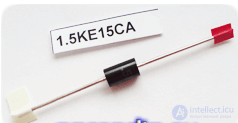 Protective diode (suppressor) 1.5KE15CA
One class of semiconductor diodes is called, in Russian technical literature, a voltage limiter (semiconductor overvoltage limiter) or suppressor. In foreign technical literature the name used is TVS diode (Transient Voltage Suppressor). TVS diodes are very often referred to by manufacturers' trade names: TRANSIL, INSEL.
In technical literature and among electronics hobbyists, the suppressor may be called by various names: protective diode, clamping zener diode, TVS diode, transil, voltage limiter, limiting diode. Suppressors are quite often found in switching power supplies, where they protect the powered circuit against overvoltage in the event of a switching power supply fault.
Let us look at what a TVS diode actually is, its operating principle, and the circuits and purposes in which it is used.
TVS diodes were created in 1968 in the USA to protect industrial equipment from atmospheric electrical discharges. In the operating conditions of electronic devices, both industrial and household, great importance is placed on protecting these devices specifically from natural electrical pulses.
Voltage surges also occur very often at power transformer substations. In such cases household appliances fail by the hundreds, since industrial facilities have comprehensive protection while residential buildings are, in this case, completely unprotected.
According to some data, losses associated with the failure and subsequent repair of all electronic equipment in the USA amount to about $12 billion per year. Specialists have calculated that losses in our country correspond to a similar sum.
To protect equipment against the effects of electrical overvoltages, a class of semiconductor devices called TVS diodes, or "suppressors," was developed. In conversation you may sometimes hear them called a "diode fuse."
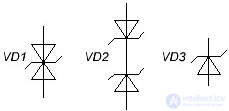
On schematic diagrams the suppressor (aka protective diode) is designated as follows (VD1, VD2 - symmetric; VD3 - unidirectional).
TVS diodes have a strongly pronounced nonlinear current-voltage characteristic. If the amplitude of an electrical pulse exceeds the rated voltage for a particular diode type, the diode switches into avalanche breakdown mode. In other words, the TVS diode limits the voltage pulse to a normal value, while the "excess" is diverted to the chassis (ground) through the diode. The process is shown more clearly in the figure.
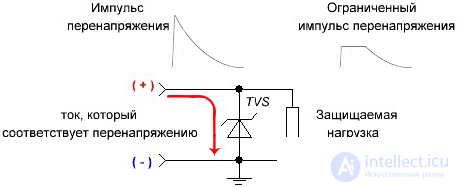
As long as there is no risk of the electronic device failing, the TVS diode has no effect whatsoever on the operation of the equipment. This semiconductor device has a higher switching speed compared to the limiters that were used previously.
Protective diodes are manufactured in both asymmetric (unidirectional) and symmetric (bidirectional) versions. Symmetric diodes can operate in circuits with bipolar voltages, while asymmetric diodes work only with a voltage of one polarity. Here is another typical connection diagram (for a bidirectional diode).
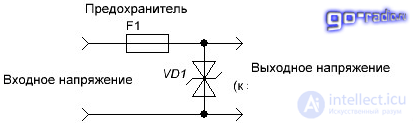
For a unidirectional suppressor the circuit looks slightly different.
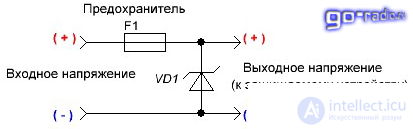
When the input voltage rises, the device reduces its resistance in a very short time. The current in the circuit rises sharply and the fuse burns out. Since the suppressor triggers very quickly, no damage is done to the equipment. A distinguishing feature of TVS diodes is their very short response time to an overvoltage. This is one of the "special features" of protective diodes.
V(BR) (V) - breakdown voltage value. In foreign technical documentation this parameter is denoted as VBR (Breakdown Voltage). This is the voltage value at which the diode abruptly turns on and diverts the dangerous current pulse to the common line ("to ground").
I(R) (µA) - constant reverse current value. This is the value of the maximum reverse leakage current present in all diodes. It is very small and has practically no effect on the operation of the circuit. Another designation is IR (Max. Reverse Leakage Current). It may also be denoted as IRM.
V(R) (V) - constant reverse voltage. Corresponds to the English-language abbreviation VRWM (Working Peak Reverse Voltage). May be denoted as VRM.
V(CL) (V) - maximum pulse clamping voltage. In datasheets it is denoted as VCL or VC - Max. Clamping Voltage or simply Clamping Voltage.
I(PP) (A) - maximum peak pulse current. In the English style this is denoted as IPP (Max. Peak Pulse Current). This value shows the maximum current pulse that the suppressor can withstand without being destroyed. For high-power suppressors this value can reach several hundred amperes!
P(PP) (Watts) - maximum permissible peak pulse power. This parameter shows how much power the suppressor can suppress. Recall that the word "suppressor" comes from the English word Suppressor, meaning "one that suppresses." The foreign name for this parameter is Peak Pulse Power (PPP).
The maximum pulse power value can be found by multiplying the values of V(CL) (VCL) and I(PP) (IPP).
The current-voltage characteristics of symmetric and asymmetric TVS diodes look as follows.
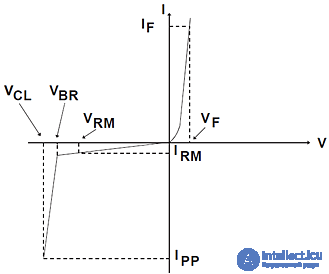
I-V characteristic of a unidirectional protective diode (suppressor)
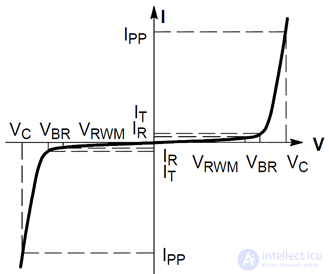
I-V characteristic of a bidirectional suppressor
A major drawback of these diodes can be considered the strong dependence of the maximum pulse power on the pulse duration. The operation of a TVS diode is usually considered when a pulse with a minimum rise time of about 10 microseconds and short duration is applied to it.
For example, at a pulse duration of 50 microseconds, a diode of the SMBJ 12A type withstands a pulse current almost four times higher than its rated value.
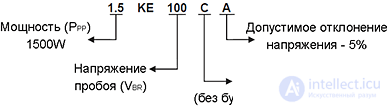
The compact TRANSZORB™ diodes of the 1.5KE6.8 - 1.5KE440 (C)A series have proven themselves very well. They are manufactured in both symmetric and asymmetric versions. For the symmetric diode, the letter C or CA is added to the designation. This series has a wide operating voltage range from 5.0 to 376 volts, a short response time of 1*10-9 sec, and the ability to suppress high-power pulses of up to 1500 W. They have proven excellent in protection circuits for television, digital, and other modern equipment.
The diodes are manufactured in a DO-201 package.
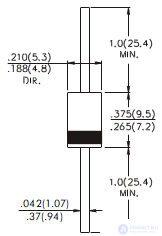
Dimensions are given in inches and millimeters (in parentheses). Asymmetric suppressors have a colored marking ring on the body, located closer to the cathode lead.
The body of the protective diode carries markings that encode its main parameters.
TRANSIL™ diodes made by THOMSON are widely used to protect automotive electronics from overvoltages. The strongest source of electrical pulses is the ignition system. A single TRANSIL™ diode is sufficient to protect a car audio system.
Bidirectional TRANSIL™ 1.5KE440CA diodes are successfully used to protect household electronic equipment in 220-volt mains networks. Their use is most effective for protecting facilities connected to overhead power lines. In this case, protection is provided both against atmospheric electrical pulses and against power-line voltage surges.

Comments