
Lecture
Here are some common symbols for fuses, circuit breakers, and protective devices often used in electrical diagrams:
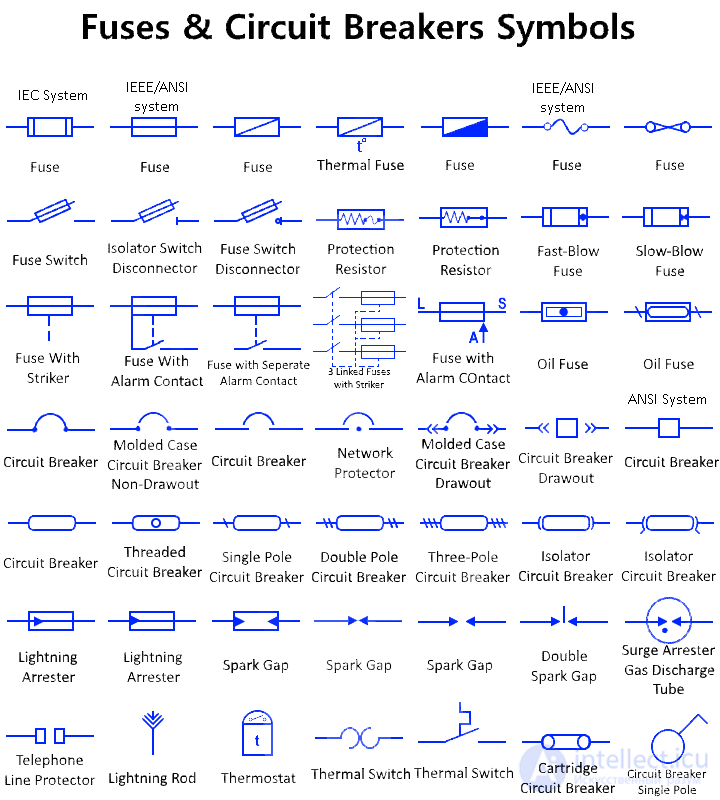
Fuse
Here are some of the symbolic representations of a general fuse used in any electrical circuit. A fuse is used to protect any electrical device from overcurrent. It contains a small wire or piece of metal that melts due to high current and opens the circuit, blocking the flow of fault currents. IEC, IEEE, and ANSI provide different representation systems.
Thermal fuse
The symbol for a thermal fuse used in any electrical diagram. A thermal fuse is a temperature-sensitive switch. It operates based on temperature rather than current, unless the current is sufficient to raise the temperature above the threshold value.
Fuse switch
This symbol represents a fuse switch. A fuse switch performs the switching action by physically removing the fuse, since the fuse is part of the switch.
Disconnector switch isolator
This is also known as a disconnector or isolating switch, which is used to isolate and completely de-energize a circuit. This is an off-load device. The symbol above represents an isolating switch.
Fuse switch disconnector
This is the symbol for a switch fuse. It is a fuse connected in series with a switch. It can manually switch the device on and off, as well as provide overcurrent protection by breaking the circuit.
Protective resistor
Both of these symbols represent a protective resistor. It functions as a current-limiting resistor, and if the current exceeds a certain limit, it burns out, opening the circuit.
Fast-acting fuse
Symbolic representation of fast-acting fuses in any electrical circuit. Fast-acting fuses burn out instantly when the current exceeds the maximum limit. This is the most common type of fuse used in electrical equipment sensitive to high current.
Time-delay fuse
Unlike a fast-acting fuse, a time-delay fuse can withstand high current for a short period of time. It will burn out after a short interval once the current exceeds the maximum limit. Motors require high current at startup, and a time-delay fuse can withstand this current without burning out.
Striker fuse
This type of fuse is also known as a striker fuse. It has a striker pin that acts as an indicator of the fuse's condition. The pin is ejected when the fuse blows.
Fuse with alarm contact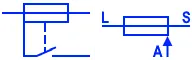
Symbolic representation of a fuse with an alarm contact. Such fuses have a built-in alarm circuit to display the fuse's status. When the fuse blows, the circuit is activated and shows a light or some other indication.
Fuse with separate alarm contact
This symbol denotes a fuse with a separate alarm contact.
3 linked fuses that trip when any striker is released
This is a symbolic representation of three connected fuses that trip when any one of the three strikers is released.
Oil-type fuse
This is the symbol for an oil fuse. It is used in switchgear that is immersed in oil. The oil serves as a coolant to increase its breaking capacity.
Circuit breaker
These are all the symbols used for a general-purpose circuit breaker. A circuit breaker is an automatic switch that protects appliances from a short circuit or excessive load current. It opens the circuit as soon as the current exceeds the maximum limit.
Fixed (non-withdrawable) circuit breaker
Fixed or non-withdrawable circuit breakers are represented by the symbol shown above. This type of breaker is fixed in place, and during maintenance the flow of power through the breaker must be stopped.
Withdrawable circuit breaker
A withdrawable breaker consists of two parts: a fixed base, and a withdrawable breaker unit that can be removed without interrupting the power supply. This type of breaker is used where continuous power is required even during maintenance.
Thermal switch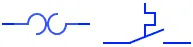
A thermal switch operates based on temperature. It controls the flow of current depending on temperature. It opens the circuit when the temperature exceeds the rated value and closes it when the temperature drops below a certain point. The designation for a thermal switch is shown above
Network protector
A network protector is used between the secondary terminal of a distribution transformer and the load network. Its function is to break the connection when it detects any reverse current, in order to prevent any losses.
Threaded circuit breaker
This symbol denotes a threaded circuit breaker.
Single-pole circuit breaker
This symbol represents a single-pole circuit breaker. It has only one live wire and trips in the event of an overload or short circuit.
Two-pole circuit breaker
This represents a circuit breaker with two poles. This type of circuit breaker has two separate live wires passing through it. When a short circuit or overload occurs in either of the two live lines, the circuit breaker disconnects both lines.
Three-pole circuit breaker
This symbol represents a circuit breaker with three poles. This type of breaker is used in three-phase industrial systems. It connects three phases, and whenever an overload or short circuit occurs in any phase, the circuit breaker disconnects all three phases simultaneously.
Isolator circuit breaker
An isolator circuit breaker is used to completely isolate the load from the source. This is a manually operated, off-load device. It has a somewhat lower current-breaking capacity than circuit breakers. It provides visual confirmation of an open circuit and the necessary safety measure during maintenance.
Lightning arrester / Surge protection device
This is the symbol used to denote a lightning arrester. This is a device used to protect against lightning or high impulse currents in a line. It has two terminals, namely a high-voltage terminal and a grounding terminal. The lightning arrester diverts lightning impulses into the ground.
Spark gap
Here are some symbols used for a spark gap. It is made of two conductors with a small gap between them, filled with gas. The gas ionizes when the voltage exceeds the gas breakdown point, creating a spark. It is used in spark plugs to ignite fuel, and as switching devices for pulsed power applications, such as discharging a capacitor at high voltage/current.
Double spark gap
This type of spark gap has two small gaps between the conductors, which creates a double spark. Shown above is the symbol for a double spark gap.
Surge limiter / Gas discharge tube
A surge limiter, or gas discharge tube, is made from a sealed gas chamber. Whenever the voltage exceeds a certain limit, an arc forms that short-circuits the entire current flow, thereby protecting the equipment.
Telephone line protector
Symbol denoting a telephone line protection device, which protects the telephone line from voltage surges or lightning, preventing damage to the conductor or equipment.
Lightning rod
This is a symbolic representation of a lightning rod. It is a metal rod placed on the roof of any building. This rod is connected to the ground by a conductor. When lightning strikes the building, the rod catches the lightning and transfers the energy to the ground, bypassing the building and preventing any damage.
Thermostat
A thermostat monitors the temperature around it and maintains it by turning cooling or heating equipment on and off. The thermostat symbol is shown above.
Cartridge circuit breaker
The symbols show a cartridge-type circuit breaker. These circuit breakers contain a cartridge-type fuse that opens when its current limit is exceeded. It can be easily replaced.

Comments