
Lecture
NOMFET is a field-effect transistor with organic memory in the form of nanoparticles. The transistor is designed to mimic the function of the human synapse known as plasticity, or the change in the speed and strength of a signal traveling from neuron to neuron. The device uses gold nanoparticles about 5-20 nm in size, containing pentacene, to mimic changes in voltage and speed within a signal. This device uses charge trapping/release in an array of gold nanoparticles (NPs) at the SiO2/pentacene interface to create a SYNAPSTOR (synaptic transistor) that mimics the dynamic plasticity of a biological synapse. This device (a memristor) mimics short-term plasticity (STP) and spike-timing-dependent plasticity (STDP), two "functions" underlying learning processes. A compact model was developed, and these organic synapstors have been used to demonstrate associative memory that can be trained to produce a Pavlovian response. A recent report showed that these organic synapse transistors (synapstors) operate at a voltage of 1 volt and with a typical plasticity response time in the range of 100-200 ms. The device also works in contact with an electrolyte (EGOS: electrolyte-gated organic synapstor) and can interact with biological neurons.
The recent creation of this new transistor opens up prospects for better recreating certain types of human cognitive processes, such as image recognition and processing. When the NOMFET is used in a neuromorphic circuit, it can reproduce plasticity functionality that previously required emulation by a group of several transistors, thereby continuing to shrink the size of the processor that will attempt to exploit the computational advantages of a pseudo-synaptic operation. (See Moore's Law)
The NOMFET transistor mimics the function of synapses by simply switching signals, thereby allowing or blocking signal transmission. It also has additional functions such as amplification, modulation, encoding, etc.
Physically, the transistor consists of a pentacene molecule (an organic semiconductor) and gold nanoparticles. It consists of a doped p+ bottom gate covered with a silicon oxide (SiO2) layer approximately 200 nm thick. The source and drain electrodes are made of gold (Au). Gold nanoparticles are deposited into the 20 nm interelectrode gap before the pentacene is deposited.
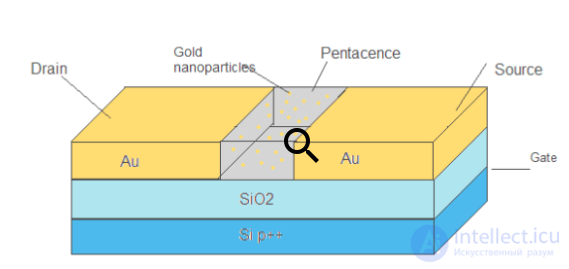
The new transistor allows for better reproduction of human cognitive processes, such as image recognition and processing. This innovation is a good start for a new generation of computers based on neurons, which operate on the principle of the nervous system. Such a computer could mimic functions of the human brain such as sensation, perception, action, and interaction.
An additional advantage of using the NOMFET in a neuromorphic circuit is its compact size, replacing a group of several traditional silicon transistors needed for the same function. This significantly increases the size of the processor.
Neurons do not function individually, but act through complex, yet synchronized, neural circuits and a network that generates sensory perceptions, actions, and memories. This is why integrating more NOMFETs into neural circuits is required for the complex functionality that will be the focus of researchers in the next period.

Comments