
Lecture
A laser diode (or laser semiconductor diode) is an electronic device used to generate narrowly directed, monochromatic light known as laser radiation.
A laser diode is a semiconductor laser built on the basis of a diode. Its operation is based on the occurrence of population inversion in the region of the p-n junction during carrier injection
Laser diodes — in the past, manufacturing lasers was associated with great difficulties, since it required a small crystal and the development of a circuit for its operation. For an ordinary hobbyist, such a task was virtually impossible.
With the development of new technologies, obtaining a laser beam under everyday conditions has become a reality. The electronics industry today produces miniature semiconductors capable of generating a laser beam. These semiconductors are laser diodes.
The increased optical power and excellent functional parameters of the semiconductor allow it to be used in high-precision measuring devices, both in industry, in medicine, and in everyday life. They are the basis for reading and writing computer discs, school laser pointers, level sensors, distance meters, and many other devices useful to people.
A laser diode has three leads and consists of the diode itself (which emits the laser beam) and a monitoring photodiode designed to control the radiation power. The anode of the laser diode and the cathode of the monitoring diode are connected to a common lead, which is connected to the housing.
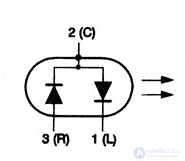
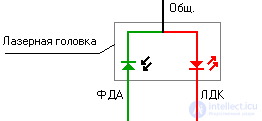
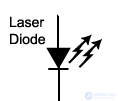
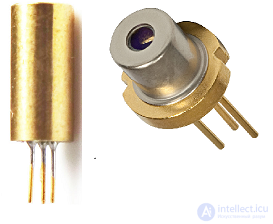
Fig. 1 Circuit symbol of a laser diode
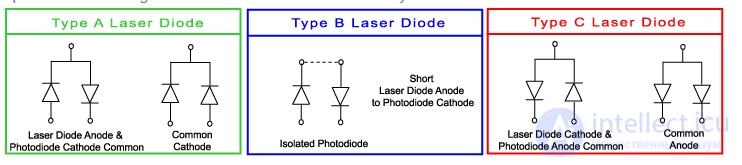
Fig. 2 Circuit symbol of a laser diode
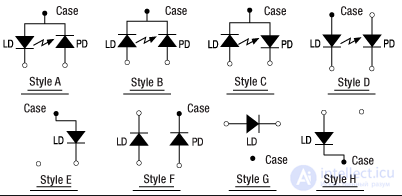
Fig. 3 Circuit symbol of a laser diode
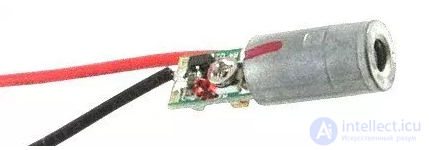
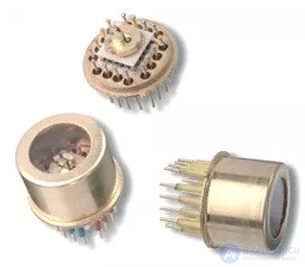
Fig. 4 Appearance of a laser diode
The emergence of this new electronic component is a revolution in the creation of electronic devices of various complexity. High-power diodes form a beam used in medicine to perform various surgical operations, in particular for restoring eyesight. A laser beam can quickly perform correction of the eye's lens.
Laser diodes are used in measuring instruments in everyday life and industry. Devices are manufactured with varying power. A power of 8 W is enough to assemble a portable level sensor under home conditions. This device is reliable in operation and capable of creating a laser beam over a very long distance. Exposure of a laser beam to the eyes is very dangerous, since at a short distance the beam can damage soft tissue.
A laser diode has significantly more monochromatic light than an ordinary photodiode. That is, a substantially narrower emission band.
In a laser diode, only those photons for which the inversion condition is met can be emitted. And this no longer has a direct relation to the width of the conduction band. Moreover, all the tricks involved are related to driving the carriers into a state in which spontaneous recombination would be impossible.
To narrow the emission band, various tricks are also used, for example creating a Bragg grating directly within the crystal structure.
The mirrors are usually simply the facets of the crystals; 30% reflectivity is usually sufficient for a laser diode. The non-working facet is often also coated with something to increase the reflection coefficient. So you won't find any mirrors there.
Also, typically, in lasers the light is emitted along the crystal, whereas in diodes it is emitted across the surface. This is because the crystal with inversion is transparent to this wavelength, while in an LED the material absorbs light very strongly.
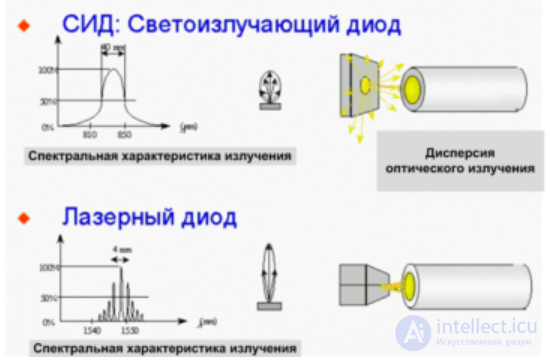
There are two main differences between a laser diode and an LED. First: a laser diode has a built-in optical resonator; second: a laser diode operates at significantly higher pumping current values, which, once a certain threshold value is exceeded, makes it possible to obtain a stimulated-emission regime. It is precisely this kind of emission that is characterized by high coherence, thanks to which laser diodes have a much narrower emission spectrum width — 1-2 nm versus 30-50 nm for LEDs.
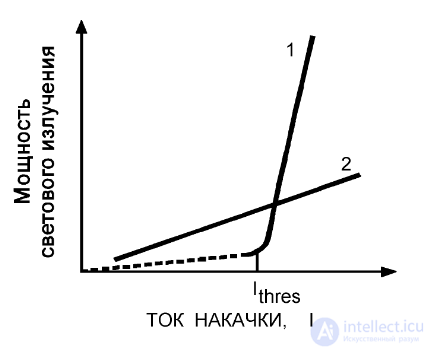
Fig. 18. Watt-ampere characteristics: 1 - laser diode; 2 - LED
The dependence of radiation power on pumping current is described by the watt-ampere characteristic of the laser diode (Fig. 18).
In a simple diode, a positive voltage is applied to the anode, that is, the diode is biased in the forward direction. Holes from the "p" region are injected into the "n" region of the p-n junction, and from the "n" region into the "p" region of the semiconductor. When a hole and an electron are located next to each other, their recombination begins, releasing photon energy at a certain wavelength and a phonon. This process is called spontaneous emission. In LEDs, it is the main source of light.
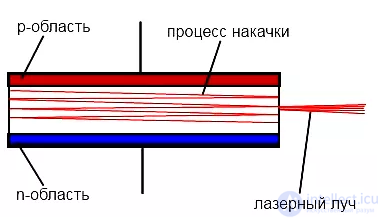
But under certain conditions, a hole and an electron are able to remain in one place for a considerable time (several microseconds) before recombining. If, during this time, a photon with the resonant frequency passes through this region, it will trigger stimulated recombination and the appearance of a second, clone photon. Its direction, phase, and polarization vector will exactly match those of the first photon.
The semiconductor crystal is manufactured in the form of a thin rectangular plate. Essentially, this plate plays the role of an optical waveguide, in which the radiation is confined to a limited volume. The surface layer of the crystal is modified to form the "n" region. The bottom layer serves to create the "p" region.
The end result is a flat p-n junction of significant area. The two side faces of the crystal are polished to create parallel smooth planes forming an optical resonator. A random photon of spontaneous emission perpendicular to these planes will travel through the entire optical waveguide. Before exiting, the photon will be reflected several times from the end faces, and, traveling along the resonator, will produce stimulated recombination, creating new photons with the same parameters, thereby amplifying the emission. When amplification exceeds losses, the generation of the laser beam will begin.
There are various types of laser diodes. The main ones are built on especially thin layers. Their structure can only generate emission in a parallel direction. But if the waveguide is made wide compared to the wavelength, it will operate in various transverse modes. Such laser diodes are called multi-mode.
Using such lasers is justified for creating increased emission power without high-quality beam convergence. Some scattering of the beam is allowed. This effect is used for pumping other lasers, in chemical manufacturing, and in laser printers. However, when precise focusing of the beam is required, the waveguide should be made with a width comparable to the wavelength.
In this case, the beam width depends on the limits imposed by diffraction. Such devices are used in optical storage devices, fiber-optic technology, and laser pointers. It should be noted that these lasers are not capable of supporting several longitudinal modes and emitting a laser beam at different wavelengths at the same time. The band gap between the energy levels of the "p" and "n" regions of the diode affects the wavelength of the beam.
The laser beam diverges immediately upon exit, since the emitting element is very thin. To compensate for this phenomenon and create a thin beam, converging lenses are used. Cylindrical lenses are used for wide multi-mode lasers. In the case of single-mode lasers, when symmetric lenses are used, the laser beam will have an elliptical cross-section, since the vertical divergence exceeds the beam size in the horizontal plane. A laser pointer serves as a clear example of this.
In the elementary device considered, no specific wavelength can be singled out, other than the wavelength of the optical resonator. In devices having material capable of amplifying the beam over a wide frequency range, and with several modes, operation at different wavelengths is possible.
Laser diodes usually operate at a single wavelength, which, however, has significant instability and depends on various factors.
When a positive potential is applied to the anode of an ordinary diode, the diode is said to be biased in the forward direction. In this case, holes from the p-region are injected into the n-region of the p-n junction, and electrons from the n-region are injected into the p-region of the semiconductor. If an electron and a hole find themselves "close" (at a distance where tunneling is possible), they can recombine, releasing energy in the form of a photon of a specific wavelength (due to conservation of energy) and a phonon (due to conservation of momentum, because the photon carries momentum). This process is called spontaneous emission and is the main source of emission in LEDs.
However, under certain conditions, an electron and a hole can remain in the same region of space for a fairly long time (up to microseconds) before recombining. If, at that moment, a photon of the required (resonant) frequency passes through this region of space, it can trigger stimulated recombination, releasing a second photon, whose direction, polarization vector, and phase will exactly match the same characteristics of the first photon.
In a laser diode, the semiconductor crystal is made in the form of a very thin rectangular plate. Such a plate is essentially an optical waveguide, in which the radiation is confined to a relatively small space. The top layer of the crystal is doped to form the n-region, and the p-region is created in the bottom layer. This produces a flat p-n junction of large area. The two side surfaces (end faces) of the crystal are polished to form smooth parallel planes, which form an optical resonator known as a Fabry-Perot resonator. A random photon of spontaneous emission, emitted perpendicular to these planes, will pass through the entire optical waveguide and be reflected several times from the end faces before exiting. Traveling along the resonator, it will trigger stimulated recombination, creating more and more photons with the same parameters, and the emission will be amplified (the stimulated emission mechanism). Once amplification exceeds losses, laser generation will begin.
Laser diodes can be of several types. In most of them, the layers are made very thin, and such a structure can generate emission only in a direction parallel to these layers. On the other hand, if the waveguide is made sufficiently wide compared to the wavelength, it will be able to operate in several transverse modes. Such a diode is called multi-mode. The use of such lasers is possible in cases where high emission power is required from the device, and good beam convergence is not a requirement (that is, significant beam divergence is allowed). Such areas of application include printing devices, the chemical industry, and pumping other lasers. On the other hand, if good beam focusing is required, the waveguide width should be made comparable to the emission wavelength. Here, the beam width will be determined only by the limits imposed by diffraction. Such devices are used in optical storage devices, laser target designators, and also in fiber-optic technology. It should be noted, however, that such lasers cannot support several longitudinal modes, that is, they cannot emit at different wavelengths simultaneously.
The emission wavelength of a laser diode depends on the width of the band gap between the energy levels of the p- and n-regions of the semiconductor.
Because the emitting element is quite thin, the beam at the diode's output, due to diffraction, diverges almost immediately. To compensate for this effect and obtain a thin beam, converging lenses must be used. Cylindrical lenses are most often used for wide multi-mode lasers. For single-mode lasers, when symmetric lenses are used, the beam cross-section will be elliptical, since the divergence in the vertical plane exceeds the divergence in the horizontal plane. This is most clearly seen in the example of a laser pointer's beam.
In the simplest device described above, it is impossible to single out a separate wavelength, apart from the value characteristic of the optical resonator. However, in devices with several longitudinal modes and material capable of amplifying emission over a fairly wide frequency range, operation at several wavelengths is possible. In many cases, including most visible-emission lasers, they operate at a single wavelength, which, however, has strong instability and depends on many factors — changes in current, ambient temperature, etc. In recent years, the simplest laser diode design described above has undergone numerous improvements so that devices based on it can meet modern requirements.
The laser diode design described above is called a "diode with an n-p homostructure," the meaning of which will become clear a little later. Such diodes are extremely inefficient. They require such high input power that they can only operate in pulsed mode; otherwise, they quickly overheat. Despite the simplicity of the design and its historical significance, they are not used in practice.
The design of the diodes discussed above has an n-p structure. Such diodes have low efficiency, require significant input power, and operate only in pulsed mode. They cannot operate otherwise, since they would quickly overheat, and therefore have not found wide practical application.
There are four main types of laser diodes: with a Fabry-Perot resonator, with distributed feedback, with distributed Bragg reflection, and with an external resonator (Fig. 19).
To organize the transmission of optical signals, it is not enough to have only a radiation source. Any optical transmitter module (OTM) design has a special holder (housing), which protects and secures the transmitter's component elements: the radiation source, the electrical interface unit, and the fiber coupling point.
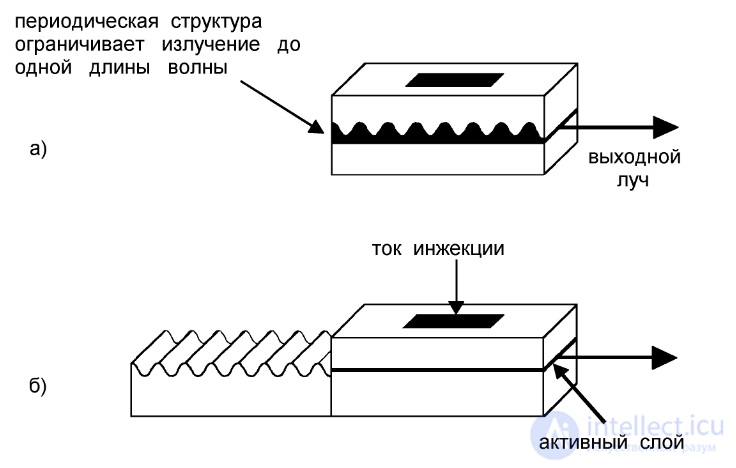
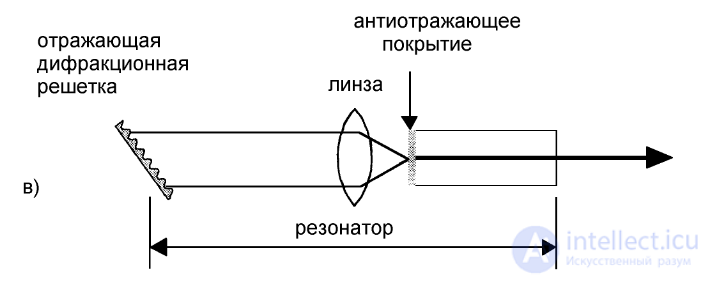
Fig. 19. Three main types of laser diodes:
For complex laser systems, output monitoring of the optical signal is added. The general design diagram of an optical transmitter, in which not all elements are mandatory, is shown in Fig. 20.
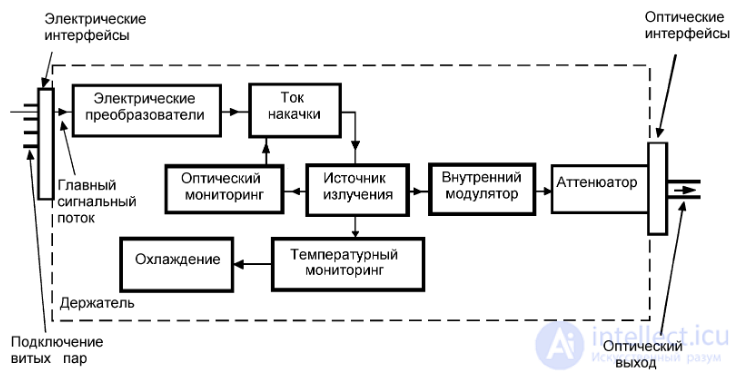
Fig. 20. Component elements of an optical transmitter module (OTM)
Double heterostructure lasers have a layer of material with a narrow band gap. This layer is located between layers of a material with a wide band gap. Aluminum-gallium arsenide and gallium arsenide are usually used to manufacture a double heterostructure laser. Each of these compounds of two different semiconductors is called a heterostructure.
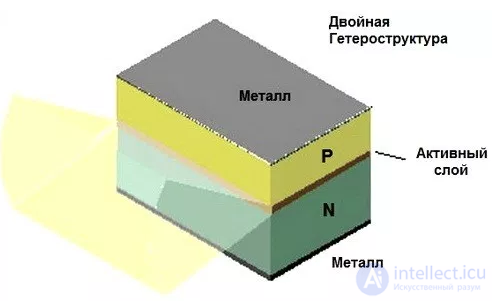
The advantage of lasers with this special structure is that the region of holes and electrons, called the active region, is located in the thin middle layer. Consequently, many more pairs of holes and electrons will be involved in creating amplification. In regions with low gain, few such pairs will remain. In addition, light will be reflected from the heterojunctions. In other words, the emission will be entirely confined to the region of highest effective gain.
Quantum well diode
When the middle layer of the diode is made thinner, it begins to function as a quantum well. As a result, the electron energy will be quantized vertically. The difference between the energy levels of the quantum well is used to generate emission instead of relying on a future barrier.
This is effective for controlling the beam's wavelength, which depends on the thickness of the middle layer. This type of laser is much more efficient than a single-layer one, since the density of holes and electrons is distributed more uniformly.
Heterostructure laser diodes
The main feature of thin-layer lasers is that they are not able to effectively confine the light beam. To solve this problem, two additional layers with a lower refractive index than the central layers are applied on both sides of the crystal. This structure resembles a light guide. It confines the beam much better. These are separate-confinement heterostructures. Most lasers in the 1990s were manufactured using this technology.
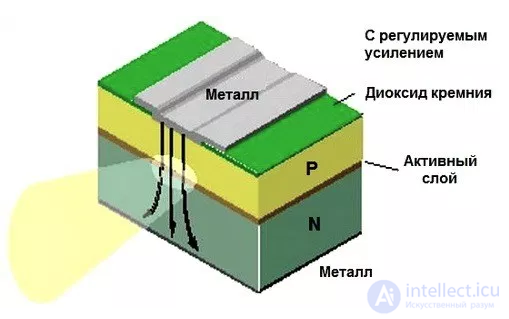
Feedback lasers are mainly used for fiber-optic communication. To stabilize the wavelength, a transverse groove is made on the p-n junction to create a diffraction grating. Because of this, only one wavelength is returned to and amplified in the resonator. Such lasers have a constant wavelength, determined by the grating's groove pitch. Under the influence of temperature, the groove changes. This type of laser model is the basis of telecommunications optical systems.
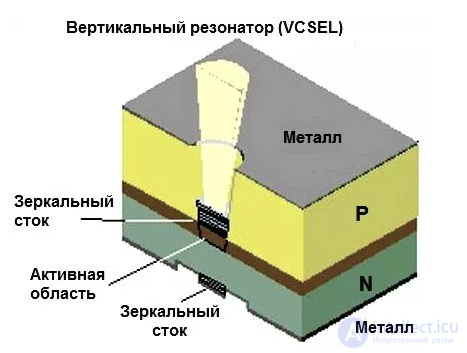
There are also VCSEL and VECSEL laser diodes, which are surface-emitting models with a vertical cavity. Their difference is that the VECSEL model has an external resonator, and its design can use either optical or current pumping.
Connection features
Laser diodes are used in many devices requiring a directed light beam. The main step in assembling a homemade device using a laser is proper connection.
Laser diodes differ from LEDs in having a miniature crystal. Therefore, high power is concentrated in it, and consequently the magnitude of the current, which can lead to its failure. To ease the laser's operation, there are special device circuits called drivers.
Lasers require stable power supply. However, there are models with red beam glow that operate normally even with unstable mains power. Even if a driver is present, the diode still cannot be connected directly. For this, a current sensor is additionally needed, whose role is often played by a resistor connected between these elements.
Such a connection has the drawback that the negative power pole is not connected to the circuit's ground. Another drawback is the power loss on the resistor. Therefore, before connecting the laser, the driver must be carefully selected.
There are two main types of drivers capable of ensuring normal operation of laser diodes.
A switching driver is designed by analogy with a switching voltage converter, capable of both raising and lowering this parameter. The output and input power of such a driver are approximately equal. However, there is some heat dissipation, which consumes a small amount of energy.
A linear driver operates on a circuit that most often supplies more voltage to the diode than required. To reduce it, a transistor is needed, converting the excess energy into heat. The driver has low efficiency, so it has not found wide application.
When using linear chips as stabilizers, if the input voltage decreases, the diode current will decrease.
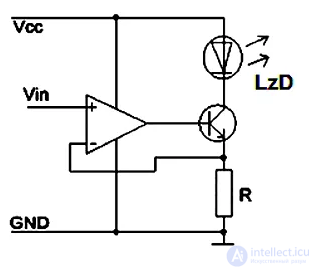
Since laser power is supplied by two types of drivers, the connection circuits differ.
The circuit may also contain a power source in the form of a battery or accumulator.
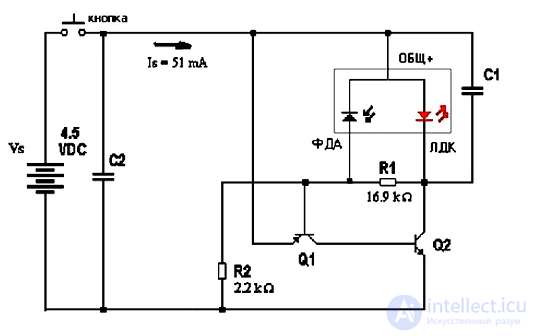
The batteries must supply a voltage of 9 volts. The circuit should also include a current-limiting resistor and the laser module. Laser diodes can be found in a faulty computer disc drive.
A laser diode has 3 leads. The middle lead is connected to the negative (positive) terminal of the power supply. The positive terminal is connected to the right or left pin, depending on the manufacturer. To determine which pin to use for the connection, power must be applied. For this, you can take two 1.5 V batteries and a 5 Ohm resistor. The negative terminal of the source is connected to the middle pin of the diode, and the positive terminal is first connected to the left pin, then to the right pin. Through this experiment, you can see which of these pins is the "active" one. The diode is connected to a microcontroller using the same method.
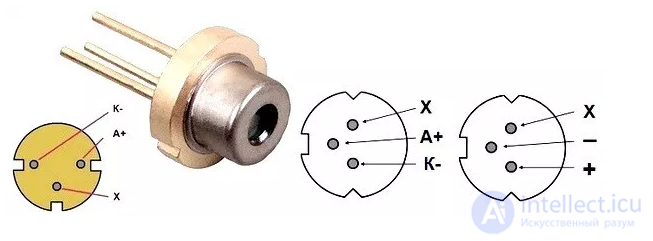
Laser diodes can operate from AA batteries or a cell phone battery. However, it should not be forgotten that a current-limiting resistor with a rating of 20 Ohms is additionally required.
Connecting to the mains supply
For this, additional protection against high-frequency voltage spikes must be provided.
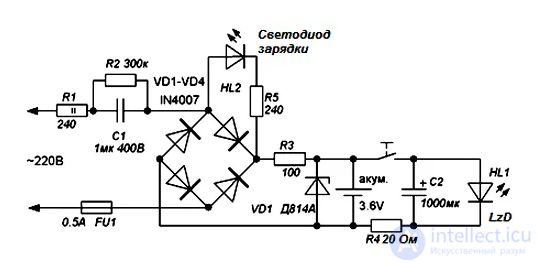
The stabilizer and resistor create a unit that prevents current fluctuations. A Zener diode is used to level out the voltage. The capacitor prevents the occurrence of high-frequency voltage spikes. With correct assembly, stable laser operation is ensured.
Connection procedure
The most convenient choice for working with is a red diode with a power of about 200 mW. Such laser diodes are installed in computer disc drives.
When connecting, remember safety. All connections must be of high quality.
The widespread use of laser diodes has led to the emergence of a great variety of packages specialized for particular applications. There are no official standards on this matter, although sometimes major manufacturers reach agreements on package unification . In addition, there are services for custom packaging of emitters to customer requirements, so it is difficult to list the entire variety of packages (miniBUT, miniDIL, etc.). Likewise, the pin arrangement in a familiar package may turn out to be unique, so the pin assignment should always be double-checked before purchasing from a new manufacturer. Also, appearance should not be associated with emission wavelength, since in practice an emitter with practically any wavelength (within a given range) can be installed in any of the packages. The main elements of a laser module are:
Listed below are the packages most common among manufacturers.
Packages of this type are intended for low and medium emission power ranges (up to 250 mW), since they do not have specialized heat-dissipating surfaces. Sizes range from 3.8 to 10 mm. The number of pins ranges from 3 to 4, and they can be wired in various ways, resulting in 8 types of pin configurations.
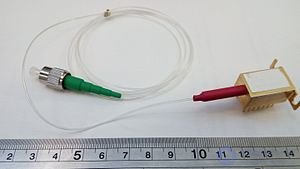
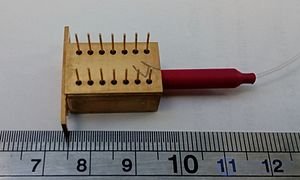
The use of this package is justified for powers above 10 mW (this value varies considerably for different wavelengths), when the surface area of the semiconductor is insufficient for heat dissipation. More efficient heat removal is achieved through the use of a built-in Peltier cooler, dissipating heat to the face of the aluminum housing opposite the fiber output. As long as the housing temperature does not change during operation, natural air cooling from the surface is sufficient. For more powerful applications, a heat sink is installed on the main heat-dissipating surface (opposite the fiber output), with lugs provided on the housing for attaching it. The arrangement of pins in 2 rows with a 2.54 mm pitch allows, alongside soldering, the use of pluggable electrical connections - a socket for electronic components in DIP packages and a zero insertion force (ZIF) socket.
The most common package for laser diodes with power from 10 mW to 800 mW and above. The main advantage over the DIL package is more efficient heat dissipation due to the increased contact area of the Peltier element with the housing of the laser module — the main heat-dissipating surface is the bottom one. For this, the electrical leads have been moved to the side faces, which complicates the organization of a pluggable connection between the laser module and the control board.
A one-sided version of the full BUTTERFLY package. Due to the halved number of leads, it is not possible to use an internal photodiode.
Usually, the wavelength does not need to be determined with great precision. In most cases, the biological hazard does not depend strongly on the wavelength. There are several exceptions (see Figure 3):
a) region 302.5-315 nm: in this range, the parameters  and
and  change significantly;
b) region 450-600 nm: in this range, the photochemical hazard decreases by a factor of one thousand;
c) region 1150-1200 nm: in this range, the thermal hazard decreases by a factor of eight;
d) 400 nm: at wavelengths above 400 nm, the hazard is mainly retinal (affecting the retina of the eye); at shorter wavelengths, the hazard is mainly non-retinal;
e) 1400 nm: at wavelengths above 1400 nm, the hazard is mainly non-retinal (not affecting the retina); at shorter wavelengths, the hazard is mainly retinal;
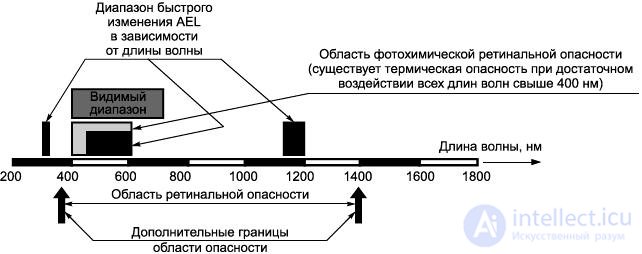
Figure 3 - Important wavelengths and wavelength ranges
Eye hazard region
Thermal hazard exists with sufficient exposure (irradiation) at all wavelengths above 400 nm.
Retinal photochemical hazard is considered only for exposure in the wavelength range from 400 to 600 nm and with an exposure time of more than 1 s.
The hazard regions are divided as follows:
In addition, AEL - Accessible Emission Limit(s) has a hazardous effect on vision
In the thermal retinal hazard region (wavelength range 400-1400 nm), AEL values depend on the subtended angle,  , of the apparent (visible) source, taking into account the correction factor
  (see Tables 4-9 in IEC 60825-1:2007). The formula used to calculate the AEL depends on
  , and depends on .
The apparent source is a real or virtual object-source forming the smallest image on the retina of the eye at a given retinal hazard evaluation location. The subtended angle of the apparent source is determined by the smallest image size on the retina that the eye can reproduce through accommodation (i.e., through changing the focal distance of the eye's lens). The subtended angle of the apparent source is used as a measure of the image size on the retina. The subtended angle is a plane angle subtended by the diameter of the apparent source at the eye's lens, see Figures 6a and 6b. The subtended angle of the apparent source can vary depending on the position along the beam axis. Except for surface emitters (such as fully diffusely transmitted or reflected beams, or LEDs without lens covers or reflectors), the location of the apparent source is also a function of the position of the eye along the beam.
This example shows a beam passing through a diffuser or reflection from a diffuser, such as a frosted lamp bulb, where the electric lamp is both the real and the apparent source.
This situation is more complex than with a simple source, as for example in Figure 6a, and both the subtended angle and the location of the apparent source usually change depending on the position within the beam.
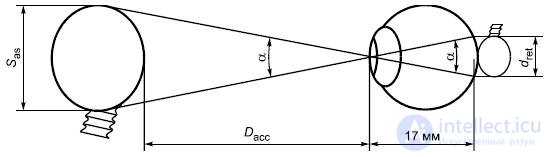
6a - Subtended angle () and apparent source size ( ) of an incoherent or diffuse source
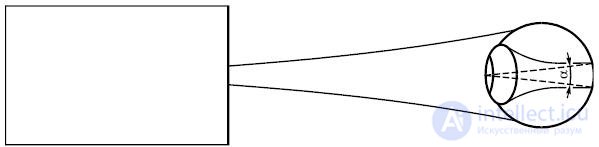
6b - Subtended angle of the primary laser beam at one of the positions along the beam
Figure 6 - Subtended angle
The same power or energy, spread over a large retinal spot, in most cases reduces the retinal hazard by a factor of . This is therefore an important parameter for medium (1.5 100 mrad) and large (
 100 mrad) individual sources and for grouped sources. However, it is often not necessary to determine the subtended angle at all, and the factor can be assumed to equal one. This provides the most stable estimate. A hazard assessment or laser classification should always begin with the assumption that the factor
  1. If this is sufficient and the AEL values for the assumed laser class are not exceeded, no further analysis is required.
Most single-beam lasers without beam-modifying optics are small sources, with a factor 1, and the location of the apparent source is not important for laser safety
Determination of the subtended angle, , using a factor  1 for the primary laser beam is given in 7.5.3.
For surface emitters, such as diffusely-transmitting or diffusely-reflecting laser beams, or bare laser diodes (without modifying optics), a simplified analysis can be used
Laser diodes are important electronic components. Laser diodes are widely used in various fields, including:
Communications: Laser diodes are used in optical fiber networks to transmit data at high speeds. They allow large volumes of information to be transmitted over long distances with high precision.
Medical equipment: In medical devices, such as laser systems for surgery and treatment, laser diodes are used for precise processing and removal of tissue.
Industry: Laser diodes are used for marking, cutting, and welding materials in industry.
Scanning and printing: They are also used in laser scanners and printers to create high-quality images and text.
Sensors and measurement: Laser diodes can be used in various sensor devices and measurement systems for determining distances and other parameters.
Laser diodes have a number of advantages, such as high efficiency, compactness, reliability, and long service life, which makes them a popular choice for many applications.
They are widely used as controlled light sources in fiber-optic communication lines. They are also used in various measuring equipment, such as laser rangefinders and levels.
Another common application is barcode reading in special scanners.
Visible-light lasers, usually red and sometimes green, are used in laser pointers and computer mice.
Infrared and red lasers were used in CD and DVD players.
Violet lasers were used in HD DVD and Blu-Ray devices.
Blue lasers are used in next-generation projectors as a source of blue light and green light (obtained through fluorescence of a special compound under the action of blue light).
The possibilities of using semiconductor lasers in fast and inexpensive devices for spectroscopy are being investigated.
Before the development of reliable semiconductor lasers, developers of CD players and barcode readers were forced to use small helium-neon lasers.
Application of laser diodes in medicine
The emergence, in the last decade of the 20th century, of high-power semiconductor lasers (laser diodes), rapid progress in increasing efficiency, reliability, and achievable output power levels while reducing cost, made it possible to largely eliminate these obstacles. Additional possibilities opened up with the use of fiber-optic principles inside the laser. Devices appeared in which the laser module is made in the form of an integrated fiber device, i.e., it does not contain discrete elements requiring precise adjustment and susceptible to external influences. A diagram of such a possible optical scalpel is shown in Fig. 10.1.
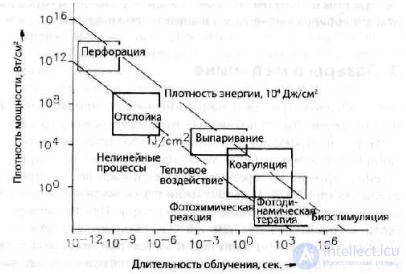
Fig. 10.1. Power density and pulse duration values when using lasers in medicine
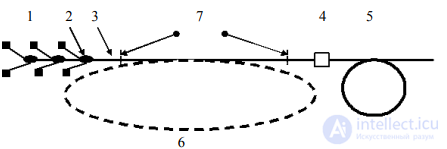
Fig. 10.1. Diagram of an optical scalpel
The emission from laser diodes with a fiber output 1, using special fused elements 2, is combined into a single fiber 3, from which it is fed through connector 4 into the working light guide 5. Developed technologies make it possible to introduce into the device a section of activated fiber 6 with fiber
mirror analogs 7, forming a fiber laser. This makes it possible to obtain laser radiation at other wavelengths. In fact, such a device is essentially a coil of optical fiber with laser diodes welded to it, and, thanks to the fiber's ability to retain light, it does not
require alignment and is not afraid of external mechanical influences, up to a level that would destroy the fiber. It is clear that dust and moisture have no access to the inside of the fiber. Thus, conditions have now been created for laser diodes and diode-pumped lasers to displace traditional lasers from medical equipment. This is due to the following advantages:
Another advantage is the possibility of exposing biological tissue to laser radiation of various wavelengths. Devices are used with operating radiation wavelengths of 0.97 µm, 1.06 µm, 1.56 µm, and 1.9 µm.
The wavelength of laser radiation turns out to be the main factor determining the depth of the radiation's effect on biological tissue, and hence the volume of tissue in which heat is generated. Fig. 10.2 shows the dependence of the relative absorption coefficients of laser radiation on wavelength
in water, oxyhemoglobin, and melanin. The figure also marks the wavelengths of laser devices built on the basis of laser diodes or diode-pumped lasers that are used, or show good prospects for use, in surgery.
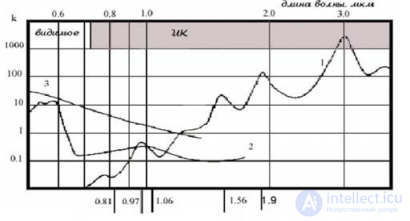
Fig. 10.2. Dependence of radiation absorption on wavelength in water (1), oxyhemoglobin (2), and melanin (3). 0.81 and 0.97 µm – laser diodes; 1.06 – laser diodes and fiber lasers with Yb (ytterbium)-doped fiber; 1.56 – fiber lasers with Er (erbium)-doped fiber; 1.9 – fiber lasers with Tm (thulium)-doped fiber.
In addition, laser diodes are used for optical tweezers (optical tweezers), (laser tweezers or optical trap)
Use of laser diodes in military applications
An important distinguishing feature of infrared radiation is its "invisibility." Thanks to an infrared laser, a spot invisible to the eye can be produced, which can nevertheless be observed with a night-vision device.
This property of infrared lasers accounts for their fairly widespread military use, since it is now easier to conceal the operation of laser guidance systems from the enemy. The emitter itself can be located either on an aircraft or on the ground, while still ensuring high accuracy for missiles and "smart" bombs, which home in on the infrared spot reflected from the target.
Laser diodes have many important military applications thanks to their ability to produce high-intensity, narrowly focused laser beams. Below are some of the specific areas in which laser diodes are used for military purposes:
Laser targeting: Laser diodes can be used to create laser target designators that help soldiers and pilots aim weapons and munitions at a target with high precision.
Laser target designation: Laser markers can be used to mark targets or locations for other weapon systems, such as guided missiles or bombs.
Optics and navigation: Laser diodes are used to create laser pointers and navigation systems that help soldiers and equipment determine their location and orient themselves on the battlefield.
Infrared markers and beacons: Infrared laser diodes can be used for night navigation and target marking under conditions of limited visibility.
Laser weapons: Lasers can also be used as weapons to temporarily blind, damage optics, or damage the enemy's sensors.
Laser detection and protection systems: Lasers can serve to detect and jam drones and other unmanned aerial vehicles.
Laser communications: Laser diodes can be used to transmit data under conditions where radio communication may be subject to interference.
Optical sensors and sights: Laser diodes are used in sights and optical systems for precisely determining distance and calculating firing trajectories.
The use of laser diodes in military applications helps improve the accuracy, effectiveness, and safety of combat operations, and also makes it possible to operate under various conditions and at any time of day — while, unfortunately, also taking the life and health of homo sapiens.

Comments