
Lecture
In recent years, humanity has been accumulating roughly 5 exabytes (1018 bytes) of information annually, and the pace continues to grow. This calls for the development of ever more capacious, faster, and more reliable data storage devices. One of many research directions employs optical holography methods. Progress in this field has been such that the first commercial products have already appeared on the market.
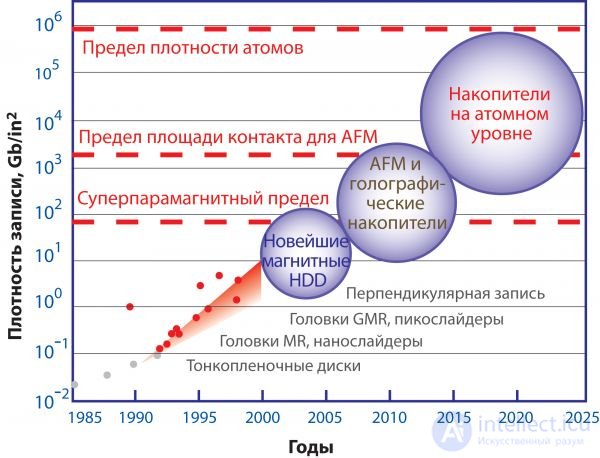
Fig. 1. History and prospects for the development of storage devices (according to IBM data). Here AFM (Atomic Force Microscopy) refers to atomic-scale microscopy methods that can be used for recording information. Atomic-scale storage devices also include atomic holography
HOLOGRAPHIC STORAGE DEVICES, devices that use a holographic method for recording, storing, and reproducing information. Information in a hologram can be stored either as a halftone image or in discrete form as a data set in binary code. The development and creation of holographic storage devices has been underway since the 1970s in many countries.
In holographic storage devices, two operations are usually performed separately:
1) input of information in the form of an image of an object or a data set, and its storage as holograms;
2) retrieval of information in the form of an image or an individual light signal.
Input and storage can be single or multiple, with complete or partial erasure of previously recorded information. Retrieval is practically always multiple. Owing to the feasibility of superimposing (multiplexing) holograms during recording in flat and, especially, in volumetric media, holographic storage devices have achieved a very high density of optical information recording (on the order of 4·108 bit/mm2, with information retrieval taking on the order of 10-3 s).
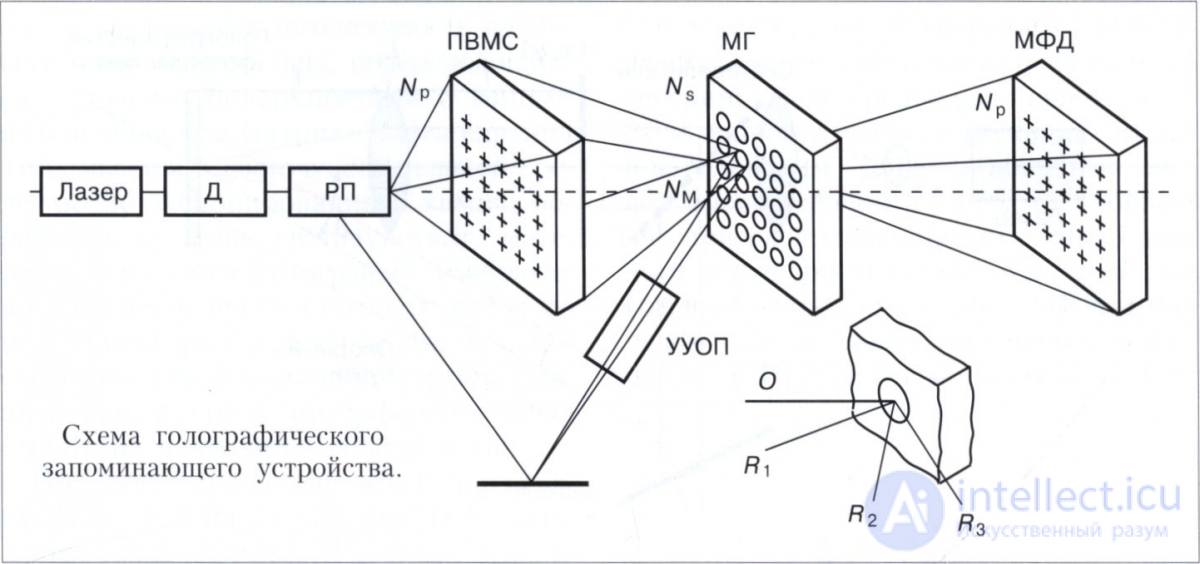 The main components of holographic storage devices (see figure) are a laser, an information input unit (typically a spatial light modulator, SLM), a medium containing a hologram array (HA), and an information output unit (for example, a photodetector array, PDA). In addition, holographic storage devices use deflectors (D), which shift the light beams across the surface of the recording medium, a beam splitter (BS) that divides the beam into object and reference beams, deflectors that steer the reference beams, and devices that control their structure (RBCD) (for multiplexing), as well as optical and mechanical elements.
The number of pixels Np contained in an image or data set and input in parallel into the holograms via the SLM must correspond to the number of pixels perceived by the PDA. The number of holograms Nh stored in the HA unit, which is not rigidly tied to the number of pixels in the SLM and PDA, is the product of Ns - the number of areas on the medium's surface where holograms are recorded sequentially - and NM - the number of multiplexed holograms recorded sequentially at one area. The total amount of information I, input simultaneously and sequentially via the SLM, is given by I = NpNhNMlog2(m + 1), where m is the number of gray levels in the halftone image, if a set of images is stored. In the case of binary information, where m=1, we have I = NpNhNM. The data output rate is given by vout = Npn, where n is the number of holograms that can be read per second. The large values of Np and NM achieved in holographic storage devices place them at a higher level compared with other storage devices.
The figure shows the possibility of sequential multiplex recording of holograms by changing the angle between the object beam (O) and the reference beams (R1, R2, R3). Multiplexing can also be achieved by varying the wavelength, the phase distribution of the reference beam, and by other methods. The recording medium plays a crucial role in the information storage unit. New holographic media have been developed (in particular, photopolymer media) that significantly broaden the range of applications for holographic storage devices. It has been proposed to use holographic discs with a capacity of about 1.6 TB in place of existing DVDs, as well as upgraded holographic devices in mobile phone memory.
IBM has studied the history and prospects for the development of storage devices in terms of areal recording density (Fig. 1). It is clear that there is only one way to overcome the superparamagnetic limit - to use non-magnetic recording methods. The most promising and most developed of these is holography.
Holographic memory has been developing since the work of Pieter J. Van Heerden, an employee of Polaroid. He proposed the idea of storing data in three dimensions back in 1963, and today some manufacturers have already begun commercial production of holographic storage devices.
The technology used makes it possible to record and read millions of bits of data in a single laser flash. The ultimate volumetric density of information N (N ~ λ3 ~ 1012 bit/cm3) is determined by the wavelength of the radiation.
Thousands of holographic pages can be stored in the same volume of recording medium using various multiplexing methods. This can be done by changing the angle of incidence of the laser beams, its wavelength, the phase of the reference beam, the spatial position of the point at which the data and reference beams enter the recording medium as it shifts or rotates, or by combining all these methods.
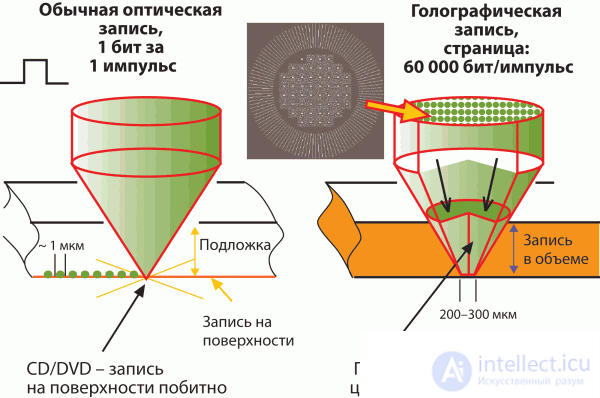
Fig. 2. Comparison of optical and holographic recording methods
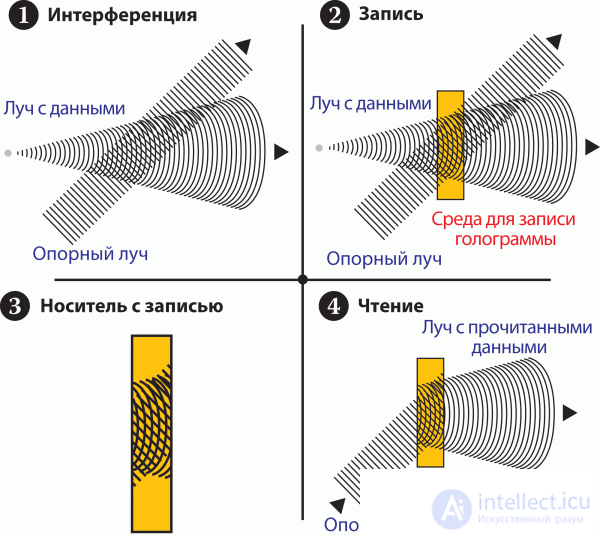
Fig. 3. Principle of holographic recording
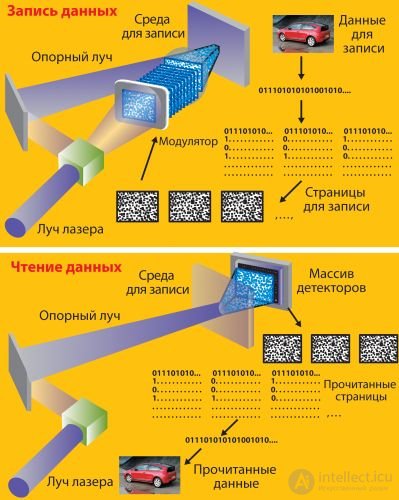
Fig. 4. Diagram of the data recording/reading process using the holographic method
Advantages of holographic memory: high recording density and high reading speed; parallel recording of information (not bit by bit, but in entire pages, Fig. 2); high accuracy of page reproduction; low noise level during data recovery; non-destructive reading; a long data storage life of 30-50 years or more; competitiveness with other optical technologies.
The principle of holographic recording is shown in Fig. 3. A beam from a single laser (not shown in the figure) is split into two beams. One of them is used as the reference beam, while the other illuminates the object (or is passed through a spatial light modulator holding a rectangular data table) - this is the beam that carries the data. When these beams intersect within a certain region of space, they create an interference pattern (Fig. 3, 1). If a transparent photosensitive medium is placed in this region (Fig. 3, 2), the interference pattern (hologram) will be preserved in it (Fig. 3, 3) - the data will have been recorded. To read the data, it is enough to illuminate the medium with the reference beam; after their interaction, a beam bearing an exact copy of the recorded data is obtained. Unlike an ordinary photograph, the information is contained throughout a large volume of the medium. If this volume is divided, say, into five parts, five identical copies of the recorded information result. This property considerably increases the reliability of data storage. A detailed diagram of a holographic recording/reading device is shown in Fig. 4.
Holographic memory technology is free of the limitations of conventional optical technologies because it uses three-dimensional data recording rather than two-dimensional reading and writing with a laser beam on a flat surface. This means that, in theory, the entire volume of a crystal can be used for recording data in holographic memory, although there are also practical limitations. Even with these limitations, however, a three-dimensional medium is a substantial advantage for holographic memory technology. Its capabilities are sufficient to leave DVD and Blu-ray far behind. Data transfer rates can reach 1 GBps or more. This is far faster than any other optical technology such as CD, DVD, HD DVD, and Blu-ray, where the maximum transfer rate does not exceed 11 MBps.
In theory, holograms can store 1 bit in a volume equal to the cube of the laser wavelength. For example, a red helium-neon laser beam has a wavelength of 632.8 nm, and a perfect holographic memory could store 4 Gb in a cubic millimeter. In reality, the data recording density is much lower, for at least four reasons: the need for error correction, shortcomings and limitations of the optical system, economic factors (as recording density increases, cost grows disproportionately faster), and physical limitations (the finite laser wavelength, the interatomic spacing in the recording crystal, and the imperfection of optical systems).
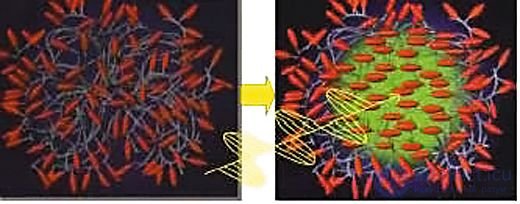
Fig. 5. A photopolymer stores information when illuminated by a laser beam
One of the main challenges in holographic data storage is developing suitable recording materials. Holographic media must meet strict criteria, including a wide dynamic range, high photosensitivity, dimensional stability (no shrinkage), optical transparency, non-destructive readout, resistance to heat and moisture, and low cost. Developers have found a wide variety of materials: phase-shifting materials, photorefractive crystals such as LiNbO3, organic polymers, liquid crystals, structured-surface polymers, and even such exotic media as bacteriorhodopsin embedded in gelatin matrices. The cheapest to produce are photopolymers. When a section of the polymer is illuminated with polarized light, its molecules become oriented and retain that state for a long time (Fig. 5).
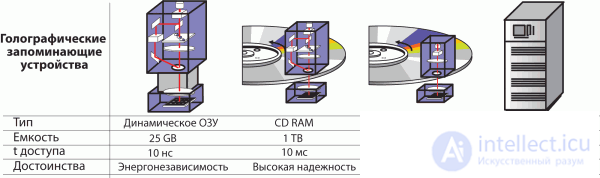
Fig. 6. Application options for holographic memory: holographic storage devices
Possible applications of holographic storage devices are shown in Fig. 6.
Work on developing holographic memory began more than 40 years ago, and today a number of companies - for example, NTT and Optware in Japan, and InPhase Technology in the US - have completed development of holographic discs (Holographic Versatile Disc - HVD) and cards (Holographic Versatile Card - HVC), and are finally beginning to sell their first commercial devices. Let us look at several holographic devices that have already reached the market.
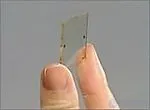
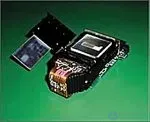
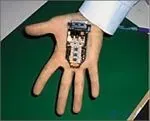
Fig. 7. The Info-MICA holographic card (top), the reading device (middle), and relative size (bottom)
NTT has demonstrated a prototype high-capacity drive based on multilayer thin-film holography technology, together with a device for reading the data (Fig. 7). The capacity of a medium the size of a postage stamp (a hundred layers) is 1 Gb. The new memory card was named Info-MICA (Information-Multilayered Imprinted CArd), since its multilayer structure resembles that of mica rock. Information is recorded as follows. First, digital data is re-encoded into two-dimensional images, which are then converted into a hologram using CGH (Computer Generated Hologram) technology, and finally these holograms are recorded as special structures in the layers of the medium. The layers act as waveguides. When a laser beam is focused on the end of such a waveguide layer, it begins to propagate along it, scattering off the recorded structures. The scattered light forms two-dimensional images in a plane parallel to the waveguide layer. These are captured by CCD sensors and decoded back into the original digital data.
The advantages of the new Info-MICA technology lie in its high recording density, small drive size, low power consumption, the possibility of cheap mass production of the media, the difficulty of unauthorized copying of data from them, and ease of disposal.
At NTT it is believed that, owing to their low cost and small size, Info-MICA cards could replace other ROM devices. They are also being considered as a replacement for paper as an information carrier. These cards will be useful for the mass distribution of games, music, films, and electronic publications, since cloning them is difficult for pirates. Many other applications of the new technology are also envisioned.
The first card readers (costing several hundred dollars) and 1 Gb media ($1-2) have already appeared on the market. The company plans to release a 10 Gb Info-MICA ROM and to develop devices for writing and rewriting the media.
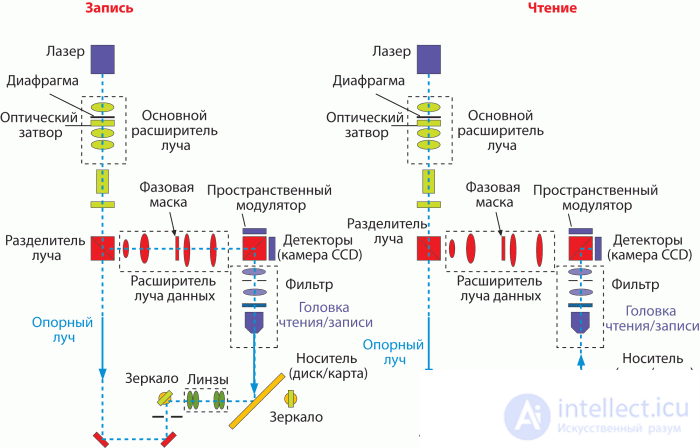
Fig. 8. Optical layout for holographic data recording/reading used by InPhase Technology
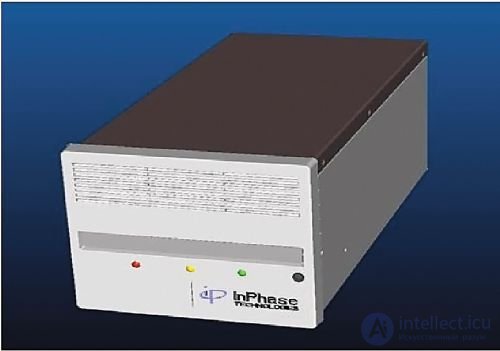
Fig. 9. The InPhase Technology HDS-300R holographic drive
The layout of InPhase's holographic device is shown in Fig. 8. As we can see, a classic scheme with two non-collinear beams is used here.
The first drive, the Tapestry HDS-300R (Fig. 9), is equipped with a built-in radio-frequency identification (RFID) system and uses 300 GB write-once discs intended for professional archiving. It has a SCSI interface with a transfer rate of 20 MBps and an average access time of 250 ms. The laser wavelength is 407 nm, the page volume is 1.4 Mb, and the error probability does not exceed 10-15. The mean time between failures is 100,000 hours. The medium is a 130 mm disc housed in a cartridge measuring 5.25×6×0.25", with a recording shelf life of up to three years and an archival storage life of more than 50 years.
In the near future, a design allowing multiple rewriting is planned. InPhase reports that by 2009 disc capacity will be increased to 1.6 TB. The release of other products is also planned, including a 2 GB medium likewise the size of a postage stamp and a credit-card-sized device with a capacity of 210 GB.
Although Optware is not currently a market leader, its technology could very soon gain wide recognition, since its holographic drives incorporate compatibility with DVD discs, physical disc encoding, and the ability to use holographic memory as an alternative to flash memory in devices such as cell phones and camcorders.
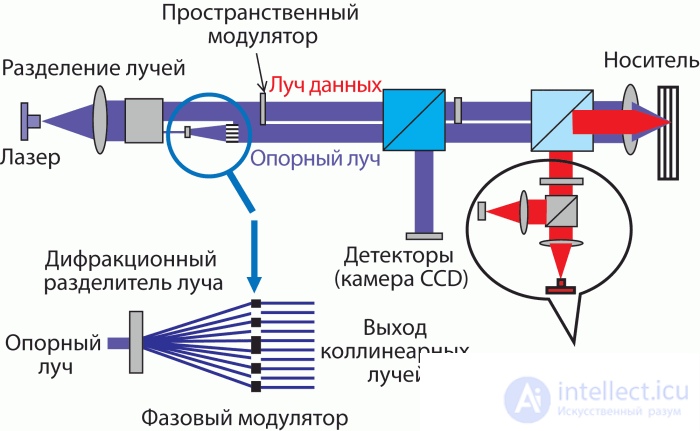
Fig. 10. Diagram of collinear holographic recording/reading (only the reference beams are used during reading)
Whereas other systems require two separate beams - a data beam and a reference beam - in Optware's system the beams are collinear (Fig. 10), which considerably simplifies the design of the read/write system, increases its reliability, and also reduces cost.
This so-called collinear system can use pre-formatted discs with address marks on the surface of the metallized coating, similar to CD and DVD technologies. While a green-blue laser reads and writes the data, a laser operating in the red part of the spectrum ensures precise positioning. The servo positioning system is so similar to a standard DVD system that Optware drives are able to work with discs of both types. Collinear technology is also convenient for physically encoding discs, which will make it possible to significantly enhance copyright protection.
A group of Japanese, European, and American companies, led by Sony Corporation, has shown considerable interest in these solutions. Back in 2004, Sony representatives ordered equipment from Optware to support the collinear technology, intending to assess the prospects for further development of holographic recording and blue-laser disc production.
"Specialists at Sony and other leading Japanese electronics companies are closely studying the features of holographic technology, which is expected to succeed HD DVD and Blu-ray discs," said Yasuhide Kageyama, Optware's marketing and business development manager. "Sony is already prepared to begin building the storage systems of the day after tomorrow, and I should note that our collinear solution has attracted considerable interest."
Optware's first commercial product, the HVD Pro Series 1000 MAGNUM (Fig. 11), will store 200 GB on a disc very similar to, and in fact compatible with, DVD. The company has experimentally tested a holographic drive with a capacity of up to 3.9 TB at a transfer rate of 1 Gbps. Optware promises that today's drives will be able to read discs with capacities of up to 3.9 TB. The company has submitted its HVD system to the European Computer Manufacturers Association for standardization and intends to submit it to the International Standards Organization (ISO) as well.
Meanwhile, both Optware and InPhase have brought their devices to the commercial market. The cost of the drives is approximately $12,000-15,000, and of the holographic discs, $120-150. An archival life of 50 years is guaranteed.
Akaev A. A., Gurevich S. B., Zhumaliev K. M. Input and Storage of Information in Holographic Memory. Bishkek; St. Petersburg, 2002.

Comments