
Lecture
Electric motor symbols in electrical diagrams often depend on the type of motor and its characteristics. Here are the main symbols:
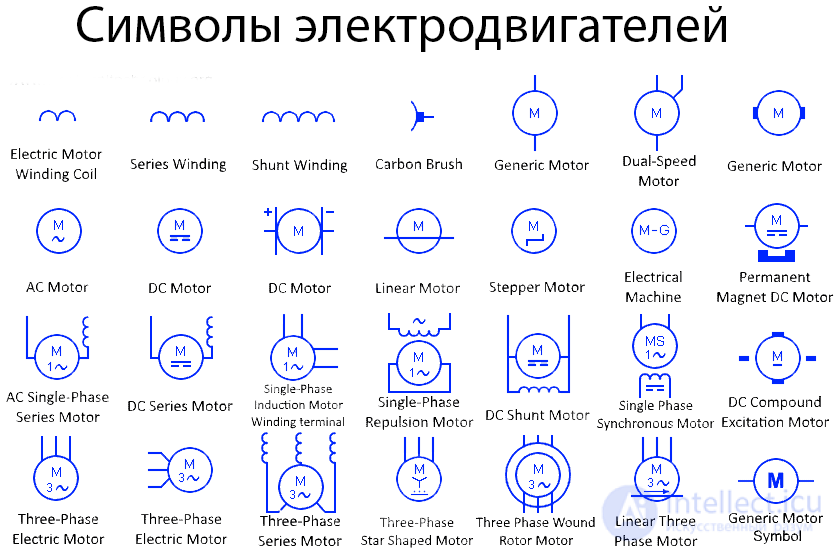
A list of all electric motor symbols in a single image is provided below for reference at the end of this article.
Motor Winding / Coil

This symbol represents the winding or coil of an electric motor. The winding inside the motor provides the necessary magnetic field when energized by electric current.
Series Winding

A field winding connected in series with the motor's armature winding is called a series winding. The current drawn by such a motor is huge, since it is connected in series, and it produces quite a large torque.
Shunt Winding

A field winding that is connected in parallel with the motor's armature winding is called a shunt winding. The resistance of the shunt winding is usually high to prevent a large current from flowing.
Carbon Brush

This is a component inside an electric motor that transfers electric current between the stator (stationary part) and the rotor (rotating part). It is usually made of graphite and can be replaced during maintenance once worn out.
Universal Motor
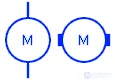
This is the symbol for a general electric motor used in electrical diagrams. The motor converts electrical energy into mechanical energy.
Two-Speed Motor

This symbol represents a two-speed motor. This type of motor has two separate windings for different gear ratios. Each winding provides a different speed and torque at the same point in time.
AC Motor

This symbol represents an AC motor. This type of motor operates only on alternating current. It converts AC electrical energy into mechanical energy.
DC Motor
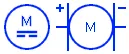
This symbol is used to denote a DC motor in any electrical diagram. It converts DC electrical energy into mechanical energy. It operates only on direct current.
Linear Motor

This is the general symbol used to denote a linear motor. A linear motor has an unrolled stator, which produces a linear force instead of a torque.
Stepper Motor

A stepper motor is a type of brushless DC motor whose full rotation is divided into a number of equal steps. It rotates one step at a time instead of moving continuously. Stepper motors are used for precise positioning using a control signal.
Electric Machine

This type of symbol is used for machines that can function as both a motor and a generator. The motor converts electrical energy into mechanical energy, while the generator does the opposite.
Permanent Magnet DC Motor

This type of brushless DC motor uses a permanent magnet to create the poles instead of field windings. The symbol above represents a DC motor with a magnet icon to indicate the permanent magnet type.
Single-Phase AC Motor

This symbol represents a single-phase AC motor. It operates from a single-phase AC source, and its field winding is connected in series with the armature winding. It is also known as a modified DC motor.
DC Motor

A DC motor whose field winding is connected in series with the armature winding is called a series-wound DC motor and is denoted by this symbol on circuit diagrams.
Single-Phase Asynchronous AC Motor with Exposed Winding Terminals

It is also known as a split-phase asynchronous motor. This type of single-phase AC motor has an accessible separate winding, known as a high-resistance starting winding. The starting winding is used to start the motor.
Single-Phase Repulsion Motor

This is a single-phase AC motor that operates on the principle of repulsion between the magnetic fields of the stator and rotor. The rotor's magnetic field is generated by induced current and can be rotated by rotating the brushes along its axis. This rotating magnetic field is used to change the motor's direction.
Shunt-Wound DC Motor

This is the symbol used for a shunt-wound DC motor, whose field winding is connected in parallel with the armature winding. Both windings are connected to a common DC source.
Single-Phase Synchronous Motor

This symbol represents a single-phase AC synchronous motor. Synchronous motors initially start as asynchronous motors but later reach synchronous speed, which depends only on the frequency of the input supply.
Compound-Wound DC Motor

This type of DC motor has both a series field winding and a shunt (or parallel) field winding. The shunt field winding reinforces the magnetic field produced by the series winding. It combines the advantages of both series-wound and shunt-wound DC motors, namely high starting torque and speed regulation.
3-Phase AC Motor
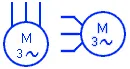
This is the general symbol used for a 3-phase AC motor. A 3-phase AC source creates a rotating magnetic field, which interacts with the magnetic field generated by the rotor, thereby rotating the rotor.
3-Phase Star-Connected Motor

This is a three-phase motor whose windings are connected in a "star" (or "Y") configuration. This symbol also denotes the motor's automatic-start function.
3-Phase Wound-Rotor Motor

This symbol represents a 3-phase wound-rotor motor. This is a type of 3-phase AC motor whose rotor is connected to an external resistance via slip rings. The advantage of a wound-rotor motor is that it produces high starting torque while using a lower current.
3-Phase Linear Motor

This symbol represents a linear motor powered by a 3-phase AC supply. The stator of such a motor is unrolled to produce a linear force instead of a torque.

Comments