
Lecture
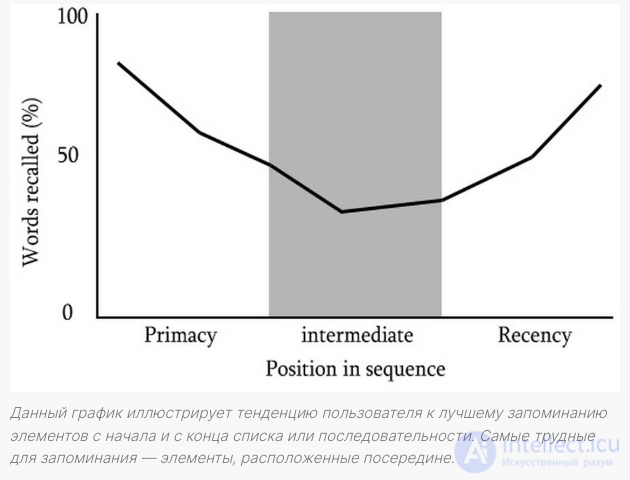
The edge effect (also known as the serial position effect) is a phenomenon showing that material located at the beginning and at the end is remembered best. It shows up both in immediate and in delayed recall. This phenomenon is easy to test on yourself at any time. Right now, read the following list of words: watermelon; pen; refrigerator; doctor; bicycle; magazine; clock; telephone; sofa; house; jacket; guitar. Now close the list and write down the words you remember. Most likely, "watermelon" and "guitar" will be among the words you remember. The words in the middle are most likely to get mixed up, be recalled incorrectly, or not be recalled at all. The edge effect doesn't only work with lists: when trying to recall a day gone by, you'll remember the morning and evening in more detail; the chronological order of scenes from a book is most often confused in the middle, and on an exam, students who have studied all the exam questions dream of getting the first or last ones.
In psychology, the experimental research method was first used specifically in the study of memory. In the late 19th century, the German psychologist Hermann Ebbinghaus decided that in order to understand the laws of "pure" memory, independent of the activity of thought, it was necessary to memorize meaningless syllables. Using this technique, he established that relatively simple events that made a strong impression on a person are often remembered immediately and for a long time. Another finding was that when memorizing a long series, the material located at the ends is reproduced better. Hermann Ebbinghaus gave this phenomenon the name "edge effect."
According to the French psychologist M. Foucault, the edge effect is the result of the interaction of internal inhibition processes that act simultaneously during learning and slow it down.
R. C. Atkinson and R. M. Shiffrin proposed a multi-level model of memory in 1968. They conducted a series of studies on the position effect as well as studies of patients with brain damage. Experiments show that when participants are given a list of words, they tend to remember the first few and last few words and are more likely to forget those in the middle of the list. The tendency to recall earlier words is called the primacy effect; the tendency to recall later words is called the recency effect.
A 1962 study by Bennet Murdock was one of the first to answer the question of why we remember what comes first . He asked participants to learn a list of 10 to 40 words and recall them. Each word was presented for one to two seconds. The primacy effect focuses on information at the top of the list. One of the proposed reasons for the primacy effect is that the initial items presented are stored in long-term memory because they receive more attention. (The first item on the list can be rehearsed on its own; the second must be rehearsed together with the first, the third together with the first and second, and so on.) The primacy effect decreases when items are presented quickly and increases when they are presented slowly. Longer lists have been found to reduce the primacy effect.
Glanzer and Cunitz were pioneers in studying this effect. In 1966, they gave 240 men a list of words to memorize. They asked them to recall some of the words. And, of course, they remembered the words at the beginning of the list and the words at the end of the list the most.
But they decided to go further in studying the recency effect and divided the men into two groups. The first group was the control group. The second group was given a 30-second task after they learned the words. The task was designed to distract the participants before it was time to recall the words. This was meant to interrupt their short-term memory.
The results were as follows: the group that had no distraction task was able to recall the words at the beginning and at the end of the list about equally well.
The group that performed the distraction task was able to recall the words at the beginning of the list very easily. However, they did not recall the words at the end of the list as often.
The words at the end of the list were still remembered better than the words in the middle, but they were not retained as well as the words at the beginning of the list.
The distraction task did indeed interfere with participants' ability to remember the words.
These results led Glanzer and Cunitz to conclude that, although words at the beginning of the list are more likely to be stored in long-term memory, words at the end are more likely to be remembered in short-term memory. The area where short-term memory is stored has limited capacity, so once the distraction task was performed, many of the subsequent words dropped out of the person's memory.
In 1977, William Crano decided to outline a study to build on previous findings about the nature of order effects, particularly primacy and recency, which had been said to be unambiguous and opposite in their predictions. The features tested by Crano were:
The change-of-meaning hypothesis
Items at the beginning of a list determine the topic that participants expect the rest of the list to fit into. The participant changed the meaning of some words on the list to match the expectations he or she had formed. Watkins and Peynircioglu (1984) explain this by saying that participants change the meaning of words that deviate from the established theme in order to reduce the amount of deviation in the information presented.
Inconsistency discounting
Participants ignored information that did not agree with items previously presented to them. In other words, discounting involves treating inconsistent information as less valuable than information that agrees with other information presented (Devine & Ostrom, 1985).
The attention-decrement hypothesis
Information presented first has a greater effect on participants than information presented later, causing a primacy effect even when the information is not contradictory. Steiner and Rain (1989) explain that people pay more attention to information presented at the beginning but gradually pay less attention to information presented to them afterward. The primacy effect arises because participants pay attention to the initial information and ignore information presented later. On the other hand, if participants are in a situation where they must continually pay attention to information, a recency effect may arise instead.
The ratio rule, or lag-recency effect, predicts that after a successful recall, the next item recalled is less likely to come from a distant serial position than from a nearby serial position (Kahana, Howard, Zaromb & Wingfield, 2002). The difference between the serial positions of two items is called the serial position lag. Another factor, called the conditional response probability, is the probability of recalling a particular serial position lag. A graph of serial position lag versus conditional response probability shows that the next item recalled minimizes the absolute lag, with a higher probability for a neighboring item than for a more distant one.
The edge effect strongly influences how each person perceives the world around them. That's why the first impression gained from encountering something is so important, because it is retained and becomes a stereotype. Further communication is then filtered through the lens of that past impression. This is exactly what the saying "You only get one chance to make a first impression" refers to.
The edge effect is widely used in the modern world in many fields. Advertising is a perfect example of applying this phenomenon. Important, key slogans of a company or brand are placed at the beginning or end of a video or audio segment. Such information is guaranteed to imprint itself in the consumer's brain. "Always Coca-Cola" is a model example of ideal advertising. Every person remembers their first teacher, their first crush, their first job, and even the first and last day of the year extremely well. If you try to recall, say, your third paycheck, the information will be hazy, won't come to mind right away, and you won't be sure of its accuracy. All of us have experienced listening to songs and having the last one keep replaying in our memory, impossible to shake off. To get rid of the music stuck in your head, you can apply the edge effect: play a different track and stop it at a point that will bother you the least.
The edge effect is actively used in intelligence work to disguise the topic that actually interests an intelligence officer. To do this, the officer discusses the topic that truly interests them in the middle of the conversation, while talking about safe subjects, such as the weather, at the beginning and end. Also, an intelligence officer may deliberately create the impression of being a slow-witted or tactless person. In that case, the interlocutor remembers the clumsy tactlessness, which pushes the substance of the topics discussed into the background.
The edge effect will not always work. If a topic that is painful for a person and evokes strong emotions is touched on in the middle of a conversation, they will remember it regardless.

Comments