
Lecture
Now that we have approached the problem of motivation, it should be noted that human behavior has two functionally interrelated aspects: the incentive aspect and the regulatory aspect. The mental processes and states we examined earlier primarily ensure the regulation of behavior. As for its stimulation, or the impulses that ensure the activation and direction of behavior, these are connected with motives and motivation.
Motive refers to the impulses to act that are connected with satisfying a subject's need. The term "motive" is also often understood as the reason underlying the choice of actions and deeds, the combination of external and internal conditions that trigger a subject's activity.
The term "motivation" is a broader concept than the term "motive." The word "motivation" is used in modern psychology in two senses: as denoting the system of factors that determine behavior (this includes, in particular, needs, motives, goals, intentions, aspirations, and much more), and as a characteristic of the process that stimulates and sustains behavioral activity at a certain level. Most often in the scientific literature, motivation is regarded as the totality of psychological reasons that explain a person's behavior — its onset, direction, and activity.
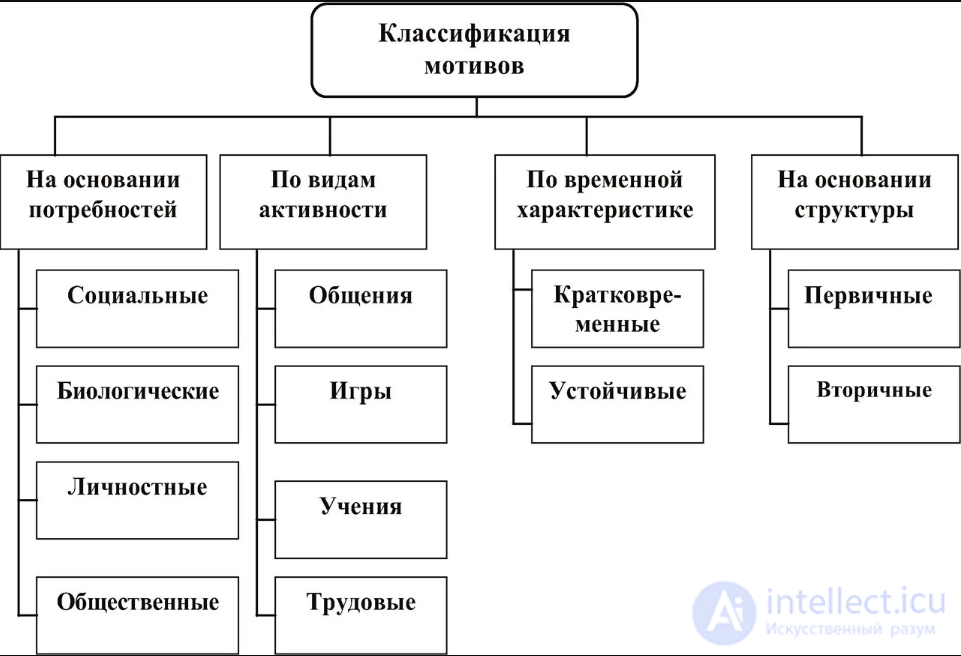
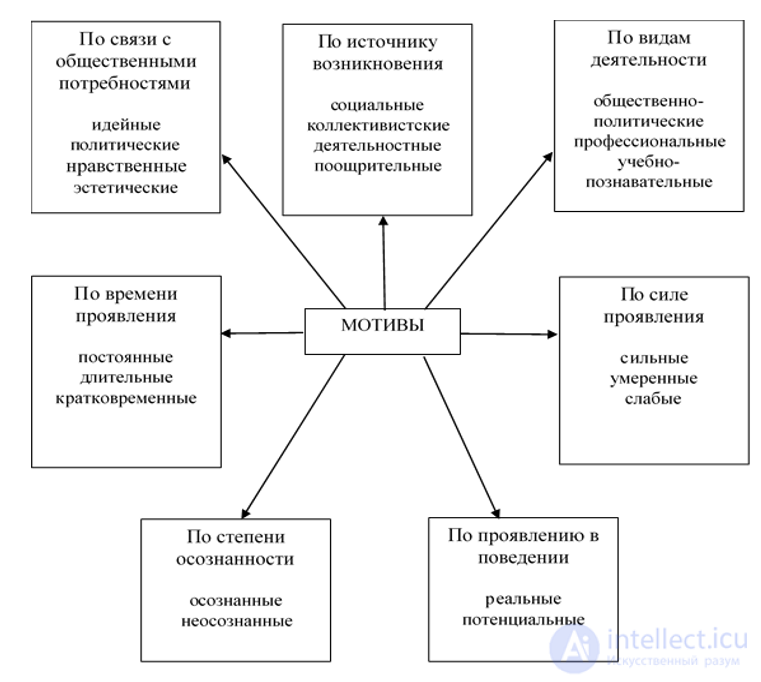
classification of motives
The question of the motivation behind an activity arises every time it becomes necessary to explain the reasons for a person's actions. Moreover, any form of behavior can be explained by both internal and external causes. In the first case, the psychological properties of the subject of the behavior serve as the starting and ending points of the explanation, while in the second, it is the external conditions and circumstances of his activity. In the first case, one speaks of motives, needs, goals, intentions, desires, interests, and so on, while in the second, one speaks of stimuli, arising from the situation at hand. Sometimes all the psychological factors that, as it were, determine a person's behavior from within are called personal dispositions. In that case, one accordingly speaks of dispositional and situational motivation as analogues of the internal and external determination of behavior.
Internal (dispositional) and external (situational) motivation are interconnected. Dispositions can be activated under the influence of a particular situation, and the activation of certain dispositions (motives, needs) leads to a change in how the subject perceives the situation. His attention then becomes selective, and the subject perceives and evaluates the situation with a bias stemming from his current interests and needs. Therefore, any human action is regarded as doubly determined: dispositionally and situationally.
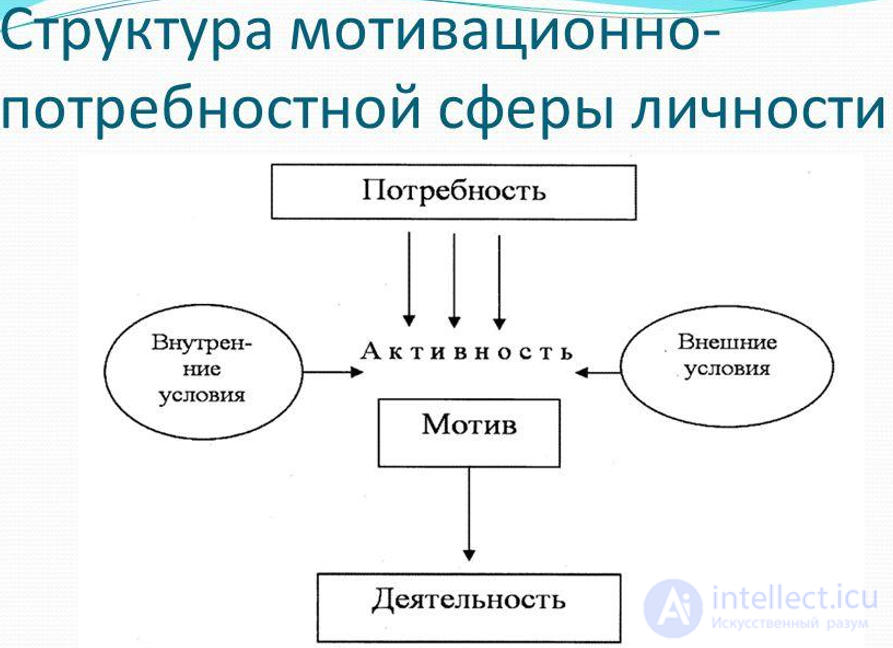
A person's momentary behavior should be viewed not as a reaction to particular internal or external stimuli, but as the result of a continuous interaction between his dispositions and the situation. Thus, human motivation can be represented as a cyclical process of continuous mutual influence and transformation, in which the subject of action and the situation influence one another, and the result of which is the actually observed behavior. From this point of view, motivation is a process of continuous choice and decision-making based on weighing behavioral alternatives.
In turn, a motive, unlike motivation, is something that belongs to the subject of the behavior himself — it is his stable personal trait, prompting him from within to perform certain actions. Motives can be conscious or unconscious. The main role in shaping the orientation of the personality belongs to conscious motives. It should be noted that motives themselves are formed out of a person's needs . A need is a state in which a person requires certain conditions of life and activity, or material objects. A need, like any state of the personality, is always associated with a person's feeling of satisfaction or dissatisfaction. All living beings have needs, and this is what distinguishes living nature from non-living nature. Another distinguishing feature, also related to needs, is the selectivity with which living things respond specifically to what constitutes the object of their needs — that is, to whatever the organism currently lacks. A need activates the organism and stimulates behavior aimed at seeking what is required.
The quantity and quality of the needs possessed by living beings depend on their level of organization, their way and conditions of life, and the place occupied by the given organism on the evolutionary ladder. Plants have the fewest needs, requiring only certain biochemical and physical conditions of existence. Humans have the greatest variety of needs, since besides physical and organic needs, they also possess spiritual and social needs. Social needs are expressed in a person's striving to live in society and interact with other people.
The needs inherent in humans can be divided into basic, derivative, and higher needs.
Basic needs are needs for material conditions and a way of life, for communication, cognition, activity, and rest.
Derivative needs are formed on the basis of the basic ones. These include aesthetic needs and the need for knowledge.
Higher needs include, above all, the need for creativity and creative work.
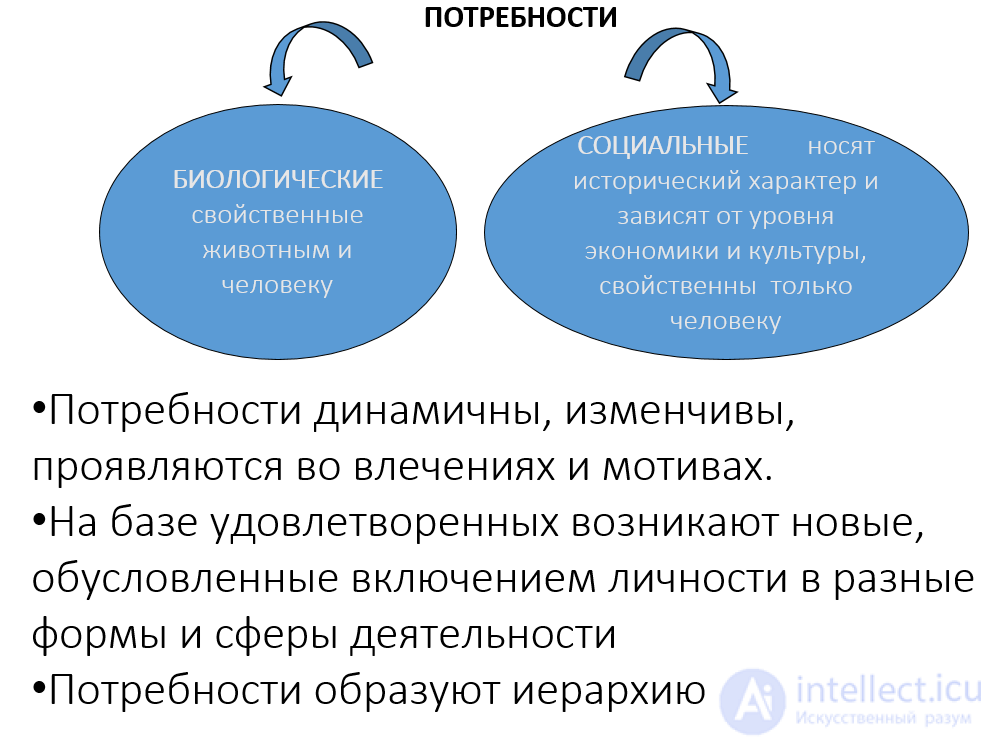
The main characteristics of human needs are strength, frequency of occurrence, and mode of satisfaction. An additional, but quite significant, characteristic, especially when it comes to personality, is the object-related content of the need — that is, the set of objects of material and spiritual culture through which a given need can be satisfied.
The factor that prompts activity is the goal. A goal is a consciously recognized result toward which the action connected with an activity satisfying an activated need is currently directed. If the entire sphere of conscious behavior is imagined as a kind of arena on which the colorful and multifaceted drama of human life unfolds, and it is assumed that the spot most brightly lit at a given moment — the one that should draw the greatest attention of the viewer (the subject himself) — is the goal. Psychologically, a goal is the motivational-incentive content of consciousness that a person perceives as the immediate and nearest expected result of his activity.
The goal is the main object of attention, occupying a certain portion of short-term and working memory; connected with it are the thought process unfolding at that moment and most of the various emotional experiences.
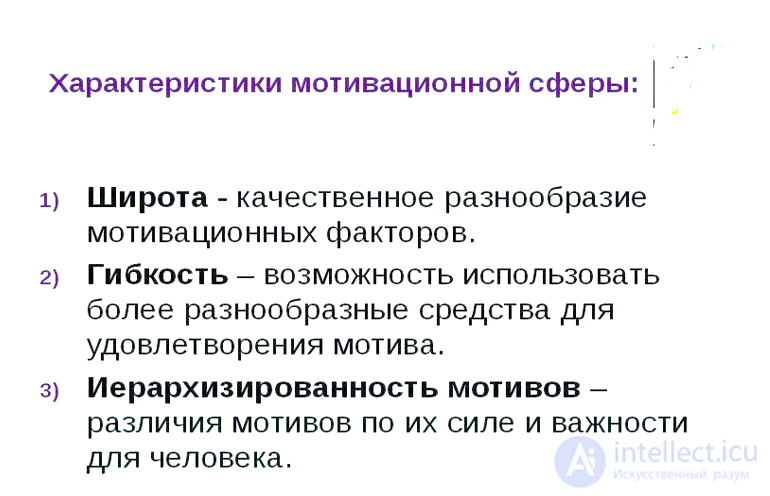
A person's motivational sphere, from the standpoint of its development, can be assessed by the following parameters: breadth, flexibility, and hierarchical organization. By the breadth of the motivational sphere is meant the qualitative diversity of motivational factors — dispositions (motives), needs, and goals. The more varied a person's motives, needs, and goals, the more developed his motivational sphere is.
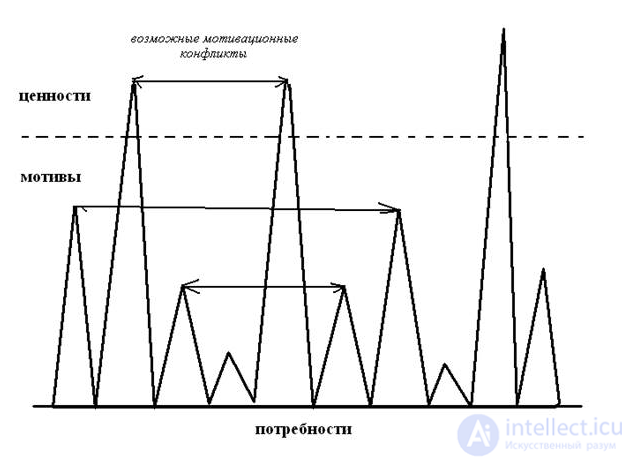
+Flexibility of the motivational sphere is expressed in the fact that, in order to satisfy a motivational impulse of a more general nature (a higher level), a greater variety of lower-level motivational incentives can be used. For example, the motivational sphere of a person who, depending on the circumstances of satisfying one and the same motive, can use a wider variety of means than another person, is more flexible. Say, for one individual, the need for knowledge can be satisfied only through television, radio, and film, while for another, the means of satisfying it also include various books, periodicals, and conversation with other people. The latter person's motivational sphere will, by definition, be more flexible.
characteristics of the motivational sphere
It should be noted that breadth and flexibility characterize a person's motivational sphere in different ways. Breadth is the diversity of the potential range of objects capable of serving a given person as a means of satisfying an activated need, while flexibility is the mobility of the connections existing between different levels of the hierarchical organization of the motivational sphere: between motives and needs, motives and goals, needs and goals.
The next characteristic of the motivational sphere is the hierarchical organization of motives. Some motives and goals are stronger than others and arise more often; others are weaker and are activated less often. The greater the differences in the strength and frequency of activation of motivational formations at a given level, the higher the degree of hierarchical organization of the motivational sphere.
It should be noted that the problem of studying motivation has always attracted researchers' attention. That is why there exist many diverse concepts and theories devoted to motives, motivation, and the orientation of the personality. Let us consider some of them in general terms.
The properties of the personality are formed in the process of a person's active interaction with the surrounding world. The activity of the personality manifests itself in its activity. The source of a personality's activity is its needs. A need is a state of the personality expressing its dependence on specific conditions of existence. The activity of the personality manifests itself in the process of satisfying needs. Human needs are of a social-personal nature; they are formed in the process of upbringing.
The characteristic features of needs are:
a) the specific substantive nature of the need, usually connected with a particular object that a person strives to possess, or with a specific activity that is meant to give the person pleasure (a particular job, a game, etc.);
b) a more or less clear awareness of the given need, accompanied by a characteristic emotional state;
c) the presence, though often only weakly conscious, of an ever-present emotional-volitional state oriented toward finding ways of possibly satisfying the need;
d) the weakening, and sometimes the complete disappearance, of the aforementioned states, and in some cases even their transformation into opposite states, upon satisfaction of a previously felt need;
e) the repeated recurrence of the need, when the underlying want makes itself felt again.
There are many approaches to the classification of needs. One of them divides needs into three groups according to the number of human structures: biological, psychological, and social. In the first structure, biogenic needs arise; in the second, psychogenic needs; in the third, sociogenic needs.
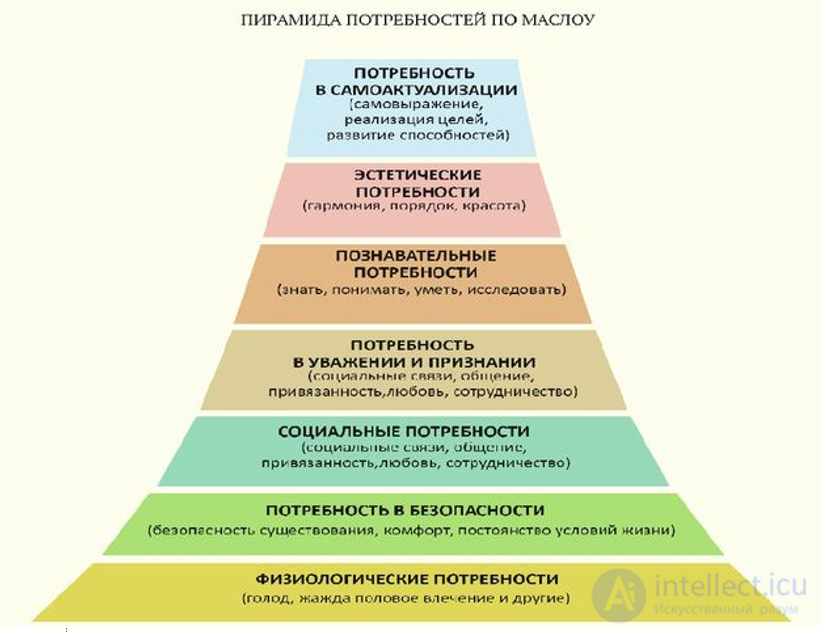
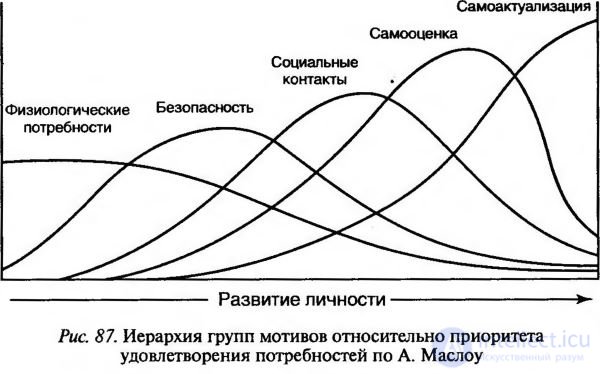
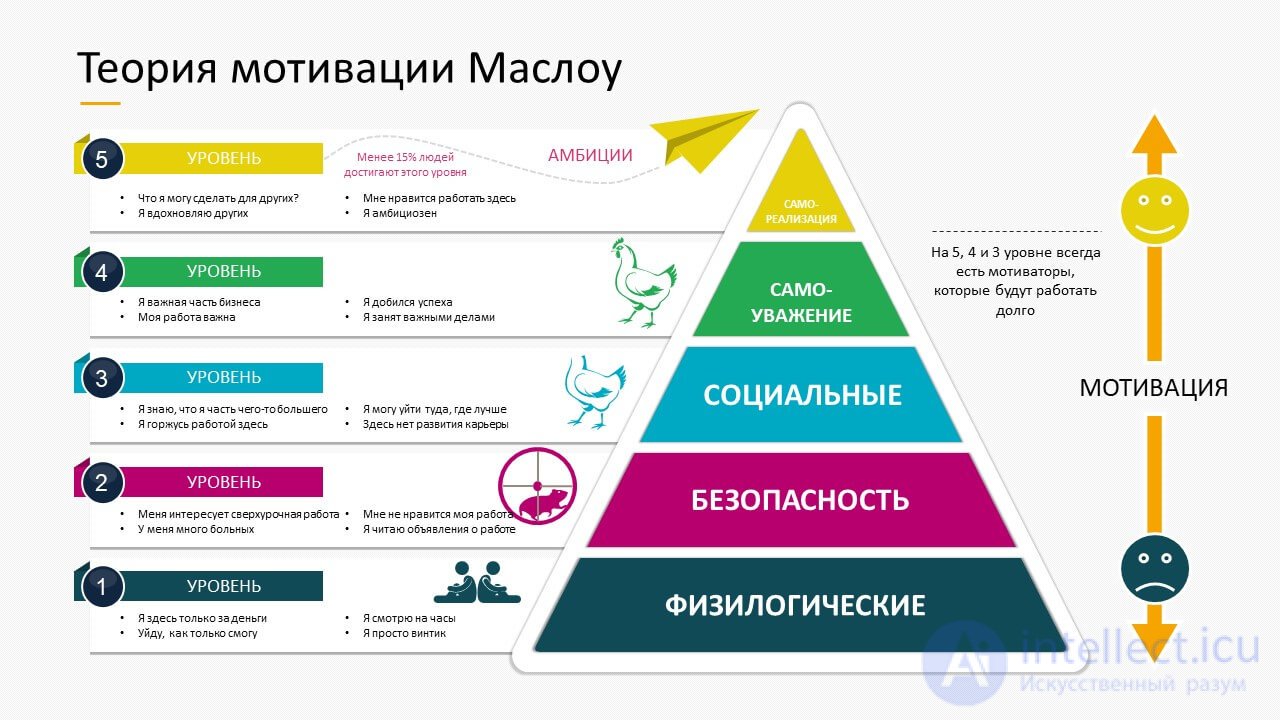
Widely known is the classification of personal human needs proposed by the famous American psychologist Abraham Maslow. The author identifies five levels of a person's personal needs:
physiological needs;
the need for safety and confidence in the future;
the needs for belonging to groups, for affection and involvement, for respect and love;
personal needs: for self-respect, self-expression, independence;
self-actualization needs: for creativity, cultural pursuits, and the achievement of goals.
According to A. Maslow, all needs form a hierarchical structure, which, as a dominant factor, determines human behavior. At the same time, the manifestation of needs follows this pattern: needs of a higher level begin to manifest themselves once the needs of a lower level have been satisfied, at least in part.
Over the course of a person's life, his needs do not remain constant — they develop and change.
Depending on the specific conditions of a person's existence, human needs manifest themselves in the form of a system of motives.
Motives are impulses to act that are connected with satisfying particular needs. Motives differ by the type of need they express, the forms they take, their breadth or narrowness, and the specific content of the activity in which they are realized.
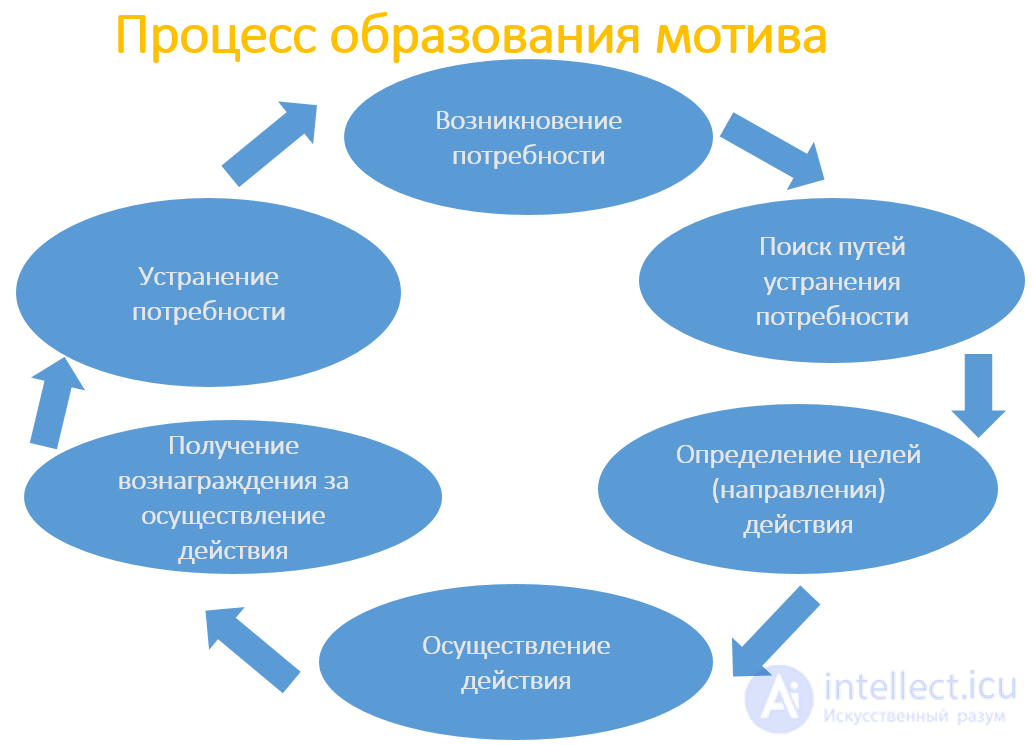
The process by which a motive is formed
Motives can be conscious or unconscious, and they can also be stable (characteristic of a given personality over a long period) or situational (determined by current conditions).
Conscious motives include interests, convictions, and aspirations.
Interests are emotional manifestations of a person's cognitive needs. By their purpose, interests can be divided into direct (caused by the emotional appeal of an object) and mediated (caused by its significance to a particular individual).
Convictions are a system of a personality's conscious needs to act in accordance with its own views, principles, and worldview. Every person, within his system of needs, has a need for self-respect, which prompts him to act in accordance with his views and principles rather than behaving like a weathervane in unstable weather.
Aspirations are motives of behavior in which is expressed a need for conditions of existence that are currently absent but could be created through specially organized activity.
Aspirations can take on various psychological forms:
a dream — an image of what is desired, created by the imagination;
an ideal — an example adopted by the personality as a model;
passion — a motive in which is expressed a need possessing irresistible force.
Interests, convictions, and aspirations are conscious motives. But besides these, there are also unconscious ones, such as set and drive.
+A set is a state of readiness for a particular activity that is not consciously recognized by the personality.
Drive is an impulse to act in which an undifferentiated, insufficiently clearly recognized need is expressed.
When goals are consciously recognized and the results of an activity are anticipated, and the reality of achieving the goal is also recognized, this state is regarded as a personality's outlook. The state of a personality opposite to the state of outlook is called frustration. Frustration arises when, on the way to a goal, a person encounters obstacles that are insurmountable or are perceived as such.
A need, as a motive, gives impetus to activity and stimulates it, but the actual forms and content of the activity are determined by social conditions, requirements, and experience. The content of an activity is determined not by the need as such, but by the goal.
Thus, the motives formed in the course of a person's life and activity, once they become habitual or primary, are reflected in the general impression a person makes on those around him.
For managerial activity, it is very important to understand the system of motivation, life values, and way of life to which people belong. According to Kurt Lewin's field theory, observed behavior is a function of the field in which it manifests itself. The two main components of this field are the personality and the environment. It is far more difficult to change the personality than the external environment, whose role is played by the work setting, the psychological climate in the organization, and other factors that motivate human behavior.

Comments