
Lecture
When we look at a person, we divide them into two components. The first is what we see in front of us — that is, their outer shell. The second is the person's inner qualities, such as character, willpower, self-confidence, and so on. It is this second component that relates directly to the concept of the human psyche.
In modern psychology, the psyche is understood as a response to external stimuli. As a result of this response, a mental image is gradually formed, through which a person's behavioral reactions are controlled. Put simply, the psyche is the instrument through which we come to know the external environment and react to it.
The human psyche is a complex system consisting of many subsystems and elements that interact with one another in a hierarchical order.
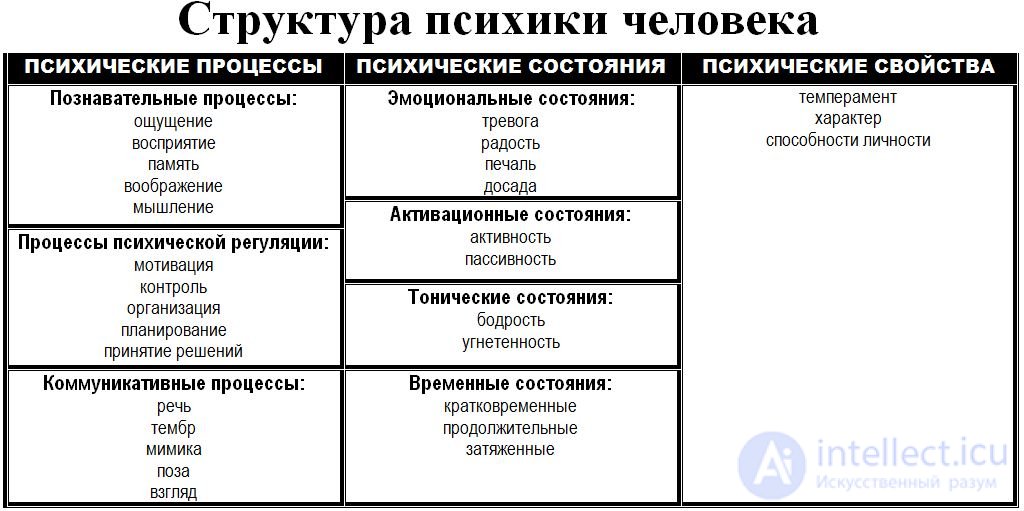
In modern psychology, the structure of the human psyche is represented through three major groups of mental phenomena:
The psyche — is a property of highly organized living matter, consisting in the subject's active reflection of the objective world, in the subject's construction of a picture of that world that cannot be separated from them, and in the regulation of behavior and activity on this basis
1) the psyche is a property of living matter alone; 2) the main feature of the psyche lies in its capacity to reflect the objective world.
2. Mental reflection is: 1) an active reflection of the world; 2) in mental reflection, incoming information undergoes specific processing, and on this basis a mental — that is, subjective in its nature and idealistic (non-material) in its essence — image is created, which, with a certain degree of accuracy, is a copy of the material objects of the real world; 3) it is always a subjective, selective reflection of the objective world, since it always belongs to the subject, does not exist outside the subject, and depends on the subject's individual characteristics.
|
The psyche is a subjective image of the objective world. |
Mental reflection is not a mirror-like, mechanically passive copying of the world (like a mirror or a camera); it is bound up with searching and choosing. In mental reflection, incoming information undergoes specific processing — that is, mental reflection is an active reflection of the world driven by some necessity, by needs; it is a subjective, selective reflection of the objective world, since it always belongs to the subject, does not exist outside the subject, and depends on the subject's individual characteristics. The psyche is a "subjective image of the objective world."
Mental phenomena correspond not to a single neurophysiological process but to organized sets of such processes — that is, the psyche is a systemic quality of the brain, realized through multilevel functional systems of the brain that form in a person over the course of life, as they master the historically established forms of human activity and experience through their own active engagement. Thus, specifically human qualities (consciousness, speech, labor, and so on) — the human psyche is formed in a person only over the course of life, through the assimilation of the culture created by preceding generations. Thus, the human psyche includes at least three components: the external world, nature, and its reflection — the full functioning of the brain — interaction with other people, and the active transmission of human culture and human abilities to new generations.
Mental reflection is a universal property of matter, consisting in the reproduction of the features, properties, and relations of the reflected object.
Mental reflection is characterized by a number of features:
it makes it possible to correctly reflect the surrounding reality, and the correctness of this reflection is confirmed by practice;
the mental image itself is formed in the process of a person's active activity;
mental reflection deepens and improves over time;
it ensures the purposefulness of behavior and activity;
it is refracted through the individuality of the person;
it has an anticipatory character.
The most important function of the psyche is the regulation of behavior and activity, thanks to which a person not only adequately reflects the surrounding objective world but is also able to transform it through purposeful activity. The adequacy of a person's movements and actions to the conditions, tools, and object of activity is possible only if they are correctly reflected by the subject.
III. Properties of the Psyche (of Mental Reflection).
1. Activity. Mental reflection is not mirror-like or passive; it involves the search for and selection of methods of action appropriate to the conditions — it is an active process.
2. Subjectivity. Another feature of mental reflection is its subjectivity: it is mediated by a person's past experience and individuality. This is expressed above all in the fact that although we all see one world, it appears differently to each of us.
3. Objectivity. At the same time, mental reflection makes it possible to construct an "inner picture of the world" that is adequate to objective reality, and here another property of the mental must be noted — its objectivity. Only through correct reflection is it possible for a person to know the surrounding world. The criterion of correctness is practical activity, in which mental reflection is constantly deepened, improved, and developed.
4. Dynamism. The process called mental reflection tends to undergo significant changes over time. The conditions in which an individual acts change, as do the very approaches to transformation. Nor should we forget that each personality possesses vivid individual characteristics, its own desires and needs, and a striving for development.
5. Continuity. Mental reflection is a continuous process.
6. Anticipatory character. Another important feature of mental reflection is its anticipatory character, which makes possible anticipation in a person's activity and behavior, allowing decisions to be made with a certain temporal and spatial lead with respect to the future.
IV. The Structure of the Human Psyche (Forms of Mental Reflection).
Three major groups of mental phenomena are usually distinguished, namely: 1) mental processes, 2) mental states, 3) mental properties.
1. Mental processes – a dynamic reflection of reality in various forms of mental phenomena. A mental process is the course of a mental phenomenon that has a beginning, a development, and an end, manifesting itself as a reaction.
1) Cognitive mental processes: sensation and perception, representation and memory, thinking and imagination;
2) Emotional mental processes: active and passive experiences;
3) Volitional mental processes: decision, execution, volitional effort, and so on.
2. Mental state – a relatively stable level of mental activity, manifested in heightened or lowered activity of the personality.
Mental states are reflexive in nature: they arise under the influence of circumstances, physiological factors, the course of work, time, and verbal influences (praise, reproach, and the like).
The most thoroughly studied are:
1) the general mental state, for example attention, manifested at the level of active concentration or distraction,
2) emotional states, or moods (cheerful, elated, sad, sorrowful, angry, irritable, and so on).
3) the creative state of a person, known as inspiration.
3. A person's mental properties are stable formations that ensure a particular qualitative and quantitative level of activity and behavior typical of that person.
The highest and most stable regulators of mental activity are the properties of the personality.
Each mental property forms gradually through the process of reflection and becomes fixed through practice. It is, consequently, a result of both reflective and practical activity.
V. The Psyche and Features of Brain Structure.
The left hemisphere possesses an enormous store of energy and zest for life. This is a fortunate gift, but on its own it is unproductive. The anxious apprehensions of the right hemisphere evidently have a sobering effect, restoring to the brain not only its creative capacities but also the very ability to function normally rather than drift among the clouds.
Each hemisphere makes its own contribution: the right shapes the image, and the left searches for a verbal expression for it — something is lost in the process (recall Tyutchev's line: "A thought once spoken is a lie") and something is gained, as the interaction of the hemispheres transforms the "truth of nature" into the "truth of art" (Balzac).
A person's mental activity, their psyche, functions simultaneously on three interconnected levels: unconscious, subconscious, and conscious.
1. The unconscious level of mental activity represents innate instinctive-reflexive activity. Behavioral acts at the unconscious level are regulated by unconscious biological mechanisms. They are aimed at satisfying biological needs — self-preservation and reproduction.
2. The subconscious level of mental activity comprises the generalized behavioral stereotypes automated through a given person's experience: skills, abilities, habits, and intuition. This is the behavioral core of a person, formed at the early stages of their development. This also includes the impulsive-emotional sphere, structurally localized in the limbic (subcortical) system of the brain.
1) Automatisms of the subconscious level are complexes of stereotyped actions in typical situations, dynamic stereotypes — chained sequences of reactions in familiar settings (habitual operation of equipment, performance of habitual duties, the manner of handling familiar objects, verbal and facial-expression clichés)
2) Various complexes — unfulfilled desires, suppressed aspirations, various fears and anxieties, ambitions and exaggerated claims
3) The highest sphere of the subconscious – intuition (sometimes even called the superconscious) – this is the process of instantaneous insights, a comprehensive grasp of a problem situation, the emergence of unexpected solutions, and an unconscious anticipation of the course of events based on the spontaneous generalization of prior experience.
3. The superconscious – the censorship, the norms of society assimilated by a person, a person's capacity for social cooperation and moral self-control. A person's entire spiritual sphere is the sphere of the superconscious, standing in opposition to a person's egoistic narrowness — the sphere of their ideological elevation and moral perfection.
4. The sphere of consciousness – the sphere of knowledge and cultural socialization of the personality. It largely controls and inhibits instinctive drives and habits.
Thus, a person's mental self-organization and their adaptation to the external environment are carried out by three types of relatively autonomous behavioral programs:
1) evolutionarily formed unconscious-instinctive programs;
2) subconscious subjective-emotional programs;
3) conscious, voluntary, logico-verbal programs.
Conscious behavioral programs for the socialized

Comments