
Lecture
Anxiety is an individual psychological trait manifested in a person's tendency to frequently experience intense anxiety over relatively minor reasons. It is regarded either as a personality formation, or as a temperament trait linked to weakness of the nervous processes, or as both at once.
Anxiety is an integral part of human experience that accompanies us throughout our lives. It can arise in response to various situations and stimuli, whether exams, public speaking, financial difficulties, or even everyday concerns. However, when anxiety becomes excessive, turning into a state of chronic anxiety, it can seriously affect a person's quality of life and physical health. In this article we will examine the nature of anxiety, its physiological and psychological aspects, as well as methods of managing and treating it, in order to help you better understand this complex aspect of human psychology and learn to cope with anxiety in everyday life.
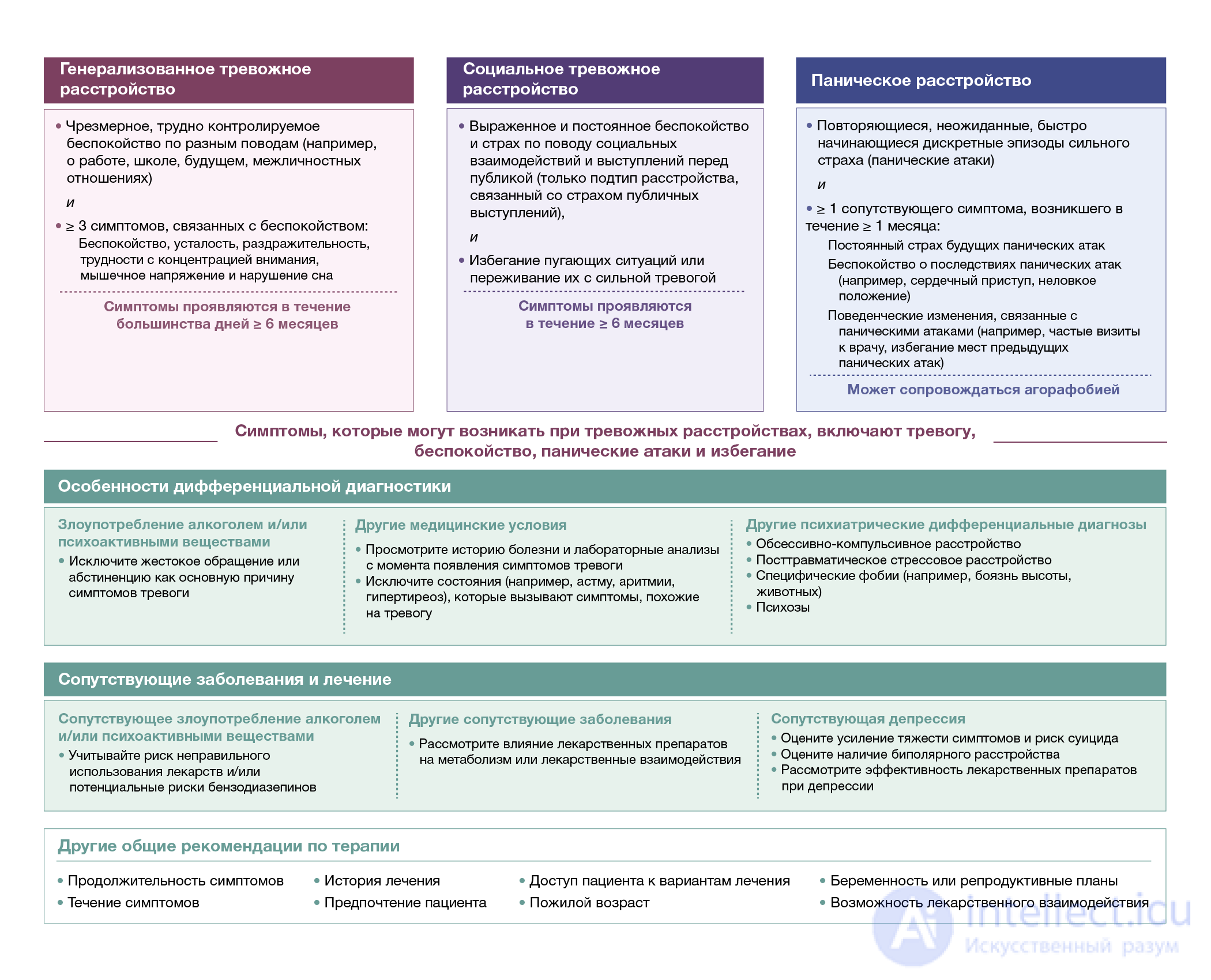
Anxiety disorders are a group of mental disorders characterized by pronounced, unwarranted anxiety or fear . Anxiety refers to a feeling of unease about upcoming events, while fear is a reaction to something happening in real time. Anxiety disorders are often accompanied by symptoms such as rapid heartbeat, difficulty breathing, dizziness, and so on.
The cause of anxiety disorders is made up of external factors and genetic predisposition.
Anxiety disorders are among the most common mental disorders. Despite the existence of effective treatment, many people suffering from anxiety disorders do not receive an adequate diagnosis or treatment. These disorders often become chronic and lead to partial or complete disability; people who suffer from them bear great emotional and financial losses .
Anxiety disorders often occur together with other mental disorders, such as depressive disorders, dissociative disorders, and disorders caused by the use of psychoactive substances.
Anxiety can manifest as prolonged, drawn-out, daily symptoms that significantly reduce quality of life (in the case of generalized anxiety disorder), or as short bursts with panic attacks. The frequency, number, and intensity of symptoms vary from person to person .

Anxiety can lead to mental or psychological problems .
Behavioral manifestations of anxiety include avoiding situations that trigger anxiety or negative memories, as well as changes in sleep patterns, changes in habits, increased or decreased food intake, and increased motor tension (such as tapping a foot)
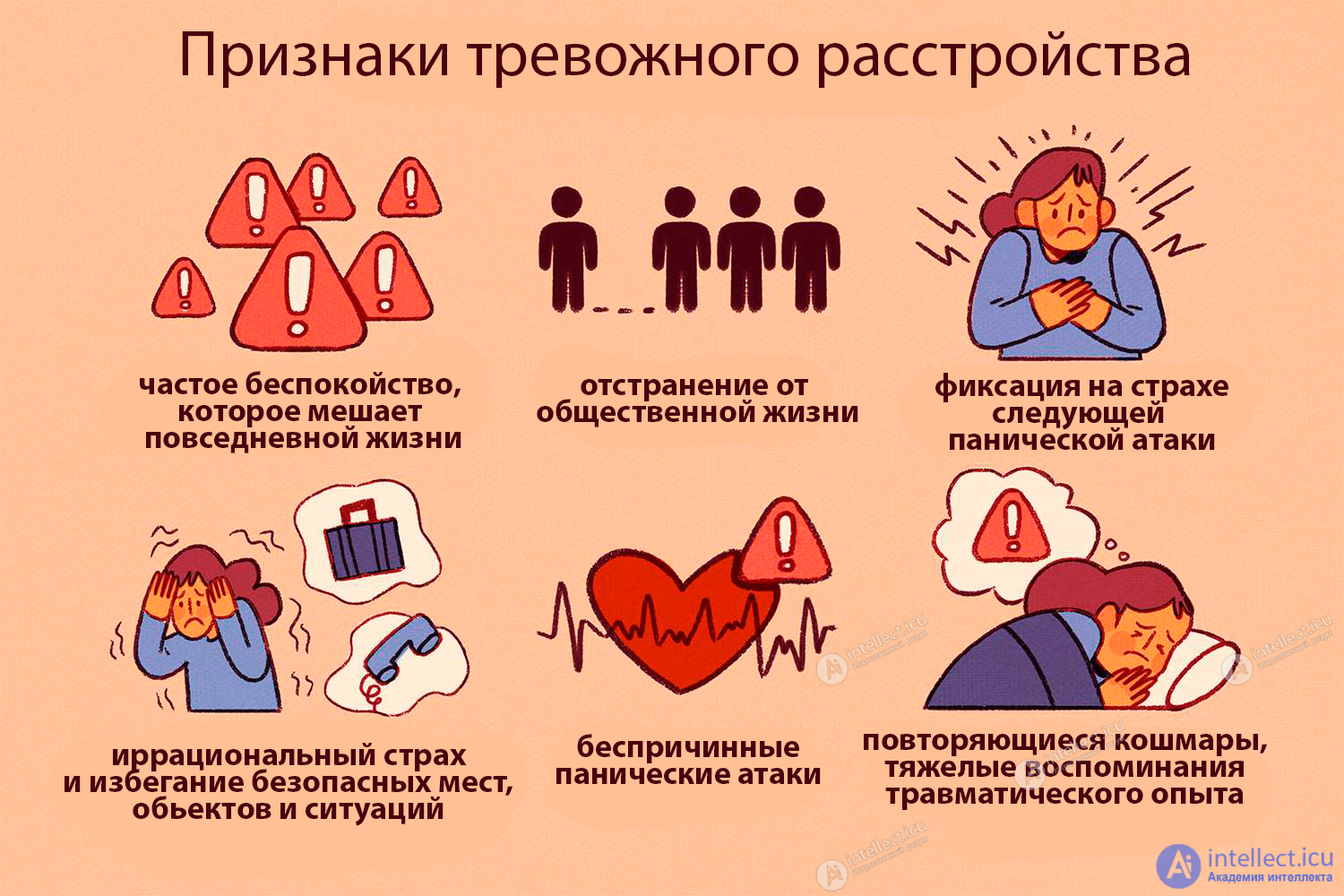
Emotional manifestations of anxiety include "a feeling of fear, difficulty concentrating, tension or nervousness, anticipation of the worst, irritability, restlessness, watching (and waiting) for signs (and events) of danger, and a feeling that the mind has gone blank" , as well as "nightmares, intrusive thoughts, déjà vu, and a feeling of being trapped in one's own mind"
From a cognitive standpoint, anxiety manifests as thoughts about perceived dangers, such as fear of death. "It starts to seem that chest pain is a fatal heart attack, or that shooting pains in the head are the result of a tumor or aneurysm. Thoughts of death bring a strong sense of fear, you think about death more often than usual, or cannot get it out of your head at all"
Anxiety was first described by Sigmund Freud . From Freud's point of view, anxiety is a function of the "Ego" and warns the "Ego" of impending danger or threat, helping the personality respond in such situations (situations of danger, threat) in a safe, adaptive way . Freud defined anxiety as an unpleasant emotional experience that serves as a signal of anticipated danger. The content of anxiety is the experience of uncertainty and a feeling of helplessness. Anxiety is characterized by three main features: 1) a specific feeling of unpleasantness; 2) corresponding somatic reactions, primarily an increased heart rate; 3) awareness
Sigmund Freud identified three types of anxiety :
By area of occurrence, a distinction is made between :
By appropriateness to the situation, a distinction is made between :
There is still no consensus on the causes of anxiety in people. The prevailing view is that anxiety has a partly innate, partly acquired nature. Having a certain genetically determined predisposition to anxiety, a person, as a result of improper actions by parents and educators, internal conflicts (primarily of a self-esteem-related nature), and other socially conditioned causes, gradually acquires it over time .
Neo-Freudians consider the main cause of anxiety to be an unfavorable early relational experience, which leads to the development of basal anxiety (according to Karen Horney). Such anxiety accompanies a person throughout life, significantly influencing their relationships with other people (according to Harry Stack Sullivan) .
Behaviorists consider anxiety to be the result of learning. In their view, it is a learned reaction to threatening situations, which is subsequently transferred to other circumstances associated with them .
In mammals and humans who have experienced negative influences during early development, an elevated level of anxiety is "programmed" . The "programming" of increased anxiety by early influences arose in the course of evolution, likely under pressure from predators .
Inadequate anxiety is an indicator of impaired personal development and, in turn, has a negative effect on it. The absence of anxiety in cases of real distress, arising as a result of the operation of defense mechanisms, also has a negative effect on development .
Anxiety can be a precursor to neurosis, or a symptom of it, as well as a means and mechanism of its development .
Anxiety is one of the main components of post-traumatic stress disorder (PTSD) .
Anxiety is also associated with mental disorders such as phobias, hypochondria, hysteria, obsessive-compulsive disorder, and others .
There are several types of anxiety disorders
In modern psychoanalysis, three main types of fear are distinguished :
According to psychoanalytic views on the nature of fear, every person transforms diffuse fear into targeted and specific fear.
The psychodynamic model, with regard to irrational fears (phobias), holds that "an outwardly harmless stimulus becomes associated with another, frightening one, which, having been repressed into the unconscious, remains unrecognized but intensifies the reaction to the outwardly neutral stimulus" .
A triggering situation can activate an existing internal conflict, resulting in the emergence of fear. In this case there are two scenarios for processing this fear: one scenario leads to anxiety neurosis, the other to phobic neurosis. If the defense mechanisms fail, a panic attack occurs and anxiety neurosis may develop. Also, if the defense mechanisms fail, the fear may be displaced onto a neutral object, which leads to the formation of a phobia. Hypochondriacal fears arise when fear is displaced onto internal objects (organs).
Unlike classical psychoanalysis, proponents of social psychoanalysis speak of two causes of a sharp rise in anxiety — perceiving the surrounding world as dangerous and perceiving oneself as unable to withstand this danger .
According to the behavioral model, a neutral stimulus paired with a frightening one begins to evoke a fear response through the mechanism of classical conditioning; then, through the mechanisms of stimulus generalization and response generalization, the range of situations triggering anxiety can expand.
Thus, phobias develop on the basis of the mechanism of classical conditioning, that is, as a result of a traumatic event.
According to the predisposition model, a person has a certain predisposition, developed in the course of evolution, to learn a fear response toward objects that caused fear in their ancestors. However, in most cases such fears are weakly expressed, and social phobia develops only in the case of behavioral inhibition, in which the behavior necessary to cope with danger is suppressed .
According to this model, biological, psychological, and social factors underlie the formation of fears, phobias, and anxiety states.
Studies of the biological factors of panic disorders postulate the contribution of various neurotransmitter systems (GABAergic, serotonergic, and others) to the emergence and development of these disorders.
Psychological factors include heightened sensitivity and a tendency to interpret various stimuli as threatening, as well as selective attention to bodily sensations. If a single panic attack progresses into panic disorder, then anxious anticipation of a repeat attack is added to the above factors, along with the emergence of a "vicious circle of fear": physiological sensation — selective attention — negative interpretation — anxiety — intensification of physiological sensations due to the addition of physiological correlates of anxiety — catastrophic interpretation — panic. Stressful life events are generally classified as social factors.
A. B. Kholmogorova and N. G. Garanyan proposed a multifactorial model of anxiety disorders, according to which the emergence and development of anxiety disorders are promoted by increasing life stress, the cult of strength and well-being, and a high level of competition. Also noted is the influence of family interaction (placing high demands on children, an elevated level of criticism, prohibition of retaliatory aggression) and features of nervous system functioning (biological vulnerability).
Thus
Anxiety is a normal and integral part of human experience. Within reasonable limits of intensity, it can be useful, mobilizing us to act in stressful situations.
However, excessive anxiety, especially in the form of chronic anxiety, can have a serious negative effect on mental and physical health. It is associated with a number of mental and physiological problems, including depression, insomnia, heart problems, and even immune disorders.
Understanding the nature of anxiety and the factors that intensify it plays an important role in managing it. Recognizing one's own anxious reactions and their sources can help develop strategies for overcoming anxiety.
There are many methods for managing and treating anxiety, including therapy, meditation, physical activity, and lifestyle changes. The effective approach may vary from person to person, and it is important to find the one that works for you.
Seeking help from a specialist, such as a psychotherapist or psychiatrist, can be a key step in managing anxiety, especially if it starts to seriously interfere with your life.
Overall, anxiety is a natural state, but it is important to learn to manage it so that it does not prevent us from living a full and happy life. By being informed about anxiety and the methods of managing it, we can achieve better mental and physical well-being.

Comments