
Lecture
Classical conditioning (also known as Pavlovian or respondent conditioning) is a learning procedure that forms conditioned reflex responses, in which an unconditioned stimulus (for example, food) is paired with a neutral stimulus (for example, the sound of a bell) until the neutral stimulus becomes a conditioned stimulus, that is, until it begins to elicit a conditioned response (for example, salivation) identical to the response produced by the unconditioned stimulus.
The process of conditioned-reflex learning (classical conditioning) was first described by I. P. Pavlov, who experimentally demonstrated how a neutral stimulus can come to elicit the same response as an unconditioned stimulus, a response to which is innate. Thus, the process of classical conditioning underlies learning throughout life and explains certain aspects of human behavior.
The most famous and most detailed early work on classical conditioning was carried out by Ivan Petrovich Pavlov in his experiments with dogs and published in 1897; according to some sources, Edwin Twitmyer published similar findings at around the same time. Together with operant conditioning, respondent (classical) conditioning became the foundation of behaviorism, a school of psychology that dominated in the mid-20th century and still plays an important role in the practice of psychological therapy and the study of animal behavior.
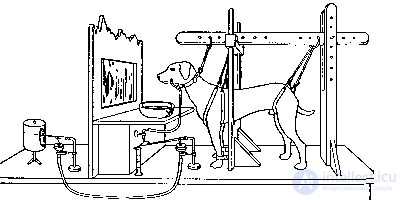
Back in the 1890s, Pavlov began his research into the physiology of digestion. In "sham feeding" experiments, a dog's esophagus was surgically severed so that its ends were brought out through the neck and attached to the skin (esophagostomy). This made it possible to measure the amount of saliva and gastric juice secreted in response to food entering the dog's mouth.
Pavlov noticed that his dogs began to salivate before food actually reached their mouths — for example, in the presence of the technician who usually fed them. Pavlov called this anticipatory salivation "psychic secretion." Initially, Pavlov hypothesized that the dogs could hear the sounds associated with the preparation of feeding. So he began conducting experiments with sounds. The first such sound was the tick of a metronome. At first Pavlov let the dog hear the metronome as a stimulus on its own — it did not elicit salivation. Pavlov called such a stimulus, one that does not evoke a reflex response, an "indifferent stimulus."
Then he presented the conditioned stimulus (for example, the sound of the metronome) and gave the dog food; after several repetitions the dogs began to salivate in response to the conditioned stimulus (the sound of the metronome) alone. Pavlov concluded that if a particular stimulus was present in the dog's environment when it was given food, that stimulus could become associated with the food and come to elicit salivation on its own.
Respondent conditioning should not be confused with respondent behavior, which is the behavioral component of an unconditioned reflex. Respondent behavior is elicited only by a preceding stimulus (an antecedent).
In Pavlov's experiments, the unconditioned stimulus (US) was food for the dogs, because its effect did not depend on prior experience. The sound of the metronome was the neutral stimulus, since exposure to it produced no salivation. After the conditioning procedure, the sound of the metronome became the conditioned stimulus, since it came to elicit salivation in the dog[10]. Accordingly, the dog's salivation became the conditioned response to the conditioned stimulus. Learning occurs more quickly when the interval between the neutral stimulus and the unconditioned stimulus is relatively short.
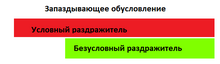
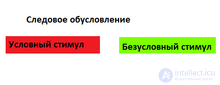
There are two main types of conditioning. The first is when the neutral stimulus is presented before the unconditioned stimulus or simultaneously with it (forward conditioning), 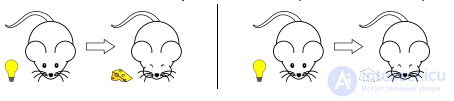
and the second, when the unconditioned stimulus is presented first, followed by the neutral stimulus (backward conditioning). Learning generally occurs faster in the first case, since if the neutral stimulus is presented after the unconditioned stimulus, it may inhibit the process, presumably because its occurrence signals that the unconditioned stimulus has ended or will not occur at all[11][12].
Within the first case, a distinction is made between:
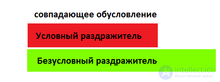
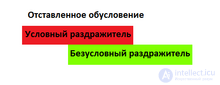

Second-order, third-order, and further conditioning requires a two-stage procedure. First, an initial neutral stimulus becomes conditioned through the conditioning procedure. Then a second neutral stimulus is paired with the already-established conditioned stimulus. In this way, the second neutral stimulus also becomes conditioned and will elicit the conditioned response. For example, we pair the sound of a bell with the presentation of food. The sound of the bell begins to elicit salivation.
Now we pair the sound of the bell with light. If, after several paired presentations of the light and the bell, the light begins to elicit salivation, then second-order conditioning has occurred. Thus, the sound of the bell is the first conditioned stimulus, and the light is the second conditioned stimulus. The length of the chain of motor conditioned reflexes that can be formed in an animal reflects the level of sophistication of its central nervous system functions. In monkeys, a conditioned reflex of the twentieth order can be obtained, while in fish only a second-order reflex is possible[16].

Comments