
Lecture
Psychological science is currently undergoing rapid development, driven by the diversity of theoretical and practical tasks it faces. Modern psychology is a highly branched science whose numerous subfields are united by a single subject — the psyche. These subfields are distinguished according to whose psyche is being studied, which aspect of it, and under what conditions. For this reason, the classification of the branches of psychology is conventional, overlapping, and subject to change. The development of the psyche in activity is generally considered the main principle underlying the classification of the branches of psychology.
The differentiation of psychology determines its branching structure. However, despite the differences among its branches, they are united by a single subject of study common to all — the mechanisms of the psyche and the laws governing them.
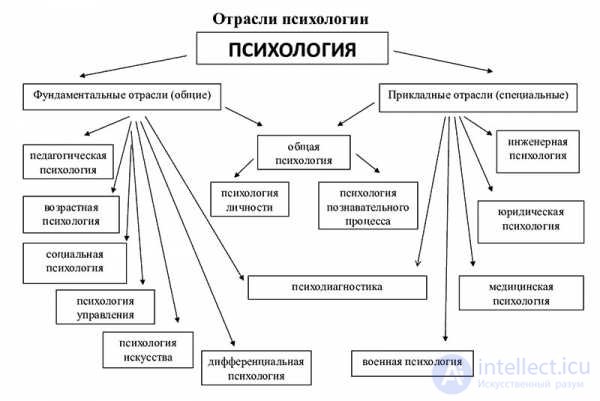
General psychology studies cognitive and practical activity. The findings of research in general psychology form the basic foundation for the development of all branches and subfields of psychological science. As a rule, general psychology provides a scientific account of the general theoretical principles and the most important methods of psychology, characterized by fundamental scientific concepts. These concepts, in turn, are grouped into three main categories: mental processes, mental states, and mental properties, or personality traits. General psychology has a number of subdivisions: the psychology of personality, of thinking, of emotions, women's psychology, and so on, including psychophysics, which studies sensitivity and stands at the headwaters of modern experimental psychology.
The basic concepts of general psychology are:
The interests of this branch of psychological science include:
Applied science-based psychology
The goal of this branch of psychological science is not only to conduct research, but also to apply the knowledge gained in practice.
Several of its subfields can be distinguished, focused on:
This same group also includes legal psychology, which deals with the study of issues related to the exercise of lawful behavior by individuals.
Practical psychology
A special place in the classification of the branches of psychology is given to practical psychology — a system of services aimed at providing psychological assistance to the population. The main goal of this branch is to create psychological and social conditions suitable for humans in all spheres of life.
Its structure includes the following areas and services:
Since the tasks of the main branches of psychology often overlap, and the methods of providing assistance frequently coincide, fairly close connections exist between them, which allow for a more complete study of the subject under investigation in various conditions.
Social psychology comprehends the laws governing the individual and social aspects of the personality's psyche, the interaction between the individual and society, and the formation and development of groups.
Developmental (age) psychology studies the psyche in ontogenesis, that is, its development from conception to death. It has a number of branches: child psychology, adolescent psychology, the psychology of youth, adult psychology, and gerontology. In recent years, the name of this branch has been changed in domestic classification, and it is now called developmental psychology. One of the subfields of developmental psychology is acmeology, which studies a person's attainment of the pinnacle of professional mastery.
Educational psychology takes as its subject the psyche (of the student and the teacher) within the conditions of the educational process (instruction and upbringing).
Occupational (labor) psychology (historically first called psychotechnics) examines the psyche under the conditions of manifold work activity. It includes a good many independent subfields: engineering psychology, ergonomics, space and aviation psychology, management psychology, and organizational, military, political, legal, forensic psychology, as well as the psychology of trade, advertising, sport, creativity, and so on.
Psycholinguistics studies speech as a form of psychic activity that uses language systems as an internal means. Here, too, subfields such as psychosemiotics and psychosemantics can be distinguished.
Psychophysiology studies the physiological foundations of mental activity, while differential psychology studies individual differences in people's psyches. Psychophysiology examines the relationship and interaction between the biological and the psychic, between the physiology of higher nervous activity and psychology. In recent years, psychogenetics has developed as a field.
Medical psychology studies the psyche under conditions of illness, whether mental or physical. It includes such subfields as neuropsychology, pathopsychology, and somatopsychology. In modern science it is known as clinical psychology.
The psychology of abnormal development, or special psychology: the psychology of intellectual disability, the psychology of deafness, and the psychology of blindness.
Within the framework of clinical psychology, which studies the manifestations and causes of various disorders in human psyche and behavior, as well as the mental changes that occur during various illnesses, a more specific field is pathopsychology, which studies deviations in the development of the psyche and the disintegration of the psyche in various forms of brain pathology.
Differential psychology studies all manner of differences among people's psyches — individual, typological, ethnic, and others. In earlier times it was referred to by the term comparative psychology.
Legal psychology studies the psychological features of legal activity (for example, the behavioral characteristics of participants in criminal proceedings, the psychological problems involved in the formation of a criminal's personality, the features of his behavior, and so on).
Political psychology studies the psychological components of people's political life and activity — their moods, opinions, feelings, value orientations, and so on.
The psychology of art studies the properties and states of a person or group of people that determine the creation and perception of artistic values, as well as the influence of these values on the life of both the individual and society as a whole.
Psychometrics (in Russian psychology — mathematical psychology) addresses questions of the mathematical modeling of the psyche, problems of measurement in psychology, and methods for the quantitative analysis of the results of psychological research.
Developmental psychology is a branch of psychology that studies the age-related dynamics of the development of the human psyche, the ontogenesis of mental processes and psychological personality traits. Developmental psychology could be called "age psychology," although that term would not be entirely accurate. In age psychology, development is studied only in connection with a specific chronological age. Developmental psychology studies not only the age stages of human ontogenesis; it also examines various processes of mental development in general. It is therefore more correct to consider age psychology one of the subfields of developmental psychology. Virtually all researchers agree that development is change over time. Developmental psychology answers the questions of what changes and exactly how; as its subject, developmental psychology studies the regular changes that occur in a person over time, along with the related phenomena and characteristics of human life.
Child psychology — the science of a child's mental development — arose as a branch of comparative psychology at the end of the 19th century. The objective conditions for the emergence of child psychology, which took shape by the end of the 19th century, were linked to the intensive development of industry and a new level of social life, which created the need for a modern school. Teachers were interested in the question of how to teach and raise children. Parents and teachers stopped regarding physical punishment as an effective method of upbringing — more democratic families began to appear.
In addition to those already named, there are other branches of psychology that are no less interesting for scientific research and no less significant for practical human activity, including: military psychology, the psychology of advertising, ecological psychology, zoopsychology, sports psychology, space psychology, and others.
Military psychology studies the psychology of the individual serviceman, the psychology of the military collective, and the psychological features of their professional activity in its various forms and types.
Pathopsychology focuses primarily on the features of mental disorders connected with various defects in the structure and functions of the organism, particularly in children.
Parapsychology studies anomalous individual and socio-psychological phenomena.
The psychology of religion studies the psychological factors of religious consciousness.
Ecological psychology studies the psychological aspects of the interaction between humans and the environment.
Zoopsychology (or comparative psychology) reveals the features and patterns of the psyche of animals at various stages in the development of the animal world.
Psychodiagnostics is aimed at developing methods for identifying and measuring the individual psychological characteristics of a person.
Sports psychology is engaged in the study of the psychological features of athletic activity.
Space psychology includes among its concerns the study of the features of the mental processes that occur in the human body under conditions of space flight, including the effects on the psyche of severe physical strain, unusual environmental conditions, and the state of weightlessness. In addition, this branch of psychology examines features of performance capability during flight, in particular when it is necessary to act under conditions of extreme time pressure, and so on.
Virtual psychology. In recent years, virtual psychology has been gaining accelerating momentum, studying psychological virtual realities and building on a specific philosophical foundation.
Each of these branches draws on the theoretical and methodological heritage of general psychology, while also being rich in its own methods, approaches, and techniques.
It should be noted that the applied branches are not isolated from one another. Most often, one branch of psychology draws on the knowledge or methods of other branches. For example, space psychology, which deals with the problems of providing psychological support for human activity in space, is closely linked to engineering psychology, medical psychology, and others.
All the branches of psychological science arose and developed as a result of the expansion of the spheres of human activity and its rationalization and improvement. However, the various branches of psychology cannot be regarded as simply the practical application of psychological laws (obtained through research, for example, in general psychology or social psychology) to this or that case in life. Only in the process of resolving concrete practical problems posed by life and by people's practice can the theoretical problems of psychology be correctly formulated and understood, and general and specific psychological laws be uncovered.
For this reason, a great deal of attention is devoted to theoretical research within each of the branches of psychology named above.
Scientific psychological research can succeed only when it is built not in the abstract, but with practical tasks in mind. In studying the laws of the human psyche, psychology does so not in isolation from various types of human activity, but in connection with them and with a specific purpose: to use the results of research to improve these types of activity.
From everything said above, one can appreciate just how broad the range of practical applications of psychology is. Psychology is one of the fundamental, system-forming scientific disciplines, whose future lies at the intersection of sciences that, at first glance, might seem far removed from it.

Comments