
Lecture
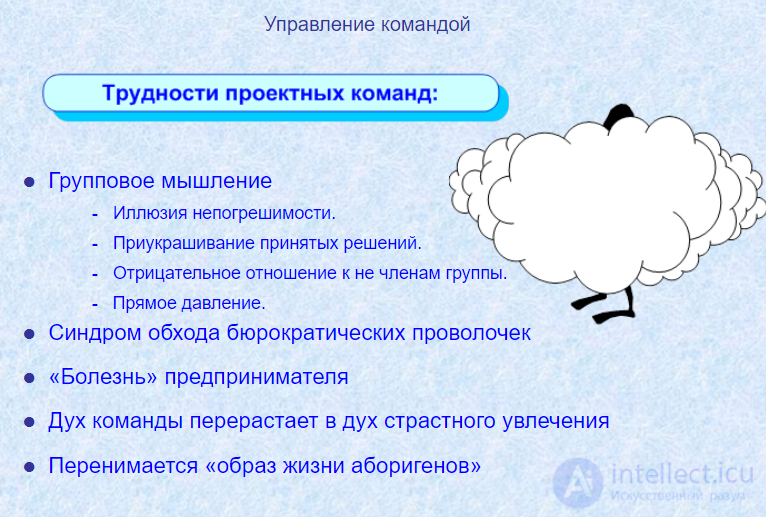
Groupthink is a psychological phenomenon that occurs within a group of people in which conformity or the desire for social harmony leads to incorrect or irrational decision-making. Members of the group try to minimize conflict and reach a unanimous decision without adequately evaluating alternative viewpoints, actively suppressing dissenting opinions and isolating themselves from outside influence.
In such a situation, unanimity among group members unjustifiably comes to be valued more highly than logic and rational thinking. The level of conformity rises significantly, information that is important for the group's activities is interpreted in a biased manner, and unwarranted optimism and a belief in the group's unlimited capabilities are cultivated. Information that does not fit the accepted line is ignored or significantly distorted by group members. As a result, an impression of unanimous decision-making is created. Groupthink can have far-reaching social and political consequences: history offers many examples of tragic mistakes made as a result of such decisions.
This is the phenomenon in which a group's drive to reach agreement and consensus leads to decisions that may be irrational or ineffective. The main characteristics and signs of groupthink include:
Groupthink can manifest in various contexts, such as:
The phenomenon of groupthink was discovered by Irving Janis while studying groups that made political and military decisions. Janis found that, over time, groups with an unchanging membership began to make decisions so unprofessional that even a layperson would not have made such mistakes. After the publication of his book Victims of Groupthink in 1972, and a new edition titled Groupthink: Psychological Studies of Policy Decisions and Fiascoes in 1982, the concept of groupthink came to be widely used to explain many erroneous historical decisions. Among them are Nazi Germany's decision to invade the Soviet Union in 1941; U.S. President Harry Truman's decision to enter the conflict in Korea; U.S. President Lyndon Johnson's decision to begin military action in Vietnam; the Watergate scandal; and U.S. President John F. Kennedy's decision on the intervention at the Bay of Pigs. In 1975, three years after the publication of Janis's first work, an article on the term was included in Webster's encyclopedic dictionary with a meaning similar to doublethink: "conformity to group values and ethics."
The phenomenon of groupthink is characteristic of both non-destructive groups and destructive cults. However, it is precisely in destructive cults that the most brutal and irrational decisions are made: for example, the poisoning of people in the Tokyo subway by members of the Aum Shinrikyo cult, or the call to death and the announcement of the "end of the world" by the White Brotherhood. In non-destructive groups, the consequences of groupthink can, under certain circumstances, later be minimized, which does not happen in destructive cults.
Irving Janis identified 8 symptoms that may indicate groupthink:
Type I: Overestimation of the group's power and morality
1. An illusion of invulnerability, which creates unwarranted optimism and encourages taking high levels of risk
2. An unquestioned belief in the group's high moral standing, and as a result, group members ignoring the consequences of their actions
Type II: Closed-mindedness toward the outside world
3. Ignoring outside signals that might call into question the conclusions reached by the group
4. Negative stereotyping of the group's opponents as weak, biased, malicious, and stupid
Type III: Pressure toward uniformity
5. Self-censorship by each group member of their own ideas that might contradict the group's overall opinion
6. An illusion of unanimity, in which silence is taken as a sign of agreement
7. Direct pressure from the group, accusing any member who questions its decisions of disloyalty
8. "Mindguards" — self-appointed members of the group who shield it from information that contradicts the group's overall opinion
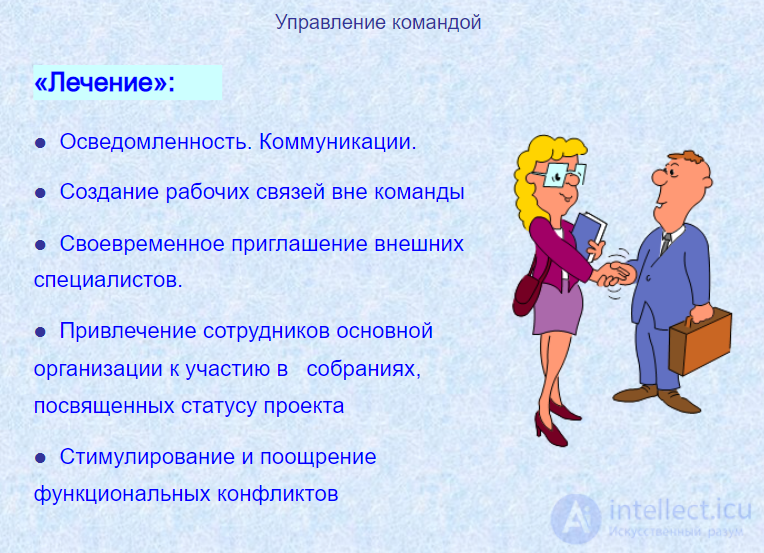
Janis developed 8 practical recommendations for overcoming groupthink:
During the Cuban Missile Crisis, President John F. Kennedy used a whole range of the tools listed above to minimize the effect of "groupthink." In particular, outside experts were invited to meetings for a free exchange of views, and all group members could ask them any questions they had. Group members were encouraged to discuss planned decisions with credible staff from subordinate units. The group was divided into several subgroups in order to reduce group conformity. Kennedy deliberately stayed away from meetings in order to avoid placing excessive pressure through his own opinion. Largely thanks to this approach, a large-scale military confrontation with the Soviet Union was avoided.
Understanding and managing groupthink is important for making more balanced and effective decisions in various group contexts.

Comments