
Lecture
The study of a student's individual memory characteristics can be carried out using various methods and tests. Below are several methods that can be used to study a student's memory:
Rorschach Inkblot Test: This projective test can help study individual characteristics of perception and memory, as well as the student's cognitive processes, through his interpretation of abstract images.
Continuous Word Association Test: The student is given a set of words and must name the first word that comes to mind after each word in the set. This test can help study memory-related associations and abstract thinking.
Wechsler Logical Memory Test: This test measures the ability to remember and reproduce sequences of events and stories. It assesses verbal memory.
Visual memory tests: Tasks in which the student is given sets of images or photographs that must be memorized and reproduced in a specific order.
Auditory memory tests: The student is asked to listen to a sequence of sounds, words, or phrases and reproduce them after listening.
Digit memory test: The student is given sequences of numbers or letters that must be memorized and reproduced.
Spatial memory tests: Tasks in which the student is given maps, plans, or diagrams that must be memorized and reproduced.
Methods for studying memorization strategies: Research into what memorization strategies the student uses, for example mnemonic devices, associations, repetition, and so on.
Memory capacity tests: Studying how much information the student is able to memorize and reproduce at a given moment in time.
Self-reports and questionnaires: Surveys and questionnaires in which the student evaluates his own memorization strategies, the difficulty of memory tasks, and so on.
The main goal is to gather data on the memory characteristics of the observed student and identify:
What are the characteristics of his involuntary and voluntary memorization? Which type of memorization predominates?
What are the characteristics of mechanical and meaningful memorization, recognition, and recall, and their age-related and individual features? (using the observation method).
Determine the student's individual memory type (using a method for determining memory types).
Determine the memorization techniques the student possesses (using the interview method).
Analyze the results and formulate conclusions about the characteristics of the student's memory processes, and determine ways to develop it.
Purpose of the study: to determine short-term memory capacity using Jacobson's method.
Materials and equipment: a form with four sets of number rows, a sheet for recording answers, a pen, and a stopwatch.
Study procedure
The study can be conducted with a single subject or with a group of 8–16 people. It consists of four similar series. In each series the experimenter reads aloud to the subject one of the following sets of number rows.
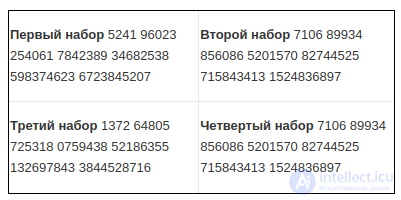
The elements of a row are presented at an interval of 1 second. After reading each row, 2–3 seconds later, on the command "Write!" the subjects reproduce the elements of the row on their answer sheet in the same order in which they were presented by the experimenter. In each series, regardless of the outcome, all seven rows are read. The instructions are the same in all series of the experiment. The interval between series is at least 6–7 minutes.
Instructions to the subject: "I will name several numbers to you. Listen carefully and memorize them. When I finish reading, on my command 'Write!', write down what you remember, in the same order in which the numbers were read. Attention! Let's begin!"
Processing the results
In the course of processing the study results, it is necessary to establish:
the rows reproduced completely and in the same sequence in which they were presented by the experimenter. For convenience they are marked with a "+" sign;
the greatest length of row that the subject reproduced correctly across all series;
the number of correctly reproduced rows longer than the one the subject reproduced correctly in all series;
the memory capacity coefficient, which is calculated using the formula:
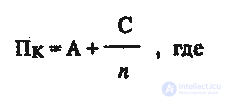
Pk – denotes short-term memory capacity,
A – the greatest length of row that the subject reproduced correctly in all trials;
C – the number of correctly reproduced rows longer than A;
n – the number of trial series, in this case 4.
Analysis of results
To analyze the results, the following rating scale for levels of short-term memorization capacity is used:
|
Rating scale for level of short-term memorization |
|
|
Memory capacity coefficient (Pk) |
Level of short-term memorization |
|
10 |
very high |
|
8–9 |
high |
|
7 |
average |
|
6–5 |
low |
|
3–4 |
very low |
When analyzing the study results, it is important to pay attention to the extreme values of the memorization levels obtained. A memorization score of 10 is usually the result of the subject using logical devices or special mnemonic techniques. In rare cases such memorization represents an unusual phenomenon.
If a very low level of memorization is obtained, the subject's memory study should be repeated after a few days. Normally, a memory capacity of 3–4 is caused by non-acceptance of the instructions.
A low or average level of short-term memorization can be improved through systematic memory training using special mnemonic programs.
Purpose of the study: to determine the influence of a system of auxiliary aids on the memorization of specific concepts.
Materials and equipment: sets of test words for memorization, a study protocol, paper for recording, a pen, a stopwatch.
Study procedure
The study consists of two trials and is conducted with a single subject.
Trial No. 1
Objective of the first trial: to determine the subject's memory capacity when memorizing verbal material that does not involve a predetermined system of connections.
The trial uses the classical method of retaining items in a series. The experimental material consists of 20 unrelated simple words of 4–6 letters each. The subject is tasked with memorizing the words presented and, on command, reproducing them on paper. The experimenter should read the words clearly and quickly, with 2-second pauses. After reading is finished, 10 seconds later the subject is asked to say aloud or write down on paper the words he remembers, in any order. The experimenter notes in the protocol which words were reproduced correctly. Incorrectly reproduced words are recorded in the notes section. The study protocol looks as follows.
|
Subject: Experimenter: |
Date: Time of trial: |
||
|
Trial 1 |
|||
|
Word no. |
Presented |
Reproduced |
Notes |
|
1. 2. 3. ... ... ... 20. |
|
|
|
|
Subject's verbal report on memorizing and reproducing the words |
|||
|
Experimenter's observations |
Instructions to the subject: "I am going to read you a series of words; listen to me carefully and try to memorize them. When I finish reading the words and say 'Speak!', name the words you remember, in the order in which they come to mind. Attention! Begin!"
Words to memorize in Trial 1:
|
1. Fish |
6. Power |
11. Squirrel |
16. Stockings |
|
2. Pound |
7. Fire |
12. Sand |
17. Wolf |
|
3. Bow |
8. Blouse |
13. Teeth |
18. Factory |
|
4. Leg |
9. Bread |
14. Window |
19. Lily |
|
5. Hay |
10. Scoop |
15. Pen |
20. Pie |
At the end of the trial, the subject gives a verbal report on how he tried to memorize the words. This report and the experimenter's observations are recorded in the protocol.
Trial No. 2
Objective of the second trial: to determine the subject's memory capacity when memorizing verbal material with a predetermined system of semantic connections.
The trial uses the paired-word retention method. As in the first trial, the words consist of 4–6 letters. The subject is tasked with listening to pairs of words and memorizing the second word of each pair. The experimenter's reading interval for word pairs is 2 seconds. After the experimenter finishes reading the word pairs to be memorized below, 10 seconds later he again reads the first word of each pair, and the subject is asked to recall the second word of that same pair. In the protocol for the second trial, correctly reproduced words are marked, while errors are recorded in the notes section.
Instructions to the subject: "I will name pairs of words to you. Listen to me carefully and try to memorize the second word of each pair. When I finish reading these pairs, I will read the first words again, and in response to each first word you name, answer with the second word of that same pair that you remember. Attention! Get ready to listen and memorize!"
Words to memorize in Trial 2:
|
1. Chicken – egg |
11. Feather – paper |
|
2. Coffee – cup |
12. Law – decree |
|
3. Table – chair |
13. Gram – measure |
|
4. Earth – grass |
14. Sun – summer |
|
5. Spoon – fork |
15. Tree – leaf |
|
6. Key – lock |
16. Glasses – newspaper |
|
7. Winter – snow |
17. Shoes – footwear |
|
8. Cow – milk |
18. Shelf – book |
|
9. Wine – glass |
19. Head – hair |
|
10. Stove – firewood |
20. Voice – singer |
At the end of the trial, the experimenter records in the protocol the subject's verbal report and his own observations about the characteristics of the word memorization.
Processing the results
For each of the two trials, the number of correctly reproduced words and the number of erroneous reproductions are counted. The data are entered into a summary table:
|
Words reproduced |
Trial 1 |
Trial 2 |
|
correctly incorrectly |
|
|
Analysis of results
When analyzing the memorization results of the two trials and comparing the quantitative indicators, it is important to pay attention to the subject's verbal reports and the experimenter's observations.
If the subject's memorization in the first trial was direct (unmediated), its capacity will fall within the range of 5–9 remembered words. But if he remembered more than 9 words, he used some mnemonic techniques and managed, in such a short interval, to devise a certain system of connections that facilitated recall.
One aspect of the analysis can be a comparison of the accuracy of the reproduced material depending on the order in which the words were presented in the first and second trials. Most subjects remember the beginning, end, or middle of a series better. Taking this into account, it is advisable to draw up recommendations for improving memory.
If several people took part in the study, then after being reminded of the rules of ethical conduct, the participants can be invited to share the techniques they used for memorization, identifying the more and less successful ones. Among such techniques, the most likely are visualizing the relevant object and picturing a situation that forms connections between the words, for example: "a pound of fish tied with a bow."
These techniques can serve precisely as a starting point for drawing up recommendations and mastering mnemonics.
Purpose of the study: to identify the predominant memory capacity for different types of presentation of verbal material.
Materials and equipment: four sets of words expressing specific concepts, one of the sets made on separate cards, four small sheets of paper for recording, a pen, and a stopwatch.
Trial procedure
The predominant memory type is determined by the method of presenting words in different ways. The study consists of four trials. In the first trial, the words to be memorized are presented aurally. In the second — visually, with each word clearly written on a separate card. In the third trial, a motor-auditory form of presentation is used, and in the fourth — a combined form, which combines auditory, visual, and motor perception of the material.
To avoid overloading the memory assessment, it is sufficient to prepare a series of 10 words for each trial.
Trial No. 1
The experimenter reads the words to be memorized to the subject clearly, with an interval of 3 seconds. The reading of the words is preceded by instructions.
Instructions to the subject: "I am going to read words to you. Listen to them carefully and memorize them. After the pause, when I say 'Write!', write down on the sheet of paper what you remember. If everything is clear, get ready to listen and memorize."
Words to memorize in the first trial:
car, apple, pencil, spring, lamp, forest, rain, flower, pot, sparrow.
After a 10-second pause, the command "Write!" is given.
Trial No. 2
The second trial can be conducted after a 5-minute break following the end of the first.
In this trial, the experimenter successively presents the subject with words written on separate cards. The exposure time of each word should correspond to the reading duration of the words in the first trial, and the interval between words remains the same, i.e. 3 seconds.
Instructions to the subject: "I am going to show you cards with words written on them. Read them carefully and memorize them. On the signal 'Write!', write down on the sheet of paper what you remember. If everything is clear, get ready to listen and memorize."
Words to memorize in the second trial:
airplane, pear, pen, winter, candle, field, nut, frying pan, duck, lightning.
After reading the tenth word, the pause before the signal "Write!" lasts 10 seconds.
Trial No. 3
The third trial, like the second, is conducted after a 5-minute break.
The subject is asked to listen to the words and trace them in the air with a pen, to ensure a motor form of perceiving the material. The interval between the words read is 3 seconds, and the reading speed is the same as in the first trial.
Instructions to the subject: "I am going to read words to you. Listen to them carefully and 'trace' them in the air with a pen while memorizing them. On the signal 'Write!' write down on the sheet of paper what you remember. If everything is clear, get ready to listen, 'trace' the words, and memorize."
Words to memorize in the third trial:
steamship, plum, ruler, summer, lantern, river, thunder, berry, plate, goose.
In the third trial, the pause before the signal "Write!" lasts 10 seconds.
Trial No. 4
The fourth trial is conducted 10 minutes after the third. The experimenter's rate of reading the words and the pauses between words remain the same as in the previous trials. To ensure a combined type of perception of the material, the subject is not only read the words, but also asked to write them down on a separate sheet as they are read, and after writing down the tenth and final word, the sheet is turned over and, on the signal "Write!", he can reproduce on the reverse side what he remembers.
Instructions to the subject: "I am going to read words to you. Write them down on this sheet as you hear them, and memorize them. After reading the last word, turn the sheet over and, on my signal 'Write!', write on the reverse side what you remember. Get ready to listen, write, and memorize."
Words to memorize in the fourth trial.
Train, cherry, notebook, autumn, chandelier, glade, thunderstorm, mushroom, cup, chicken.
The signal "Write!" is given, as in all previous cases, after 10 seconds.
Processing the results
The indicator of memory capacity in these trials is the number of correctly reproduced words. The data is entered into a table.
|
MEMORY TYPE |
||||
|
Number of correctly reproduced words |
Auditory |
Visual |
Motor/auditory |
Combined |
|
|
|
|
|
Analysis of results
The predominant type of memory for different types of presentation of verbal material is determined by comparing the number of correctly reproduced words in each of the four trials.
A normal capacity of immediate memory should be considered as memorizing 5–9 words. If in any trial the subject remembered 10 words, this means he used some system of aids, which it is desirable to learn about from his self-report and from observations.
The leading memory type is linked to the corresponding representational system a person uses. Identifying it will help formulate multifaceted recommendations for the subject, especially with regard to memorizing the most significant information.
This method is designed to assess short-term visual memory, its capacity and accuracy. The task consists of showing the subjects, for 20 seconds, a table with twelve two-digit numbers, which they must memorize, and after the table is removed, write them down on a form.
Instructions: "You will be shown a table with numbers. Your task is to memorize as many numbers as possible within 20 seconds. After 20 seconds the table will be removed, and you must write down the numbers you remember."
|
13 |
91 |
47 |
39 |
|
65 |
83 |
19 |
51 |
|
23 |
94 |
71 |
87 |
Short-term visual memory was assessed by the number of correctly reproduced numbers. The norm for an adult is 7 or higher. The method is convenient for group testing.
SERIES A
Material. Word pairs for memorization: doll – play, chicken – egg, scissors – cut, horse – hay, book – learn, butterfly – fly, brush – teeth, drum – pioneer, snow – winter, rooster – crow, ink – notebook, cow – milk, locomotive – ride, pear – compote, lamp – evening.
Trial procedure. The subjects are read the words. They must try to memorize them in pairs. Then the experimenter reads out only the first word of each pair, and the subjects write down the second.
When checking, the word pairs are read slowly. If the second word is written correctly, a "+" sign is placed; if incorrectly or not written at all, a "–" is placed.
SERIES B.
Material. Word pairs for memorization: beetle – armchair, feather – water, glasses – mistake, bell – memory, dove – father, watering can – tram, comb – wind, boots – kettle, lock – mother, match – sheep, grater – sea, sled – factory, fish – fire, poplar – jelly.
Trial procedure. The manner of presentation and checking is the same as in series A. After conducting the trial, the number of remembered words in each series is compared, and the subjects answer the questions: "Why were the words in series B remembered worse? Did you try to establish a connection between the words in series B?"
Processing the results. For each trial, the number of correctly reproduced words and the number of erroneous reproductions must be counted. Enter the results into the table:
|
Logical memory capacity |
Mechanical memory capacity |
||||
|
Number of words in the first series (a1) |
Number of remem- bered words (b1) |
Logical memory coefficient |
Number of words in the second series (a2) |
Number of remem- bered words (b2) |
Mechanical memory coefficient |
|
C1 = |
b1 |
C2 = |
b2 |
||
|
a1 |
a2 |
||||
|
|
|
|
|
|
|
Conclusion. For memorization to be successful, the material must be incorporated into a system that reflects objective connections.
This method, proposed by A.R. Luria, is a variant of mediated memorization; however, it is used not so much to study memory as to analyze the nature of associations. It can be used to study subjects with an education of at least 7 grades.
A pencil and paper are sufficient to conduct the trial. It is necessary to prepare in advance 12–16 words and expressions for memorization. A sample set of words that can be used:
|
|
However, it is not necessary to use standard sets of words; they should be varied slightly, that is, while keeping the main composition of words, two or three of them should be replaced.
The subject is told that his visual memory will be tested, and is asked whether he has noticed how it is easier for him to memorize – "by ear or with the help of sight." Then he is given a sheet of paper and a pencil and told: "You may not write any words or letters on this paper. I will name words and whole expressions that you must memorize. To make it easier to remember, for each word you must draw something that could help you recall the given word. The quality of the drawing does not matter; you can draw anything, in any way, as long as it can remind you of the given word – like tying a knot to remember something. For example, here is the first expression I am giving you, 'Joyful holiday.' What could you draw to later recall 'Joyful holiday'?" It is desirable not to give the patient any further prompts unless absolutely necessary. If he persistently complains that he cannot draw, one can advise: "Draw whatever is easier." If the subject states that he is unable to draw a holiday, one can repeat to him that he should not draw "a joyful holiday" itself, but only something that can remind him of a joyful holiday. If he easily comes up with drawings and tells the experimenter aloud himself what he is choosing and how he plans to recall it, the experimenter silently keeps the protocol. The protocol is kept according to the following scheme.
|
Given expressions |
Patient's drawings and explanations |
Recall after an hour |
|
|
|
|
If the subject does not explain on his own, he should be asked each time: "And how will this help you recall the given word?"
One should not object to or express disapproval of whatever unusual connections the patient may establish, but if his drawings are too crowded with objects, one can ask him to draw a bit faster.
In the course of performing the task, the experimenter varies the order of the words given to the subject: depending on how easily the subject establishes connections, the experimenter offers either easier, more concrete expressions ("delicious dinner," "hard work") or more abstract, difficult ones ("development," "doubt," "justice").
After completing the task (from 12 to 16 words), the sheet with the drawings is set aside, and only at the end of the study (an hour later) is the subject asked to recall the given words from the drawings. Recall should not be requested in order; it is better to ask for one word from the beginning, another from the end. The subject can be asked to write, under the drawing, the word or expression that was given to him. It is essential to ask how he managed to remember the word, and how the drawing helped him.
When interpreting the results of the trial, one should first pay attention to whether the subject is capable of generalized symbolization of the word, i.e. whether he can independently find a generalized mediating image. Normally even a schoolchild with 5 grades of education can find such an image; for example, for the words "hard work" he draws a shovel or a hammer, a person with a load; for the word "doubt" – a fork in the road (which way to go?) or a question mark or a door (should I go through it?). For an intellectually deficient subject such a task is difficult. For the words "hard work" he would like to draw an entire scene of work in a mine, but is afraid he will not manage to do it. For the word "doubt" he cannot come up with anything at all. In mild intellectual deficiency, the subject is able to draw something for concrete concepts: for the word "illness" – a bed; for the words "delicious dinner" – a table, plates. But such words as "justice," "doubt," "development" remain inaccessible for mediation. Such manifestations of concreteness of thinking and difficulties of generalization are observed in oligophrenia and epilepsy. In other cases the subject manages to accomplish the task of generalization, but is quite unable to limit himself to a single image and draws a multitude of them.
Thus, for example, deciding to draw a growing plant for the word "development," he draws not just a single sprout but an entire series of gradually enlarging flowers, numbering 7 or 8. For the word "illness" he draws a bed and a patient on a pillow, and a bottle of medicine, and also a thermometer. Such multiple associations in pictograms indicate circumstantiality of thinking, a tendency toward detail, and are usually observed in epileptics, as well as in some patients who have had encephalitis. It is also noted in passing that these same categories of subjects draw excessively carefully and slowly, returning to a previous drawing and correcting it even when the experimenter has already given them the next word. Such "returns" and the striving for unnecessary thoroughness in drawings also indicate inertia of mental processes.
The second criterion on which the evaluation of this task is based is the criterion of adequacy of associations.
Mentally healthy people usually establish varied but meaningful connections. Thus, for example, for the expression "joyful holiday" they might draw a flag or flowers, or even a glass of wine; for the word "separation" – an envelope or a locomotive, or a hand waving a handkerchief; for the word "development" – a growth chart or a plant, or an infant, or an egg, or an athlete. All these and many other connections are equally good, since they can indeed serve as a means of recalling the given word – they mediate it. But a patient with schizophrenia, for the word "doubt," draws a river and explains it thus: "There's a Glinka romance called 'Doubt,' and Glinka is the same as Neglinka – a river." Such a connection is cumbersome and contrived in character. In another case, to memorize the words "delicious dinner," the patient draws a bathroom, and in his reasoning during the task arrives at this as follows: "A delicious dinner means it smells good... a smell... I'll draw a toilet." In this association one can also see paradoxicality. Another elderly patient, to memorize the words "warm wind," draws lips and explains that this is "a mother's kiss." Despite the vivid emotionality, this association too is not adequate to the task; the drawn lips do not serve the purpose of memorizing the given words.
In some cases the emptiness and lack of content in the associations of schizophrenic patients reach such a degree that for various words they draw only little lines, checkmarks. Such sparseness of images is often observed in individuals of a hysterical disposition, though it is not excluded even in mentally healthy people. Some patients perceive each word given to them for the pictogram through the prism of their personal tastes and aspirations. Thus, for example, a patient says: "'Warm wind' – I simply cannot remember, since we don't have warm wind up north; 'delicious dinner' – for me only sour milk will do for dinner; 'joyful holiday' – I never have holidays; 'justice' – I am treated unjustly," and so on. Such egocentricity of perception is observed in epileptics and some psychopaths. At the same time, even normal people are characterized by a small degree of personal reaction, especially to emotionally significant words.
Therefore, if patients select completely neutral, abstractly universal images for all such emotionally significant words, for example "happiness" – the sun, "sadness" – bad weather, and so on, this can be assessed as a manifestation of a certain emotional detachment, introversion, or even coldness.
The final criterion by which the results of the pictogram method are evaluated is the criterion of memorization. The method itself was created for studying memory. Of particular interest is a comparison of the results of memory studies using the 10-word learning method and the pictogram method. If a patient learns 10 words poorly but recalls words in the pictogram much better, this indicates an organic weakness of memory. Learning new material is difficult, but the ability to meaningfully mediate and logically connect the material helps the patient, so he copes better with the pictogram.
If, on the other hand, the subject easily learns 10 words but cannot recall words in the pictogram, this indicates that the mediating connections only hinder his recall. Such a ratio is observed in schizophrenic patients with a thought disorder and preserved formal abilities of learning new material. Some conclusions about a patient's memory can also be drawn from how precisely he reproduces the given words – sometimes patients reproduce only the approximate content of the given words.
The pictogram should be evaluated "as a whole," i.e. by the overall nature of the images chosen by the subject, and not by individual associations. Thus, for example, abstract signs and symbols are often found in the pictograms of completely healthy people. Let us give an example of a pictogram composed by a mentally healthy, very capable female student (fig. 1).
In this pictogram, abstract symbols alternate with emotionally rich, lively, figurative ones. 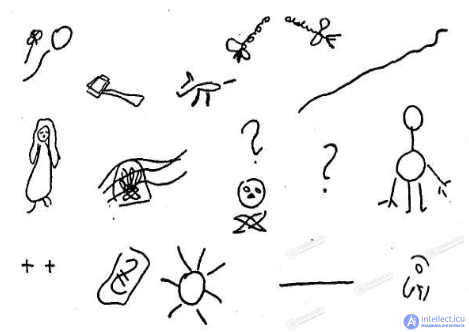
In this pictogram, the very abstract associations for the words "separation" and "justice" might raise concern. However, its overall liveliness and variety, ease and simplicity of execution, and finally the complete reproduction of all the given words, give confidence that these two associations too were not empty but genuinely abstract symbols.
Figure 1 – Pictogram of a healthy student
Pictograms composed by schizophrenic patients with empty and meaningless associations look completely different (fig. 2).
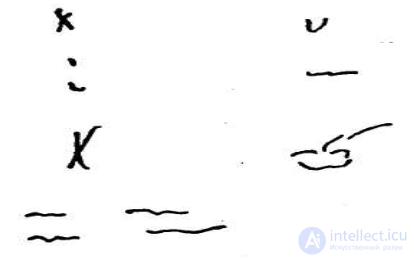
Figure 2 – Empty, meaningless symbols.
This patient was given the same words, but there is no need to decode them here. Neither at the moment of composing the pictogram, nor during recall (which turned out to be completely impossible, despite the fact that during the 10-word learning task the patient showed good retention abilities), could she explain why she would be able to recall "joyful holiday" by a small cross, "development" by a checkmark, "illness" by two dots, and "friendship" by one. Some subjects (in most cases this is characteristic of schizophrenic patients, but in a few cases over the decades such pictograms have also been produced by patients who had encephalitis or suffered from epileptic seizures) try to associate a concept with various line contours. Thus, for example, one patient symbolizes "joyful holiday" with the rounded contours of a winding line (above) and "separation" with an angular zigzag line (below). He offers no explanation as to why he denotes "happiness" with a straight line running into a shapeless lump above "separation," and "doubt" with a straight line running into a zigzag.
Geometric symbolization of concepts in general is very often found in the pictograms of schizophrenic patients. Thus, for example, a schizophrenic patient who composed a pictogram consisting only of geometric shapes symbolizes "doubt" as a circle, but then begins to doubt whether he chose the diameter of the circle correctly. He says that "a circle is uncertainty," and quite seriously asks the experimenter: "In your opinion, would 'uncertainty' be narrower or wider than 'doubt' in area?"
Let us give examples of two more empty pictograms composed by schizophrenic patients (figs. 3, 4).
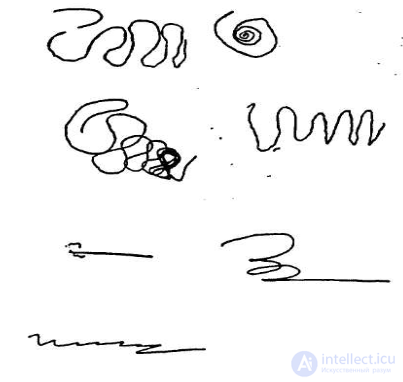
Figure 3 – Symbolic zigzags (of a schizophrenic patient)
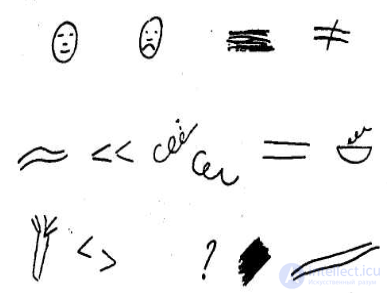
Fig. 4 – Pictogram of a schizophrenic patient
There is no point in decoding them, since only a few individual strokes-symbols carry meaning (in fig. 4, in the center, a spiral rising upward denotes "happiness," while one descending downward nearby denotes "illness"). For the most part, the arrows, checkmarks, lines, crosses, and small circles are devoid of objective content and do not serve even the patients themselves as a means of connection and memorization; attempts to "read" one's own pictogram, that is, to recall the given words, prove unsuccessful. Some pictograms should also be mentioned which, in appearance, seem simple and concrete, but on more careful psychological analysis reveal signs of profound thought disorder. Figure 5 shows the pictogram of a schizophrenic patient with verbal hallucinosis. The patient's associations are concrete and meaningful in nature, but they are striking in their stereotypy both in content and in execution of the drawings.
The last pictogram is likewise concrete in nature. Disorders of thinking are revealed here not in the drawings but in the patient's explanations (schizophrenia, defect state).
The patient reproduces some words approximately, and cannot recall others. Her explanations reveal the whimsical, vague nature of her associations and, at the same time, their considerable inertia, since the choice of some new images is influenced by the patient's preceding images and thoughts (illness – labor, drunkard – fence).
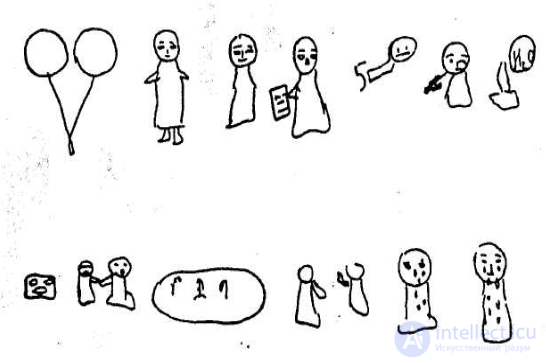
Fig. 5 – Stereotyped drawings
Overall, the "pictogram" method is very multifaceted; it allows many observations to be made regarding essential features of patients' psyche.
Purpose of the study: to establish the role of a system of auxiliary pictographic signs in expanding memory capacity.
Materials and equipment: sets of words, a test form for pictograms in the size of a standard sheet divided into 20 cells, a study protocol, paper, pencils or pens for writing and drawing, a stopwatch.
Study procedure
The study consists of two trials, which are conducted with a single subject.
Trial No. 1
Objective of the first trial: to determine the subject's memory capacity for abstract concepts using the classical method of retaining items in a series.
The material for memorization consists of 20 abstract concepts of equal volume. The experimenter clearly reads out the concept-words during the trial, making a short pause of 10–12 seconds between each of them. After reading all 20 words, there is a pause of 5 minutes, after which the subject is asked to write down in the protocol the words he remembers, preserving their order as far as possible:
Instructions to the subject: "I will read you 20 words. Listen to me carefully and memorize them. When I say 'Write!', write down in the protocol the words you remember, preserving their order of presentation as far as possible. If everything is clear, get ready to listen and memorize."
Words to memorize in the first trial:
|
1. Sanction |
8. Confidence |
15. Legality |
|
2. Fantasy |
9. Patience |
16. Loneliness |
|
3. Superstructure |
10. Concept |
17. Recognition |
|
4. Generalization |
11. Renunciation |
18. Ability |
|
5. Probability |
12. Thinking |
19. Induction |
|
6. Aesthetics |
13. Space |
20. Composition |
|
7. Intuition |
14. Creation |
|
After the trial, the subject's verbal report about the method he used to memorize the words and the experimenter's observations are recorded in the protocol.
Trial No. 2
Objective of the second trial: to determine the subject's memory capacity for abstract concepts when retaining a series of items using the pictogram method.
The second trial is conducted no earlier than 30 minutes after the end of the first. The experimental material, as in the first trial, consists of abstract concepts of the same number and volume.
In this trial the subject is given a test form for drawing, in its cells, the concepts offered for memorization. In these same cells he can later reproduce the concepts he remembers. The experimenter should read the concepts clearly, pausing between each word for drawing for no more than 10–12 seconds. After reading all 20 concepts, there is a pause of 5 minutes. Then, on the signal "Write!", the subject reproduces the concepts he remembers, and afterward gives an account of how he connected them with the drawings.
A drawing form, which is a standard sheet of paper divided into 20 squares numbered in the upper left corner, is given to the subject before the instructions.
Instructions for the subject: "I will read you 20 words. These are abstract concepts. Listen to them carefully and, to remember them better, draw each one in the corresponding square of the form given to you. The quality of the drawings does not matter, but writing words, letters, or numbers in the squares is not allowed. When all 20 words have been read and drawn, turn the form over so you don't see your drawings. After a pause, I will say: 'Write!' Then turn the form face up and in each square write down the concepts that you remember based on the drawing. Is everything clear to you? If so, get ready to listen, draw, and remember!"
Words to memorize in the second trial:
|
1. Erudition |
8. Adventurism |
15. Ignorance |
|
2. Perception |
9. Indifference |
16. Attitude |
|
3. Basis |
10. Reflection (deliberation) |
17. Jubilation |
|
4. Abstraction |
11. Vocation |
18. Inclination |
|
5. Possibility |
12. Sensation |
19. Analogy |
|
6. Ethics |
13. Reflection |
20. Judgment |
|
7. Statement |
14. Destruction |
|
Processing the results
The indicator of memory capacity for abstract concepts is the number of words correctly reproduced in each trial. Since incorrectly reproduced words are used to analyze the process of mediated memorization, both the correctly reproduced words and the indicators of incorrectly reproduced ones are entered into a summary table:
|
Words reproduced |
Trial 1 |
Trial 2 |
|
correctly / incorrectly |
|
|
Analysis of the results
By comparing the results of both trials in terms of quantitative and qualitative indicators and verbal reports, one should establish the differences between direct and mediated memorization. In analyzing them, it is important to demonstrate the usefulness of drawings as a means of memorization.
In discussing the results, it is advisable to trace the nature of the connection between what was remembered and the content of the drawings, especially if the reproduction was successful. The use of drawings, that is, pictograms, for memorizing abstract material is possible when the subject's thinking is well developed. In this connection, a typology of drawings can be distinguished. People with predominantly abstract thinking more often draw symbols in the squares, such as wavy lines, sets of dots, mathematical signs, and so on. Those with predominantly figurative thinking prefer to draw something concrete: flowers, trees, anthropomorphized objects, etc.
If a group of subjects took part in both trials of this study, one can compare the subjects' drawings and determine in which cases, and which particular drawings, favored memorization, and the nature of which ones led to erroneous reproductions. If the subjects also took part in Study 8, this provides a basis for generalizations and conclusions regarding the significance of auxiliary means — that is, semantic connections and drawings — for retaining and reproducing words.
Purpose of the work. Determining the capacity of short-term and long-term memory.
Control tasks. Determine the capacity of short-term and long-term memory for each student in the study group by determining the number of words remembered after each of five readings by the researcher of 20 text words.
METHOD 1. Learning 20 text words
Procedure: The experimenter reads out 20 words. There should be no words denoting objects currently surrounding the subject. The subject reproduces the words in writing after each reading, in any order (covering up the results of the previous reproduction).
Assessment of short-term memory. To assess memory, it is recommended to construct a graph. The number of remembered words is plotted on the y-axis, and the number of repetitions on the x-axis. If by the 5th reading the subject has remembered 20 words, this is satisfactory; if by the 3rd, this is good. If the number of words increases and a maximum is established by the third reading, this means that no mental exhaustibility is noted. If the subject reproduces few words and their number decreases after 2–4 repetitions, this indicates exhaustibility. The insertion of extraneous words is regarded as one of the signs of weakened mental activity.
METHOD 2. Memorization and reproduction of a text with semantic connections is carried out.
Testing of long-term memory. After about 0.5 hours, the subject is asked to repeat these words. Reproduction of 2/3 of the words is satisfactory. Then reproduction of the text with semantic connections is carried out. This reproduction is compared immediately after reading and after 0.5 hours with the memorization of 20 words without semantic connections.
In the protocol and on the classroom board, the results of the study for various subjects are recorded in the form of a table, and a conclusion is drawn about individual differences in memory and the significance of associative (semantic) memory in humans.
Analysis of the results of the work performed. Record the results of the experiment in the form of a protocol. Formulate conclusions from the laboratory studies presented, and provide a summary.
EXPERIMENTAL MATERIAL FOR METHOD 1.
20 proposed words and their sequence numbers.
Cover the text, and on a sheet of paper write the words with their sequence numbers.
|
|
You can calculate the productivity of memorization using the formula:
|
number of correctly reproduced words |
x 100% |
|
number of words proposed |
EXPERIMENTAL MATERIAL FOR METHOD 2.
Within 60 seconds, read the text. It has 10 main ideas highlighted in bold and numbered. Try to reproduce them, preserving the indicated sequence.
In 1912, a disaster occurred in the Atlantic Ocean. The huge passenger steamship "Titanic," on its maiden voyage from Europe to America, collided in the fog with a floating ice mountain — an iceberg. 1) It received a hole in its hull and began to sink. 2) "Lower the boats!" the captain commanded. But there were not enough lifeboats. 3) They were enough for only half the passengers. "Women and children to the gangways, men put on life jackets," came the second command. 4) The men silently stepped back from the railing. The steamship slowly sank into the dark, cold water. 5) Boarding of the last lifeboat began. 6) And suddenly some fat man with a face twisted in fear rushed toward the gangway, shouting. 7) Pushing aside women and children, he tried to jump into the boat. 8) A click was heard — it was the captain firing his pistol. 9) The coward fell dead on the deck. 10) But no one looked back at him.
Formula:
|
number of correctly reproduced ideas |
x 100% |
|
number of highlighted points in the text |
By adding up the figures obtained from the two methods and then dividing the sum by two, you will find out the average productivity of memorization. 90–100 — excellent result; 70–90 — very good result; 50–69 — good; 30–49 — satisfactory; 10–29 — poor; 0–9 — very poor.
This method is one of the most frequently used. It was proposed by A.R. Luria. It is used to assess the state of the subjects' memory, fatigability, and attentional activity. The method makes it possible to study the processes of memory, memorization, retention, and reproduction.
No special equipment is required. However, to a greater extent than with other methods, silence is necessary: if there is any conversation in the room, it is not advisable to conduct the experiment. Before starting the experiment, the experimenter should write down, in a single row, a series of short (one- and two-syllable) words. The words should be chosen to be simple, varied, and having no connection with one another. Usually each experimenter becomes accustomed to some one set of words, but it is advisable to use not just one but several sets, so that subjects cannot hear them from one another.
First explanation. "Now I will read 10 words. You need to listen carefully. When I finish reading, immediately repeat as many as you remember. You can repeat them in any order, the order doesn't matter. Understood?"
The experimenter reads the words slowly and clearly. When the subject repeats the words, the experimenter puts crosses under these words in his protocol (see the protocol form). Then he continues with the instructions (second stage).
Continuation of the instructions. "Now I will read you the same words again, and you must again repeat them — both the ones you have already named and the ones you missed the first time — all together, in any order."
The experimenter again puts crosses under the words that the subject repeated. Then the trial is repeated again, 3, 4, and 5 times, but now without any instructions. The experimenter simply says: "Once more."
If the subject names any extraneous words, the experimenter is sure to write them down next to the crosses, and if these words are repeated, crosses are placed under them as well.
If the subject tries to insert any remarks during the course of the experiment, the experimenter stops him; no conversation should be allowed during this experiment.
After five repetitions of the words, the experimenter moves on to other experiments, and at the end of the study, 50–60 minutes later, again asks the subject for these words (without reminding them). As a result, the experiment protocol takes the following form:
|
|
forest |
bread |
window |
chair |
water |
brother |
horse |
mushroom |
needle |
honey |
fire |
|
1 |
+ |
|
+ |
|
+ |
+ |
|
|
|
|
|
|
2 |
+ |
|
+ |
|
|
+ |
|
+ |
|
|
+ |
|
3 |
+ |
+ |
|
|
+ |
+ |
|
+ |
|
|
+ |
|
4 |
+ |
+ |
|
|
|
|
|
|
|
+ |
0 |
|
5 |
+ |
+ |
|
|
+ |
+ |
|
+ |
+ |
|
|
|
After an hour |
|
0 |
|
|
|
0 |
|
0 |
|
|
|
From this protocol, a "memorization curve" can be constructed. To do this, the trial numbers are plotted on the horizontal axis, and the number of correctly reproduced words on the vertical axis. Based on the sample protocol given, the curve takes the following form (fig. 1).
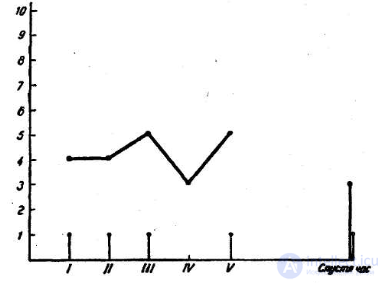
Figure 1. Memorization curve.
The shape of the curve can be used to draw certain conclusions about the memorization characteristics of the subjects. Based on a large number of healthy subjects, it has been established that in healthy people, both adults and school-age children, the memorization curve generally has a pattern like this: 5, 7, 9, or 6, 8, 9, or 5, 7, 10, etc., i.e., by the third repetition the subject reproduces 9 or 10 words and on subsequent repetitions stays at 9 or 10. In the protocol given above, the curve (4, 4, 5, 3, 5) indicates poor memory and inactivity on the part of the subject. In addition, this protocol notes that the subject reproduced one extraneous word, "fire," and subsequently, on repetition, "got stuck" on this error. Such recurring "extraneous" words, according to observations by some psychologists, are found in the study of patients suffering from current organic brain diseases, and also sometimes in schizophrenic patients during a period of intensive drug therapy. Especially many such "extraneous" words are produced by children in a state of disinhibition and by adults at the end of, or before the onset of, disturbances of consciousness syndromes.
The "memorization curve" may also indicate a weakening of active attention and pronounced fatigability of the subjects. Thus, for example, sometimes a subject reproduces 8 or 9 words the second time, and then, after each subsequent reproduction attempt, fewer and fewer. In life, such a person usually suffers from forgetfulness and absentmindedness, but underlying his forgetfulness is transient asthenia, exhaustibility of attention. Exhaustibility of the subjects' attention does not necessarily show up in a curve with a sharp downward drop (fig. 5); sometimes the curve takes on a zigzag shape, indicating instability of attention, fluctuations in it.
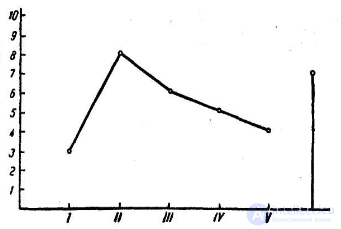
Figure 2. Curve of attentional exhaustibility
In individual, relatively rare cases, subjects reproduce the same number of the same words. The curve has the shape of a plateau. Such an absence of any increase in word retention after repetition indicates emotional apathy in the subjects; there is no interest in the study, no motivation to remember more.
The number of words retained and reproduced by the subject an hour after repetition indicates, to a greater extent, memory in the narrow sense of the word, i.e., the fixation of traces of what was perceived.
NUMERICAL MATERIAL ("Jacobs' method")
Procedure. Subjects are read series of numbers with a steadily increasing number of digits. After the command "Write it down," subjects must write down the numbers they remember in the same order in which they were presented.
Protocol form for the experimenter (the form for the subject should not include the stimulus material)
|
No. |
Stimulus material |
Subject's response in trials 1–4 |
Number of errors |
Points |
|||
|
1 |
4 397 |
|
|
|
|
|
|
|
2 |
39 532 |
|
|
|
|
|
|
|
3 |
427 318 |
|
|
|
|
|
|
|
4 |
6 194 735 |
продолжение следует...
Часть 1 Studying a Student's Individual Memory Characteristics During Teaching Practice and in the Teacher's Everyday Work
Часть 2 See also - Studying a Student's Individual Memory Characteristics During

Comments