
Lecture
Personality psychology is a branch of psychology that studies personality and the various individual processes, dynamic aspects of mental life, and individual differences. It reconciles the picture of personality in its relationships with the world, life, society, and others.
The core category of the depth paradigm in psychology is the category of the unconscious, proposed by Sigmund Freud at the end of the 19th century. In a broad sense, the unconscious refers to a vast layer of a person's mental life that is not correlated with the conscious "I" and includes vitality, psychic energy, unrecognized corporeality, instinctual drives (libido and mortido), unrevealed potentials, repressed desires, and forgotten events and experiences.
Sigmund Freud proposed structural and topographic models of personality. The structural model consists of the components
The "Ego" consolidates over the course of a personality's ontogenesis out of the primary unconscious psychoid and represents an agency belonging predominantly to the sphere of the conscious. Thanks to the "Ego," a personality possesses the capacity for conscious relations with the world, reflection, self-regulation, and self-determination. The Superego appears at the oedipal stage and represents internalized parental images, specifically in the aspect of the norms and rules of social life.
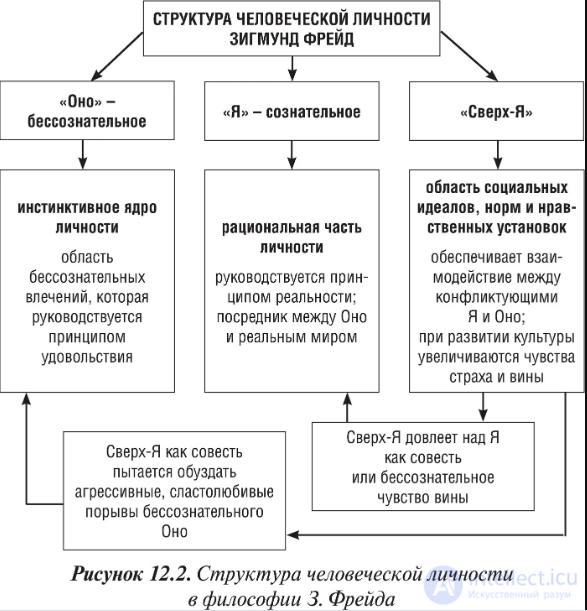
From Freud's point of view, it is precisely in the Superego that the unconscious idea of the Absolute is laid down — that is, the foundation of a personality's religiosity. The "Id" consists of two instincts — libido and mortido — and represents the primary basis of a personality's psychic life and the pure energy that feeds conscious activity. Ideas about the genesis, dynamics, interrelations, and contradictions of these structural elements form the practice-oriented model of personality used in modern psychoanalytic practice.

The topographic model of personality includes the conscious, preconscious, and unconscious. The conscious contains contents of individual life that relate to the "I." The preconscious contains forgotten, repressed contents that were previously related to the "I" and can either be actualized through an effort of the Ego or extracted by the method of psychoanalysis. Unlike the sphere of the unconscious, these contents are already "known" to the conscious Ego and possess verbal-symbolic characteristics. The contents of the unconscious, in turn, are preverbal — they are pure drives, instincts, potentials, and psychic energy.
Another practice-oriented model of S. Freud's is the model of psychosexual periodization of life, based on the idea of the "migration of libido" through various zones of the body during the ontogenetic development of the personality. The bases of this periodization are the bodily zones where libidinal energy is concentrated; the main themes of parental upbringing and the individual's social interactions; the typical and individual personality traits formed at each stage; and the success of passing through the stages or the formation of fixations.
The main methods of orthodox psychoanalysis are the couch method, the method of free association, the method of dream interpretation, and the analysis of resistance, transference, and countertransference.
Classical psychoanalysis brought to the psychology of personality the idea of the unconscious determination of individual life and had a substantial influence on the culture of self-knowledge and psychohygiene. In addition, one cannot fail to appreciate S. Freud's broader view of the nature of sexuality as a primary vital force, a powerful energy of life and creativity — in opposition to its being reduced solely to the function of reproduction.
C. Jung's views on the nature of the unconscious differed substantially from S. Freud's understanding of the unconscious. According to C. Jung, the unconscious includes the personal and the collective unconscious. The personal unconscious contains contents similar to those of the preconscious in S. Freud's theory. The collective unconscious comprises specific patterns of perception, response, relationships, and behavioral models that became fixed in the organic foundations of the psyche through their countless repetitions in the experience of humankind.
Archetypes are systems of attitudes that are inherited along with the structure of the brain, being its psychic aspect. This is the "chthonic" part of the soul, through which it is connected to nature, the world, and the earth.C.G. Jung, The Problems of the Soul of Our Time
C. G. Jung named these patterns archetypes and described the principal ones: the self, the persona, the shadow, the anima and animus, the mother, the father, the child, the hero, and the trickster. The archetypal contents of the unconscious constellate in significant situations of individual life, and their influence is, as a rule, unrecognized by the person.
If you observe the behavior of a neurotic, you can see him performing certain acts that appear conscious and purposeful. Yet if you ask him about them, you find that he either is not aware of them or has something quite different in mind. He listens but does not hear, he looks but does not see, he knows yet is not aware. Such examples are so frequent that a specialist realizes that unconscious mental content behaves as though it were conscious. In such cases one can never be certain whether a thought, word, or action is conscious or not.C.G. Jung, Man and His Symbols
Archetypes have their equivalents in culture, expressed in specific plots, images, and cultural symbols. For example, the mother archetype is represented in the images of Mary, Gaia, Aphrodite, Medea, and the Stepmother; archetypal motifs of motherhood may include the birth of a child, self-sacrifice, salvation, and care for the child, or, conversely, expulsion and the destruction of the child's life.
The idea of using cultural plots and symbols as models for understanding and interpreting the contents of individual life became the basis of the Jungian method, was further developed in contemporary analytical psychology, and became one of the foundations of the cultural paradigm in the psychology of personality.

The humanistic psychology approach to the study of personality is in some ways similar to existential psychology. The person and their existence are recognized as unique, and an important point is self-improvement and the individual's responsibility for their actions. A person's personality is studied as something whole, rather than divided into various parts (emotions, the subconscious, behavior, etc.).
In existential psychology the emphasis is placed, firstly, on the uniqueness of each individual's life, and secondly, a distinctive feature of the existential approach in psychology is the shift of attention from "essence" to "existence" — a process in which observation and analysis are directed precisely at the process of a person's life.
In the cognitive psychology of personality, emphasis is placed on the various functions of human thought, perception, memorization, and reproduction of surrounding events and the world as a whole. This approach to studying personality is complemented by behaviorist concepts, which place at the forefront exclusively a person's actual behavior, their words, actions, and reactions to external stimuli.
The foundations of psychological research in Russian psychology were laid in pre-revolutionary Russia by A. F. Lazursky, V. M. Bekhterev, and M. Ya. Basov. Among the works on personality theory in Soviet psychology, the works of V. S. Merlin, L. S. Vygotsky, A. N. Leontiev, S. L. Rubinstein, K. A. Abulkhanova, A. V. Petrovsky, V. A. Petrovsky, B. A. Sosnovsky, A. G. Kovalyov, V. N. Myasishchev, and K. K. Platonov stand out.
A. G. Kovalyov raises the question of the holistic spiritual makeup of personality, its origin and structure, as a question of the synthesis of complex structures:
All these structures arise from the interconnection of a person's mental traits, which characterize a stable, constant level of activity ensuring the individual's best adaptation to the stimuli acting on them, owing to the greatest adequacy of their reflection. In the course of activity, traits become linked to one another in a particular way in accordance with the requirements of the activity.
V. N. Myasishchev builds a concept of personality whose central element is the notion of relation (attitude). A personality's relation is an active, conscious, integral, selective connection of the personality with various aspects of reality, based on experience.
V. N. Myasishchev characterizes the unity of personality by: orientation (dominant relations — toward people, toward oneself, toward objects of the external world), general level of development (in the course of development the personality's overall level of development rises), the structure of personality, and the dynamics of neuro-psychic reactivity (referring not only to the dynamics of higher nervous activity (HNA), but also to the objective dynamics of living conditions).
From this point of view, the structure of personality is only one of the definitions of its unity and integrity — that is, a more specific characteristic of personality, whose integrative features are linked to the motivation, relations, and tendencies of the personality.
The concept of the dynamic structure of personality (K. K. Platonov). The most general structure of personality consists of assigning all its features and traits to one of four groups, forming 4 main aspects of personality:
Aspects 1 and 2 are socially conditioned; 3 and 4 are genetically conditioned.
All 4 aspects of personality interact closely with one another. However, the dominant influence always remains with the social side of personality — its worldview, orientation, needs, interests, ideals, and aesthetic qualities.
According to Yu. V. Shcherbatykh, the concept of personality includes two pairs of dialectically contradictory characteristics, without understanding which it is difficult to grasp this term.
According to Ganzen, the structure of personality includes temperament, orientation, character, and abilities.
B. G. Ananyev believes that the structure of personality includes the following properties:
In contemporary psychology there are two main concepts for defining human personality. The first can be called objectivist, since experimental research is applied to individual components of a person's personality — emotions, behavior, needs — while the person is merely an object of influence of certain external forces (this concept is characteristic of behaviorism and cognitive psychology). The second concept of the psychology of personality can be characterized as subjectivist, since it proclaims the innate freedom of the individual and abounds in notions such as "individuality," "responsibility," and others. This concept is predominantly characteristic of the existential and humanistic psychological schools.
In defining the subject matter of the psychology of personality, one may encounter certain difficulties, since personality is a collective concept encompassing several manifestations, and this science is therefore further divided into several disciplines studying various manifestations of personality. The psychology of personality is subdivided into the psychology of emotions, motivation, will, and others. In general, it can be said that the psychology of personality, with all its subdivisions, studies emotions, feelings, thoughts, self-awareness, higher nervous activity, motives, intelligence, social roles, and other manifestations of personality.
Standard methods of psychological research are used to study personality.

Comments