
Lecture
Ignoring (avoidance) is a psychological defense mechanism that consists of unconsciously controlling information about the source of an unpleasant impact, the presence or nature of a threat (danger); limiting the amount of such information or perceiving it in a distorted way.
When applying this defense on its own, a person does not refuse to acknowledge the existence of danger or an unpleasant impact, as in the case of denial; does not forget about it, as in the case of repression; does not stop perceiving surrounding reality, as with primitive isolation; and does not diminish the significance of information, as with devaluation. He simply avoids situations in which he might receive information that is unpleasant to him.
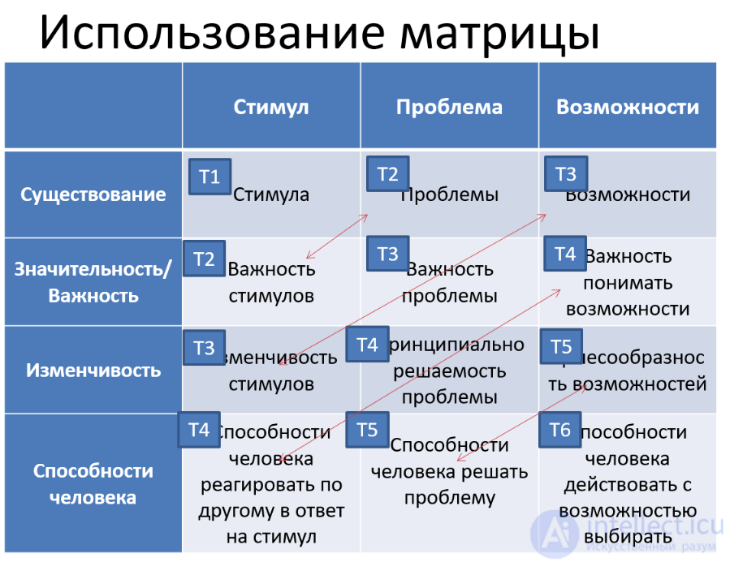
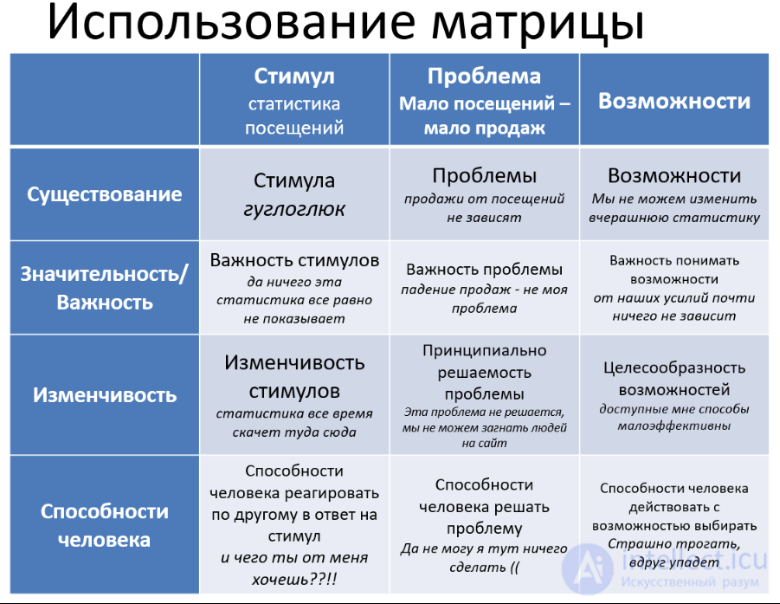
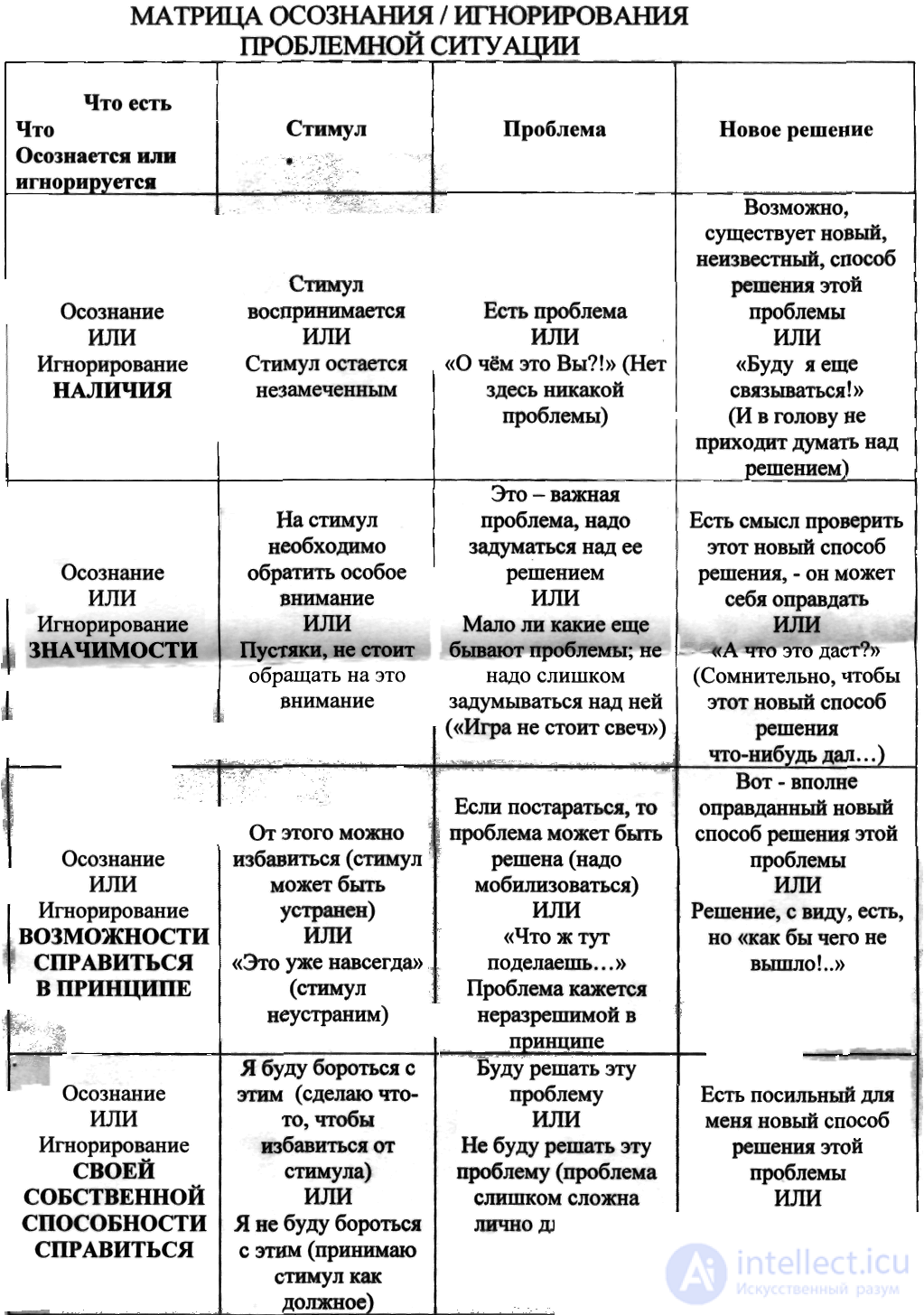
Ken Mellor and Eric Sigmund once developed a scheme for matrix-based determination of the degree and object of discounting (ignoring). Three different criteria are considered: level, area, and type. There are four levels of discounting in this case. These are: the existence of a possibility (a person discounts the existence of possibilities for solving the problem at all); its significance (understanding that a solution exists, but denying its effectiveness in advance); changing possibilities (understanding that a solution exists, but refusing in advance to apply it); and personal abilities (the inability to carry out a possible solution due to a personally unacceptable attitude toward that method). There are three areas of discounting: self, other people, and the situation. The types of discounting are stimulus, possibility, and problem. Combining these three criteria produces a matrix: using this matrix, one can identify at what level a problem is being discounted and, accordingly, influence the person to prompt them to look for a solution to the problem. The search for the "source" should begin in the top row, in the leftmost cell, and then proceed down the diagonal.
The discounting matrix was originally developed for use in therapy (within transactional analysis), but it is also an effective tool for solving problems in organizations. Problems often remain unresolved because they are approached too low on the discounting matrix's diagonal. The remedy is as follows: to identify missing information, start at the top left corner of the matrix, checking the squares down the diagonals.
Discounting does not contribute to problem-solving. Consequently, by developing a way to determine the nature and intensity of discounting, we obtain a reliable tool for solving problems. Such a tool is known as the "discounting matrix," developed by Ken Mellor and Eric Sigmund (Mellor, Sigmund, 1975). The essence of the matrix is that instances of discounting are classified according to three different criteria: area, type, and level.
Areas of discounting. There are three areas that can be discounted: self, others, and the situation.
Types of discounting. There are three types of discounting: of stimuli, of problems, and of possibilities. To discount a stimulus means to strike from our perception the very fact that something is happening. A person who discounts a problem understands that something is happening, but discounts the very fact that a problem exists. When discounting possibilities (choices), a person realizes that something is happening and that this is precisely what constitutes the problem, but discounts any possibility of solving it.
Levels (modes) of discounting. The terms "level" and "mode" are interchangeable, though the former conveys the idea better. There are four known levels of discounting: existence, significance, change of possibilities, and personal ability.
The discounting matrix diagram. The discounting matrix accounts for all possible combinations of types and levels of discounting (Table 2.2).
Table 2.2. The Discounting Matrix
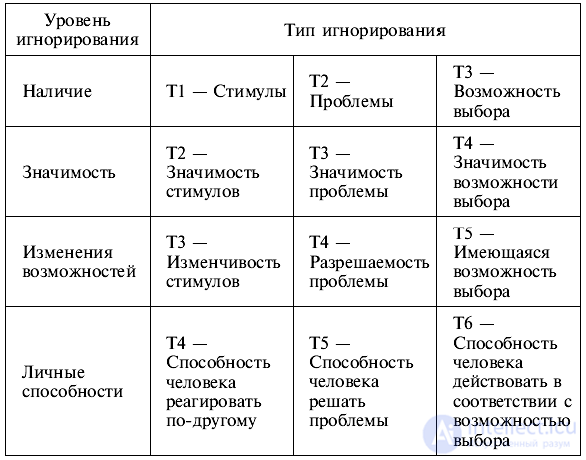
Discounting at any square includes discounting at the squares located below and to the right of it.
The arsenal of a person in love contains no shortage of tricks. Often these are elaborate multi-step strategies designed to draw a love interest into their net. For example, some people resort to ignoring, considering it the best way to attach the person they like to themselves.
Such a strategy can indeed bring the desired result, but it needs to be used correctly. It's also worth remembering that the effect of such actions needs to be "reinforced," otherwise the love interest will cool toward their conqueror in no time at all.
Why is this method considered effective? This is largely related to one curious trait of human beings: the ability to feel interest in someone who is ignoring them.
Nevertheless, psychologists say that this approach can only help capture a person's attention for a while; once the goal is achieved, the person doing the ignoring will lose that interest. Moreover, according to specialists, one can only count on this method when the love interest already has at least a minimal degree of liking for the person trying to win them over.
You can display indifference in several situations: right away, as soon as someone starts paying attention to you; or you can start ignoring a person to attach them to you after flirting, or even at the initial stage of a romantic relationship. This is a more advantageous option, since you let your love interest know that you find them appealing, whereas in the first case you might simply scare them off with your indifference. Moreover, before attaching a person to yourself, you'll be able to understand how they feel about you and whether there's interest on their part.
WHAT DO PSYCHOLOGISTS SAY ABOUT ATTACHMENT? Specialists describe it as a state in which a person feels drawn to someone or something. At the same time, the definition of attachment mentions that this attraction is, as a rule, not driven by benefit, love, or any other interest. Nevertheless, this doesn't mean that a person who has been ignored is guaranteed not to start developing feelings of liking or even love for their conqueror. Psychology distinguishes several types of attachment between people. Speaking of relationships between a man and a woman, it's worth remembering that partners sometimes develop a pathological attachment. In the case of an unhealthy, painful attachment, a person is deprived of freedom and becomes dependent on their partner, as a result of which, as a rule, neither person in such a couple experiences comfort. Love, too, is usually not part of such a union. But relationships can also develop along a different scenario. A feeling of attachment can arise not only on the basis of mutual liking; you can also attach a loved one to yourself on the basis of an aspect such as shared interests.
Take note of a few pieces of advice from psychologists:
If you like a member of the opposite sex, try to display indifference not right after meeting them, but once they've already sensed mutual liking from you; to attract the attention of the person you like using the "ignore" tactic, always be polite and even gentle, even at moments when you're turning down a meeting with them. Moreover, don't consider it reckless to tell your love interest that you're very sorry your date won't be happening; don't put off your meetings for a long time, otherwise ignoring them may lead the member of the opposite sex you like to simply cool off; postpone your meeting with your potential partner a few times. At the same time, it wouldn't hurt to actually schedule a date a couple of times, but then call back at the last moment and say your plans have suddenly changed. Don't forget that you need to act subtly and very carefully for this method to work; otherwise the member of the opposite sex you like will guess your strategy and lose interest. Moreover, you can't use this method toward a person who used ignoring to attract your attention. If you've decided to use indifference to draw attention to yourself, you should also think about what to do next, since psychology says that this method often only attracts attention for a short time. WHAT TO DO NEXT? Sooner or later you'll meet up with your love interest, since neither you nor your partner needs you keeping them in suspense for years. Above all, remember that the initiator of the date you finally agree to should be the member of the opposite sex. Take note of the advice psychology offers on how to attach a person to yourself.
Find shared interests with them and unobtrusively point them out. It's important that these really be your interests, plans, hobbies, and so on. Don't lie about liking to do, watch, or listen to something if that isn't true — sooner or later the deception will come out, and you'll disappoint the person you wanted to win over; be optimistic. You should bring joy to your potential partner, not bore or depress them. Your communication should be light and unobtrusive; together with your love interest, you should enjoy life. Create comfortable conditions for pleasant time spent together. Try to talk less about your own problems to your partner, so that psychologically they perceive you as an airy, carefree person — this will help you attach the person to yourself faster; don't forget about your appearance. However trite this advice may sound, remember that a member of the opposite sex also needs to be attracted visually; the ability to communicate well also matters greatly. Try to keep the conversation going and show interest in your partner's opinion, so that they feel psychologically comfortable and don't get the impression that they're an uninteresting conversational partner for you. If you're a professional in some field, show off your knowledge, but not too insistently, so as not to tire your conversation partner; if you get a chance to talk with someone from your love interest's circle, that's the best opportunity to influence the person you like through them. For this, though, you need to do everything possible to be liked by these people, whoever they may be — friends, colleagues, relatives, or even parents.
These are the first steps you'll need to take in the early stages of building a relationship. If you decide your feelings are strong and a wonderful future together awaits you, you'll have to put in more effort. At this stage, ignoring is not the best tool, since you'll need to act quite differently. Become reliable and supportive in every way for your other half; don't try to change them — besides a negative reaction on their part, that's all you'll achieve.
Accept the person as they are, rather than trying to turn them into whoever you'd like to see in front of you. Become a source of inspiration for your partner, but there's no need to control them — they should feel that you trust them. So, it is possible to attach a person to yourself using the "ignore" tactic, but first think carefully about whether you've truly planned your actions well, since they must not suspect anything.
Ignoring as a form of severe emotional abuse
Ignoring is one of the most powerful forms of emotional abuse. It has a harmful effect not only on the person subjected to this kind of psychological punishment, but also on the person carrying it out. Let me try to prove this.
Ignoring, or shunning, is quite an old technique of manipulation or suppression. But in today's information space and post-industrial society, it is taking on new features.
"Ignore" (colloquial, from the English "ignore") refers to a chat or forum visitor's refusal to communicate with another visitor. Rude or simply pesky interlocutors are typically "put on ignore." The "put on ignore" function exists in almost every chat and forum. Such a function exists on the phone too. If you want to shield yourself from unwanted incoming calls, use the "Ignore" service. It allows you to block calls from specific and hidden numbers.
In short, no one is surprised by ignoring anymore these days. Any pesky conversation partner, advertiser, PR person, or salesperson can easily be gotten rid of with an ignore. It's a rather useful thing that saves our time, money, and nerves.
But right now I want to talk about something else: about ignoring as a method of psychological manipulation used by destructive people with the aim of humiliating another person, taking revenge, subjugating them, or destroying them as a rival or competitor. And sometimes it's used by men and women as bait and a way to attach a person of the opposite sex to themselves. In this case, we're dealing with one of the most powerful forms of emotional abuse. And it works in a very targeted and painful way. It's especially painful when it concerns close people, relatives, loved ones, friends — that is, those whose indifference is perceived as the most brutal insult, hurt, blow, humiliation, or, if you like, betrayal.
It hurts us to be ignored because, subconsciously, every person is oriented toward
• belonging,
• recognition, and
• empathy.
All these conditions are necessary for us as social beings. And if we don't receive them — that is, if we're being ignored, especially if it's done deliberately and demonstratively — we begin to experience severe discomfort from the lack of value-based identification of our own personality.
What happens to a person who is being ignored?
They feverishly begin searching for the reason behind such behavior toward them. "Maybe I'm too bad, not even worthy of their attention?" they think. "Am I really so repulsive that it's impossible to even talk to me?"
In general, there are several possible reactions to being ignored:
Boomerangs always come back
Depending on how the ignored person behaves, their tormentor will either reap a whole array of psychological bonuses for their petty little soul, which feeds on the humiliation of others, or will be left empty-handed and feel how the game they carefully constructed starts working against them. Boomerangs always come back.
Sometimes they return in the form of hatred and aggression, curses and revenge. At times, the person doing the ignoring gets hit back from an unexpected direction — not from the person they offended with their demonstrative indifference, but precisely from the person whose attention and love they themselves were counting on. This happens according to laws of karma that are incomprehensible to them, yet very logical and explicable. Pride is always cured by humiliation.
Sometimes, having driven their enemy to suicide or tragedy, the person doing the ignoring suddenly begins to feel guilt, which follows them for the rest of their life.
But the most terrible blow for people who play at emotional abuse through ignoring for the sake of their own whims and ambitions turns out to be the successful advancement, happiness, and joy of the very person against whom they aimed their terrible weapon. They ignore him, and it rolls right off him like water off a duck's back. He invents a generator of good mood and doesn't care that some random person is ignoring him. He has his own goals and his own values. And they don't consist merely in winning that person's attention or anyone else's. He still has a particle accelerator to launch — no time to dig through your manipulations and psychological games.
In essence, ignoring is an ordinary psychological manipulation. But by and large, it's a signal that the person who started it is infected with pride and selfishness. "They don't talk, they don't communicate. Why? I don't know, some old story," you sometimes hear about close relatives or former friends who've given each other the silent treatment for years. They've already forgotten how it started, but out of habit they keep ignoring each other. Although they may well monitor each other's successes and failures and be quite well informed about each other's lives. All of this is a manipulative game for those who don't know how to communicate and are incapable of understanding another person. Or maybe they simply don't want to, because they see in that person a danger of being exposed themselves. After all, people sometimes ignore someone who tells them the truth about themselves — that is, someone capable of seeing their flaws and tricks and showing them their true face, both to themselves and to others. So that this clever person doesn't do that, they need to be put on ignore as quickly as possible. Shut their mouth and lock them up so they don't act up.
What those doing the ignoring fail to consider, however, is that by acting this way they not only punish the person who may have offended or hurt them in some way, and toward whom they consequently feel envy or dislike — they also expose their own weak points, demonstrating to everyone their quarrelsome nature and inhumanity, their inability to negotiate, their incapacity to understand and forgive.
But there are cases where ignoring is a rescue, when it comes to hysterical, paranoid, or manipulative behavior. In such cases, ignoring truly is sometimes the only way to defuse a conflict or tragedy. But even in this case, ignoring should be temporary, because a person who behaves inappropriately, hysterically, and manipulatively is still a person, and they need help — psychological, medical, or simply human. If you yourself are not a manipulator or a complete egotist, you won't be able to bear completely ignoring another person for long. You're not some kind of monster; you can put yourself in their shoes and imagine what they feel when you treat them like a lamppost. Don't be cruel, even if you really dislike this person. You can choose not to be friends with them, not to talk to them, but don't ignore them. Who knows, maybe they're exactly the well you'll someday need to drink from. Life is unpredictable…
Many have probably heard that you can simply ignore a person to attract their attention. Let's figure out how this works. All people are, by nature, self-centered creatures. It's foolish to deny this fact! So by ignoring someone we've previously talked to, we draw their interest toward us. The other person tries to figure out what the "ignoring" is about, and they become intrigued. These are laws of nature, and there's no point arguing with them.
In most cases, to attract male attention, women use ignoring. The scheme works, and many women know it. On a subconscious level, a person is used to loving themselves, and this is precisely what drives a man to show interest in a woman who has decided to ignore him. A man will pursue a woman to the very end in order to prove his own worth to himself. It's worth noting that this method of attracting attention doesn't work 100% of the time. In some cases, a man may interpret being ignored as proof that the woman didn't like him. If that happens, the man is more likely to distance himself further from women than to fall for the trick. It will then be very difficult to convince the guy that the woman is interested in him.
Every woman senses on an instinctive level how a man feels about her. She immediately understands whether she was liked or not. If you want to attract the attention of a man you like, you shouldn't immediately switch on "ignore" mode. The man may simply not understand what's happening. This occurs in several cases.
1. Indecisiveness and shyness. Having run into being "ignored," a man may not know how to act. Perhaps you seem too beautiful and fatal a woman, and he's simply afraid of being rejected. Many men consider themselves unworthy of beautiful women. In such a case, the man may withdraw entirely. The woman should make it clear through her whole demeanor that she likes the guy. There's no need to ask him out on a date right away — just talk, show a bit of light flirtation. He needs to fully understand that you've taken an interest in his presence. 2. A life partner. It's worth considering whether he already has a life partner, a girlfriend he's seeing. In that case, ignoring will mean that the man values his feelings and doesn't intend to start a new romance. Simply by talking, you can immediately find out how free the man is. Through conversation, you can sort out all your priorities and understand for yourself how to proceed.
3. Heightening interest. Many men may start ignoring a woman in order to attract her attention. They understand how the fair sex operates and use the same kinds of tricks. It's hard to say how to act in such a case — you may have to play his own game! This way, you'll prove to the man that he really has caught your interest.
4. He didn't like you. You can't rule out the possibility that the man simply didn't like you. It can be hard to read behavior, especially if the guy is very polite. He may show signs of attention but avoid any further development of the situation. This happens in cases where the man is excessively courteous and can't bring himself to refuse a woman. It's worth noting that some young guys may behave strangely and do things that defy logic. Don't try to decode their behavior — a person in love can do the silliest things!
With the shift of communication into the digital realm, we've gained the ability to always be in touch. But the further digital channels develop, the more often they're used for the opposite purpose — to quietly avoid communication. Online ignoring is becoming an increasingly widespread phenomenon, but no less baffling for it.
Is it normal to stay silent in response to messages on messaging apps or email, and why do we act this way? We look into it together with a psychologist, a digital communications specialist, and an etiquette expert.
A lack of feedback is irritating and sometimes even throws us off balance. And the more delicate the silence looks (a classic case being a message that's been delivered but not read by the recipient), the more room is left for negative interpretations. We start to worry and guess.
Psychologist and founder of the Genius.People center Lesya Kovalchuk notes that this kind of anxiety is a natural reaction to an unfamiliar situation: "Just ten years ago, we would call or arrange a meeting with a person if we had something to ask them. As technology developed, we gained the ability to communicate faster, almost instantly, using various channels. But this is still a new practice for us; the culture of this kind of communication hasn't fully taken shape yet.
There are no clear boundaries of behavior in messaging apps — we simply don't know what a conversation partner's silence means. Our imagination kicks in — either the person doesn't want to talk to us, or they're busy, away, deleted the contact, and there are plenty of other possibilities."
There's an illusion that users in messaging apps are available 24/7 — that everyone checks the pop-up notifications on their smartphones, and therefore should reply to messages almost instantly.
"When we communicate online, space and time somehow disappear. People can be in contact while being on opposite sides of the world and in different time zones — America, Europe, and Asia. But it's very important here to see the difference between the virtual world and the real one," Lesya believes.
The paradox is that, on the one hand, digital channels create a kind of barrier between us and the world, giving us a certain sense of safety. On the other hand, they blur personal boundaries. In the past, it would never have occurred to a colleague, client, or boss to call your home phone after nine in the evening. Today, receiving a message at night like "Hi. Take a look at what our payouts were for last quarter" is common practice.
A logical question arises: maybe ignoring certain messages isn't such a bad idea after all?
When needed, messaging apps and social networks help users delicately disappear from the radar. There are special tools for this, such as the "mark message as unread" option on Facebook. Most of us use such tricks from time to time when we need to get out of uninteresting, unpleasant, or pointless conversations.
"Using the barrier that messengers and email create, you can take a pause to think something over, or simply decide not to decide anything and avoid contact. At the same time, we count on being able to shift responsibility onto the specifics of the communication channel — bad connection, no internet access, and so on," comments Lesya Kovalchuk.
Communications strategist and digital specialist Evgeny Zingerman believes it's right to filter incoming requests in email and messaging apps. Consciously allocating your own resources, including your time, only benefits productivity. Whereas a phone call distracts a person from what they're currently doing and pushes someone else's task to the forefront, digital channels give us the freedom to manage our own priorities.
"Today we try to separate work time from non-work time. Within the former, you're able to handle a limited number of tasks, and outside requests get in the way of that. So all of us, myself included, can respond to someone's message whenever it's convenient for us. This is healthy selfishness. You prioritize the things that give you something — knowledge, money, and so on.
At first, digital tools allowed us to expand our circle of contacts many times over, and then gave us the ability to control it. That's how it should be — otherwise we'd go crazy answering endless messages to each other," notes Evgeny.
Lesya Kovalchuk agrees that in digital communication, it's very important for us to take care of preserving our own personal boundaries: "From my own experience, I know that a huge number of questions come in through social networks and other channels, some of them quite absurd. If I tried to answer all of them, I'd burn out emotionally very quickly and start getting irritated.
In any communication, including online, it's worth forming a certain model for responding to messages from the outside. Ask yourself questions — why am I here (note: in this communication channel), why am I using this particular channel, who is my audience, and what are my expectations. Your communication is built on the basis of that.
Of course, it's also important to remember about etiquette. For example, if someone has thanked you in a message or given you feedback, you need to at least reply with a "thank you."
Etiquette and behavior-modeling specialist Anna Chaplygina notes that ignoring messages in messaging apps and email can't be called an established norm of modern life. However, situations vary, and sometimes it really is simpler to stay silent, pressing the coveted "invisible/mute/mark as unread" button, than to spend energy on an unconstructive exchange.
"Ideally, you should reply to everything you've opened," Anna explains. "But there are extreme cases. For example, when a message comes from someone you find very unpleasant. If you really don't want to reply, don't open it. This is one of the extraordinary tricks. But before resorting to it, weigh who you'll be making things worse for.
Sometimes it's better to say right away that you're not interested in the offer. A person who doesn't get any feedback may start pestering you across every channel — calling, texting. Calmly and without insults, formulate your refusal: 'Good afternoon! Thank you for your offer. I really appreciate it, but I'm not interested at the moment.' Honesty is, at the very least, not painful."
It's one thing when you don't enter into a dialogue at all, and quite another when you're being strung along. Worrying and racking your brain over what went wrong is unconstructive in this case. So is getting angry. Anna Chaplygina offers a few simple pieces of advice that will help you keep a handle on situations involving feedback.
Messaging apps exist for very quick, "off the cuff" conversation. It's better to send important materials by email, and in something like Telegram simply give the person a heads-up that you've written to them by email.
We all want a reply to an important letter to come within at least a day. But even if that doesn't happen, you shouldn't immediately conclude that you're being deliberately ignored. Perhaps the recipient just glanced at the message in a hurry and then forgot about it.
Anna Chaplygina advises: "If you wrote to someone in a messaging app about a business matter, I'd recommend reminding them about it by the end of the workday, or the next day.
If you wrote by email — relax. Email is for everything that's not urgent. You can expect a reply to an email within up to three days. If you're the recipient and you realize you won't be able to give a substantive response within that time, just calmly write, 'Thanks, got it. I'll be able to reply by such-and-such date.'
If you're the sender and your message hasn't been answered after three days, you can get a bit closer — write to the person on the social media messaging apps where they've voluntarily given others access to them. But don't jump straight to Telegram or Viber — those are already tied to a personal phone number."
Clarify the time by which you should expect a reply to a letter, or when it's okay to remind the recipient about it. This way you'll take control of the situation and free yourself from the agonizing need to constantly recheck your email or messaging apps in the hope that the long-awaited feedback is about to pop up.
"When there are clear deadlines, you can go without communicating for, say, a week with a clear conscience, and then get in touch on the agreed day and settle everything," Anna believes.
It seems like an obvious condition that so often gets lost in everyday communication, yet it still works quite well: so that your message doesn't turn into a mere notification, include a specific question to the recipient in it.
Of course, communicating online is simple, quick, and safe. Along with the lack of clear guidelines about what's right and what isn't, it's precisely this convenience that sometimes makes us hostages of a situation called "uncertainty." However, without new experience — even if sometimes negative — you can't build a culture of new communication.
Besides, we still have good old face-to-face communication in our arsenal. Sometimes it's far better suited for discussing urgent and important matters, whether work-related or not.
"Move important matters into a different sphere, and simply warn the person that you'll call them, so it doesn't come as a surprise. Or invite them for a cup of coffee. Yes, time is our most valuable resource, but on the other hand, it's better to spend 15 minutes or an hour on face-to-face communication and dot all the i's than to spend days on end making up stories that don't exist."

Comments