
Lecture
A student's psychological and pedagogical profile is a document that describes the psychological and pedagogical characteristics of a student, along with recommendations for their instruction and upbringing. It is important to note that the exact format and content of such a profile may vary depending on the school, the educational system, and applicable requirements.
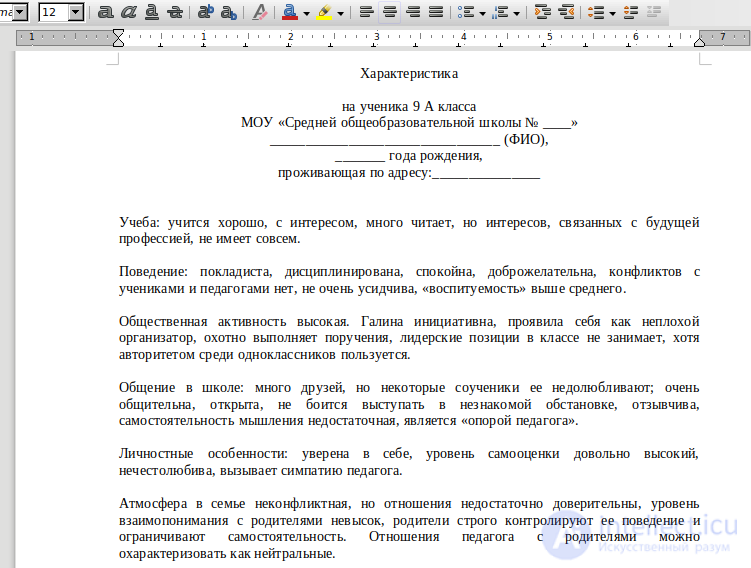
fig. sample profile
A psychological and pedagogical profile typically includes the following elements:
Information about the student:
Physical and psychophysiological condition:
Intellectual and psychological characteristics:
Academic achievements and progress:
Social and pedagogical adaptation:
Recommendations:
General development. Speech culture, breadth of reading, regularity of reading, stability of reading interests, attendance of movies, theaters, etc.
The child's attitude toward schoolwork. How the student approaches their studies at school. Regularity of class attendance. Is the student attentive in class? Does the student consistently prepare homework? Can the student organize their own schoolwork independently? Does the student make an effort to catch up on missed material? How does the student react to their successes and failures in schoolwork?
The student's academic performance. How does the student perform in various subjects? Which subjects does the student like? Which subjects come easily, and which are difficult?
Attitude toward physical labor. How does the student feel about self-care tasks? Does the student enjoy working in school workshops and on the school grounds? The child's work-related and moral qualities.
The student's level of discipline. Has the student developed skills and habits of well-mannered behavior? The student's organization in class. Politeness in dealing with adults and peers. The student's tidiness.
The student's interests and inclinations. Academic interests. Interests in literature, art, science, technology, and sports. Breadth and stability of interests. Which clubs does the student attend? What profession interests them? Are their interests connected to their choice of future profession?
Social awareness. Worldview. Civic stance. The overall direction of the student's ideals and aspirations, and their ability to embody these in concrete actions — in studies, in community work, in labor. Motives behind academic and social activity. The student's moral qualities. A sense of love for the homeland. Interest in events in the country. Willingness to help the school and society through their own effort.
A sense of collectivism, sense of duty, responsibility, truthfulness and honesty, principledness, modesty. Attitude toward parents and family members, attitude toward teachers and older peers. Does the student show sensitivity and attentiveness toward their classmates, and do they help them?
Volitional character traits. Purposefulness. Activity, decisiveness, courage, independence, initiative. Organization: self-control, composure, self-confidence, discipline. Fortitude, persistence, perseverance, bravery, self-criticism, modesty.
Features of the student's temperament and mental processes. Strength, balance, and mobility of nervous processes. Does the child react, speak, and act quickly or slowly? Do excitation or inhibition processes predominate in the child? Does the student switch easily from one task to another? What are the features of intellectual or emotional processes (speech, attention, memory, emotions)? How does the student express their feelings?
Participation in the social life of the class. Interest in class life and degree of activity in community work. Involvement in children's (youth) organizations. The manner in which community work is carried out. Conscientiousness. Ability to see a task through to completion. Ability to involve other students in the work. Does the student have organizational skills?
The student's place within the class group. Is the student connected to the group or cut off from it? How do the students in the class treat them? Do they enjoy respect and authority in the class?
Family members: father, mother, and other family members living with the student; each one's year of birth and education; profession, place of work, and position held;
Socio-demographic conditions of the family: large family, single-parent family, ill or disabled parents;
Material or housing conditions: low-income, low-earning, living in poor housing conditions; the student's living conditions: whether they have a separate room or corner, a separate desk, or lack a permanent place to study, etc.;
The nature of the relationship between parents and other family members and the student: caring, friendly, trusting, based on equality, distant, overly controlling in trivial matters, fully independent, autonomous, unsupervised, etc.;
Socio-psychological conditions: an unfavorable psychological climate in the family, parents who are pedagogically inadequate, emotionally conflictual relationships within the family;
Criminogenic conditions: immoral lifestyle of the parents, alcohol abuse, drug use, social parasitism, cruel treatment of children.
Conclusions: identifying and keeping track of children and adolescents:
Who find themselves in unfavorable family conditions that threaten their health and development;
Who need financial assistance;
Who temporarily need to live apart from their parents;
Who live in social risk groups.
physical development, spiritual development, developmental abnormalities, chronic illnesses.
Does the student enter into conflicts with parents, teachers, or fellow students?
Features of the student's sociability;
Manifestation of positive personality traits and behaviors: respect for elders;
Attentiveness, sensitivity, kindness; modesty, diligence, conscientiousness; self-organization, independence, discipline, other qualities;
Manifestation of negative behaviors: rudeness, individualism, egoism, conceit, arrogance; frivolity, carelessness, dishonesty, stubbornness, cruelty; bad habits and other negative qualities;
Ability to choose an independent occupation. Duration of interest shown in the chosen occupation.
Conclusions: identifying and keeping track of children with antisocial behavior:
Truancy;
Vagrancy, begging;
Acts containing elements of a crime;
Offenses;
Consumption of alcoholic beverages, drugs, or psychotropic substances;
Gambling and other antisocial manifestations.
A psychological and pedagogical profile is developed taking into account the specific needs and characteristics of the student, and it serves as an important tool for teachers, parents, and psychologists to ensure the student's effective education and upbringing. It can also be updated and supplemented over the course of schooling to reflect changes in the student's development.

Comments