
Lecture
T. Ribot's Theory of Attention is a motor theory of attention proposed by the French psychologist Théodule Ribot, described in his 1888 work "Psychology of Attention" (La Psychologie de l'attention), according to which involuntary and voluntary attention are directly determined by the intensity and duration of the emotional states associated with the object of attention.
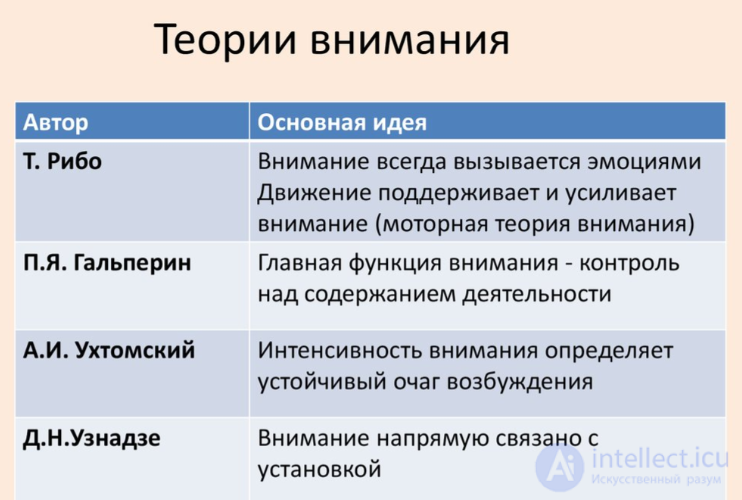

T. Ribot defines attention as a temporary unity of consciousness (mental monoideism — the dominance of a single idea in consciousness, as opposed to polyideism, the ordinary state of consciousness), accompanied by natural adaptation of the individual (in the case of involuntary attention) or artificial adaptation (in the case of voluntary attention). In describing the essence of attention, T. Ribot emphasizes the limited duration of this state. The state of attention is always accompanied not only by emotional states but also by certain physiological changes in the organism. The necessary conditions that constitute the component elements of attention are movements. They are neither the cause nor the consequence of attention.
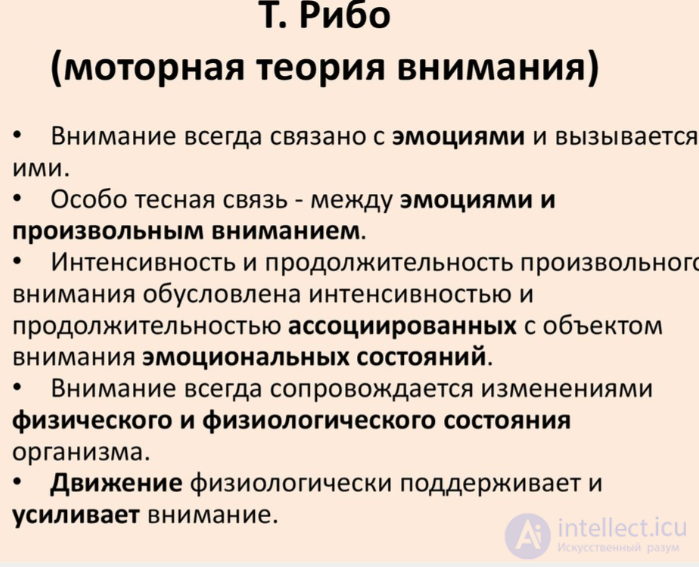
Movements constitute the objective side of attention, while its subjective side is the reflection in consciousness of the quantity and quality of muscular contractions and organic changes. Attention is not a purely psychic activity; it is connected with certain physiological and physical processes, acts through them, and depends on them. The main role of movements in the act of attention is to maintain and reinforce this state of consciousness. Muscular elements participate in all acts of attention — "actual movements or movements in an embryonic state," "a motor act and an inhibitory act." T. Ribot identified three groups of elements of attention as a physiological process:
According to T. Ribot, the motor effect of attention consists in the fact that certain sensations, thoughts, and memories acquire a special intensity and clarity because all motor activity turns out to be concentrated precisely on them. T. Ribot illustrated the inseparable nature of the physiological and psychological aspects of attention with such stable expressions as: "to collect one's thoughts," "to rack one's brains," "eyes popping out of one's head."
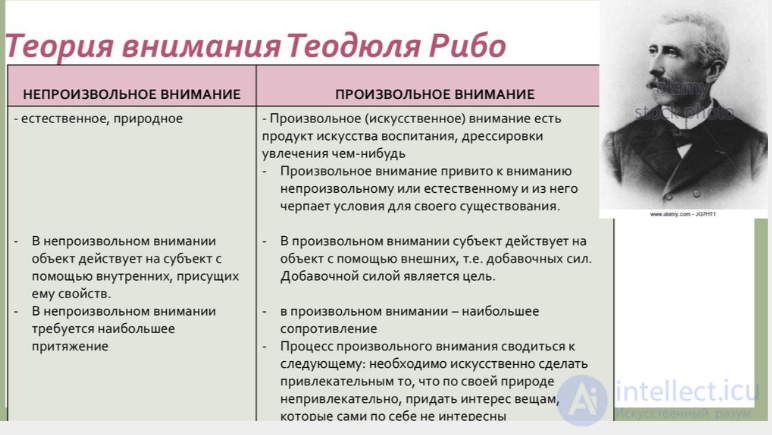
Involuntary (natural) attention is the original and fundamental form of attention. It depends directly on affective (emotional) states and is accompanied by certain physiological processes. In the case of involuntary attention, the whole body concentrates on the object of attention: the eyes, ears, sometimes even the hands — all movements seem to "freeze." The personality is captured, and all energy is directed toward the object of attention. Both physical and mental adaptation occur. Voluntary (artificial) attention is based on involuntary (natural) attention, yet it is a product of civilization . It represents merely imitation, a result of upbringing, training, or being drawn to something. In cases of voluntary attention, the body's adaptation is often incomplete and unstable. The organism concentrates, but sluggishly and weakly. Interruptions in physical adaptation indicate interruptions in mental (intellectual) adaptation. The personality is captured only partially. The main feature of artificial attention is that interest is formed (cultivated) as circumstances demand. According to T. Ribot, as soon as humans developed a need for labor, voluntary attention became vitally important in a new form of the struggle for life. It was precisely when people were able to devote themselves to labor — unattractive by its nature but necessary for survival — that voluntary attention came into being. It is easy to prove that before the emergence of civilization, voluntary attention did not exist, or appeared only momentarily. He calls artificial attention a social phenomenon, a necessary adaptation to the conditions of higher social life.
R. S. Nemov proposed calling T. Ribot's concept psychophysiological, since a direct link is evident between the psychic and physiological mechanisms of attention. D. N. Uznadze believed that attention is directly connected with "set" (Einstellung), which arises directly at the moment of a person's interaction with changed conditions, and it is precisely this that determines the direction and selectivity of human behavior.

Comments