
Lecture
The principles of psychology are the fundamental propositions that determine the understanding of the essence and origins of people's psyche, the peculiarities of its formation and development, the mechanisms of its functioning, and the forms of its manifestation, as well as the approaches to studying and changing it. The principles accumulate the basic patterns and laws operating in the sphere of the psychic. Identifying and formulating principles is the result of lengthy research by specialists into the psychic and the spiritual. In this sense, the diversity of approaches to understanding the psychic is explained by the variety of psychological schools, the distinctiveness of philosophical positions, and the preferences of the researching psychologist. A major contribution to the development of the principles of psychology was made by the philosophical sciences, as well as physiology, pedagogy, sociology, economics, political science, ethics, and aesthetics. All these sciences study relatively independent spheres of people's life and activity that influence the formation and development of their psyche. It is important to understand that the laws operating in these spheres possess relative independence, although they do experience mutual influence in the peculiarities of their manifestation. Thus, regarding the interaction between the laws of social life and human biology, A. N. Leontiev noted: what kind of food enters a person's stomach is determined by social circumstances, but the process of digestion occurs according to the laws of physiology.
Drawing on philosophical, natural-scientific, and other scientific foundations, domestic psychology has formulated the leading methodological principles that determine its position in understanding the psychic.
The principles of psychology are the fundamental propositions that determine the understanding of the essence and origins of people's psyche, the peculiarities of its formation and development, the mechanisms of its functioning, and the forms of its manifestation, as well as the approaches to studying and changing it. The principles accumulate the basic patterns and laws operating in the sphere of the psychic, and it is therefore extremely important to grasp the content of the principles and their basic requirements. At the same time, it must be understood that principles are not the starting point of research but its final result (F. Engels). Identifying and formulating principles is the result of specialized and often lengthy research by specialists into the psychic and the spiritual.
A decisive contribution to the development of the principles of psychology was made by the philosophical sciences, and above all by the development of the fundamental question of philosophy, the general laws of dialectics, the leading categories of philosophy (quantity, quality, measure, necessity and chance, cause and effect, form and content, truth and its criteria, development, motion, interconnection, the category of matter, the material and the ideal), the theory of knowledge, and so on. In this sense, the pluralism of approaches to understanding the psychic and the diversity of psychological schools are largely explained by the distinctiveness of philosophical positions and the preferences of the researching psychologist.
The physiological sciences, and above all the physiology of the brain and the physiology of higher nervous activity, have had a great influence on the understanding of the psychic and the development of the principles of psychology.
Among the other sciences that have influenced the understanding of the psychic, its origins, and its distinctiveness are, first and foremost, pedagogy, economics, sociology, political science, ethics, aesthetics, and jurisprudence. All these sciences study relatively independent spheres of people's life and activity that influence the formation and development of their psyche.
The laws operating in these spheres possess relative independence, although they do experience mutual influence in the peculiarities of their manifestation. This is important to understand when taking into account the interaction between the laws of psychology and the social sphere of people's life activity and the laws of their biology. Thus, regarding the interaction between the laws of social life and human biology, A. N. Leontiev noted: what kind of food enters a person's stomach is determined by social circumstances, the conditions of their life, and so on, but the process of digestion and its processing in the stomach occurs according to the laws of digestive physiology. And it is understandable that the quality, composition, and quantity of what enters a person's stomach can significantly affect the manifestation of the laws of digestive physiology, leading to disturbances in the body and in the person's nervous system, and to distinctive features in the formation and manifestation of their psyche.
Drawing on philosophical, natural-scientific, and other scientific foundations, domestic psychology has formulated the following main, leading methodological principles that determine its position in understanding the psyche and the approaches to studying and shaping it.
The principle of reflection. This reveals the understanding of the essence of the psychic and its main functions and levels in the development of the human psyche. The distinctiveness of the human psyche—a special form of reflection—is conditioned by many circumstances: the peculiarities of objective reality itself, perceived both through the sense organs and with the help of speech; the state of the brain; the person's physical and mental health; and the content and state of their psyche.
The principle of reflection reveals the understanding of the essence of the psychic and its main functions and levels in the development of the human psyche. According to A. N. Leontiev, there is not a single trace in the psyche that is not a reflection of something.
It is evident that the distinctiveness of the human psyche, this special form of reflection, is conditioned by many circumstances, among which the leading roles are played by the following: the peculiarities of objective reality itself, perceived both through a person's sense organs (via the first signaling system, including through extrasensory perception) and through language and speech (via the second signaling system); the state of the brain and the person's physical and mental health; and the content and state of their psyche.
The peculiarities of psychic reflection are examined in more detail in the first chapter of this textbook.
The principle of determinism. This explains the causes of the development of the psyche and its origins. The human psyche is conditioned by, and is the result of, the interaction of factors of a biological, natural, and social nature. At the same time, the psyche is not simply a product but the result of the interaction and influence on the person of social, biological, and natural factors. Thus, the psyche is capable of changing and developing.
The principle of activity. This orients the researcher, when studying psychic phenomena, to take into account that external and other circumstances are reflected in a person's consciousness consciously and purposefully, not merely as in a mirror. The principle of the activity of the psychic and of consciousness orients the researcher, when studying the psyche and psychic phenomena, to take into account that external and other circumstances are reflected in a person's consciousness in the form of one image or another selectively and purposefully, not merely as in a mirror. This is conditioned and determined by the life, professional, and other experience a person has, by their needs and interests, and by the fact that every act of the psychic also contains a relational aspect. A person's psyche, its content and state, act as a kind of transformer, a prism for all external and other influences. Some circumstances, facts, and events, being perceived inadequately, noticeably intensify their impact on the person and their psyche; the degree of influence of other events, on the contrary, weakens. Toward a number of life circumstances, at one moment or another, a person develops a neutral attitude, as if indifferent to them. Much of what happens in the surrounding reality and in the person's own body is reflected at an unconscious level, bypassing consciousness. However, everything that in one way or another affects a person leaves "traces" in the brain, which sooner or later may be activated and create a distinctive functioning and disposition of the psyche in perceiving and evaluating objective reality.
The principle of development. This reveals the origins of the human psyche as a dynamic phenomenon. The psyche can be correctly understood only if it is regarded as the result of social interaction—of a person's interaction with the social and natural environment, as the result of their activity and communication with other people, and the result of their upbringing and education. The principle of the development of the psyche and of a person's consciousness in activity and in interaction with the environment explains that the psyche and consciousness of a person develop through activity and through interaction with the world and communication with other people. In the process of an individual's interaction with the social, technical, and natural environment, the origins of the human psyche are revealed. A person's psyche and consciousness can be correctly understood and explained only on the condition that they are regarded, as a rule, as the result of a person's social interaction with the surrounding social, technogenic, and natural environment, of activity and communication with other people, and of their upbringing and education. A specifically human form of psychic development is socialization, as the process by which a person assimilates social experience. It is through socialization that a person's consciousness and self-awareness are formed and developed, and their system of values takes shape. Thus, whatever the social circumstances of people's life and activity are, so too are the people themselves: their consciousness, interests and needs, aspirations, abilities, and so forth. A change in life circumstances, and above all in the nature and conditions of activity and in relations between people, leads to changes in their psyche and consciousness. S. L. Rubinstein noted that, in manifesting itself in activity, consciousness is also formed in activity.
The principle of interconnection and unity. Distinguishing two facets in the manifestation of the psychic—the subjective (what and how a person thinks, experiences, and evaluates) and the objective (real behavior, actions, and deeds materialized and objectified as the results of a person's actions)—gives grounds to assert that the most adequate understanding of the psychic is possible only on the basis of a system of its subjective and objective manifestations. The principle of the interconnection and unity of consciousness, the psychic, and activity and behavior shows that the human psyche is formed, functions, develops, and manifests itself only in the process of social labor activity and a person's interaction with other people. The unity (but not identity) of consciousness, the psychic, and activity and behavior consists in the following: consciousness and the psychic prompt a person to act, forming the internal plan of activity and behavior, their program and model, by means of which a person orients themselves in the surrounding environment. This principle orients the specialist and practitioner, when studying and analyzing people's behavior and activity, not only to take into account the external picture and pattern of behavior and external circumstances, but also to determine the internal psychological mechanisms (goals, motives, value orientations, knowledge, skills, abilities, etc.) of the personality that produced the corresponding behavior, action, or deed, as well as its results.
The principle of a holistic, systemic approach. This presupposes understanding and studying interconnected and mutually conditioning psychic phenomena, orienting the specialist toward recognizing the psyche as a holistic, integral phenomenon. The principle of a holistic, systemic approach to understanding and studying the psyche orients the specialist to understand that the psyche is formed, functions, and manifests itself as a holistic, integral phenomenon. All individual and group (social) psychic phenomena are interconnected and mutually conditioning. Their isolation and separate examination in psychology as an academic discipline (and indeed in science) is conventional in nature and is intended to reveal the peculiarities and properties of these phenomena. At the same time, quantitative and qualitative changes occurring in individual psychic phenomena, processes, and mechanisms immediately lead to changes in the functioning and manifestations of the entire psyche as a system. The human psyche, whether of an individual or of various forms of human communities, is a holistic, systemic, hierarchically organized, and multi-content formation, and therefore any correction of individual characteristics of the psyche alters it as a whole. It is also important to emphasize that the human psyche, functioning systemically amid the diversity of interconnections among its various phenomena, possesses compensatory properties: insufficient development of some psychic functions can be compensated for by the corresponding development of others. For example, a lack of interest in an academic subject or in a particular activity can be compensated for by a person's high degree of volitional preparedness and self-discipline, and insufficient ability by diligence, and so on.
The principle of relative independence. This does not contradict the previous principle but points to the fact that every psychic phenomenon has its own distinctiveness, both in its physiological foundations and in its own laws of formation, functioning, and development. The principle of the relative independence of psychic phenomena does not contradict the previous one but merely indicates that each psychic phenomenon in a person may have not only distinctive physiological foundations (see Chapter 2 of this textbook) but also its own laws of formation, functioning, and development (for example, memory, will, emotions, abilities, character, etc.). Moreover, both individual and group, mass psychic phenomena can function (and be formed) quite intensively independently of other psychic phenomena, determining and ensuring corresponding behavior and actions of people (for example, this or that personality accentuation, dominant need, tradition, value, etc.).
The principle of the personal approach, taking into account group and social interests and values. The study of the psyche is adequate only when personal and group characteristics of people are taken into account together: their needs, interests, life and professional experience, abilities, and the psychotypical and individual-psychological peculiarities of people. The principle of the personal approach, taking into account group psychology in studying, understanding, and shaping individual psychic phenomena, facts, and mechanisms. In accordance with the requirements of this principle, the study of the human psyche and its individual phenomena can be correct only if the main, leading, fundamental personal and group characteristics of people are taken into account together, in unity: their needs, interests, life and professional experience, abilities, and other characteristics as a whole, taking into account the distinctiveness of both the psychotypical and the individual-psychological peculiarities of people.
The principle of unity. This orients specialists toward a content-based, axiological analysis of people's psyche, taking into account the specific historical conditions of their life and activity. The principle of the unity of the concrete-historical approach and content-based analysis in understanding people's psyche orients the specialist toward a content-based and value-based (axiological) analysis of people's psyche, taking into account the specific historical conditions of their life and activity. A person's psyche cannot be correctly and fully understood if the requirements of this principle are ignored. A purely content-value or, conversely, purely concrete-historical analysis of the psyche and its individual phenomena is not sufficient for their correct understanding.
The principle of determinism explains the causes of the development of the psyche and its origins. Here it is important to see and grasp two circumstances.
The first—the human psyche is conditioned by, and is the result of, the interaction of many factors and circumstances of a biological, natural, technical, and social nature. At the same time, the leading role in the formation and development of the human psyche, both of individual people and of various forms of human communities, is played by the social conditions of their life and activity. The content of a person's psyche is determined by the way and level of people's life and activity and changes as life circumstances change. Its origin, formation, and development depend decisively on the mode of production, distribution, and consumption of material and spiritual means, and on the social, group, and individual existence of the person. It is above all the distinctiveness of these circumstances, as well as of the moral, aesthetic, political, legal, religious, and other social norms, rules, and values dominant in society, that determines the particular content, level of functioning, and orientation of people's psyche.
At the same time, the human psyche is not simply a product of circumstances. Through people's activity, it can change these circumstances (K. Marx).
The second circumstance is that the human psyche is not simply a product, a result of the interaction between a person and social, biological, technogenic, and natural factors and circumstances. S. L. Rubinstein noted that "psychic phenomena appear in a person's life not only as conditioned but also, at the same time, as conditioning; determined by the conditions of a person's life, psychic phenomena condition their behavior and their activity,"1 by means of which a person transforms the surrounding social and natural world and themselves.
The human psyche, therefore, possesses the capacity to change and develop itself.
In speaking about the principles of psychology, it is important to single out especially the principles of integrative psychology, as a major contemporary trend in psychological knowledge.
The principle of wholeness. This implies understanding the psyche as an extremely complex, open, multilevel, self-organizing system, capable of maintaining itself in a state of dynamic equilibrium and of producing new structures and new forms of organization.
The genetic principle, or the principle of development, is expressed in the fact that the development of the human psyche has many potential directions. These directions are determined at critical points—bifurcation points—where the system makes a choice regarding the path of its further development. It can be said that at the bifurcation point the system is in a state of temporary instability and is extremely sensitive even to minor external influences. This state of the system corresponds to the initial stages of a crisis, when, against a background of growing instability, there occurs a mobilization of psychic and physical resources and an active search for new paths of development.
The principle of conditionality. The psychic space represents a system of interconnected spatiotemporal conscious and unconscious structures (gestalts, wholenesses of psychic reality, systems of condensed experience, etc.), between which there exists an energy-informational interaction within the psyche. The nature of this interaction is determined by the patterns of a person's relationships with the surrounding world.
The principle of positivity implies that the specialist and the client center on positive experience.
The principle of correspondence implies that the nature and intensity of the impact of psychotechnologies should match the patient's level of maturity and the degree of sensitivity of their psyche.
The principle of potentiality. If one pays attention to the peculiarities of the Russian mentality, one can note a distinctive way of perceiving space. It is experienced as expanse, as something one breaks out into from captivity, as the pure potentiality of being, will, freedom, full breathing—that is, a spiritual life unconstrained by worldly sorrow.
Integrative methodology, drawing on a holistic vision of the person in the perspective of their material, social, and spiritual growth, provides, in psychosocial work with the client, for the disclosure of their potentiality and the development of their intuition, creativity, higher states of consciousness, and personal resources.
The principle of the multidimensionality of truth. Any theory, concept, therapeutic myth, teaching, idea, or everyday judgment about psychic reality, however complete and universal it may appear, is valid only under certain circumstances and with a certain degree of probability. It should be remembered that both the most brilliant psychological theories and some clients' statements about being "hexed" or "cursed" are, first and foremost, attempts to structure and convey their own inner experience.
BASIC ETHICAL PRINCIPLES IN PSYCHODIAGNOSTICS
The professional and ethical norms of work in the field of psychodiagnostics have been formulated in a number of principles. They are elaborated and complemented in the works of contemporary psychologists A. A. Bodalev and V. V. Stolin,2 as well as A. G. Shmelev.3 An analysis and comparison of these authors' positions has made it possible to identify eight fundamental ethical principles in psychodiagnostics. Let us examine them in more detail.
1. The principle of responsibility: this presupposes the responsibility of the psychologist-diagnostician for preserving the mental and physical health, emotional and somatic comfort, and social well-being of the person being examined in the course of diagnostics.
2. The principle of competence: this presupposes that a psychodiagnostic examination is always carried out by qualified psychologists who have a basic higher psychological education. The diagnostician takes on only those tasks and questions in which they are professionally competent.
3. The principle of confidentiality. This principle presupposes the non-disclosure of results without the personal consent of the person on whom the psychodiagnostics was conducted. The exception is cases where psychodiagnostics is conducted for scientific purposes as part of an experimental study, but even in such cases it is not recommended to give the exact names and surnames of the subjects in publications.
4. The principle of scientific validity of a psychodiagnostic method requires, at a minimum, that it be valid and reliable, that is, that it produce results that can be fully trusted.
5. The principle of doing no harm presupposes that the results of psychodiagnostics must never be used to the detriment of the person being examined. If psychodiagnostics is conducted for the purposes of competitive selection or when hiring a person for a job, this principle is applied together with the principle of openness of results to the person examined, which requires that they be informed about what and how will be tested, what the results of their examination are, and by whom and how these results will be used in deciding their fate.
6. The principle of objectivity of conclusions drawn from testing results requires that they be scientifically grounded, that is, that they follow from the results of testing carried out using valid and reliable methods, and that they not be determined by, or in any way dependent on, the subjective attitudes of those conducting the testing or using its results. In selecting methods for an examination program, the psychologist is not guided by subjective preferences in evaluating the methods but proceeds from the requirement of maximum diagnostic efficiency—maximum reliability at minimum cost. The psychologist must necessarily consider, alongside the most probable one, an alternative psychodiagnostic hypothesis (interpretation of the data), applying in psychodiagnostics a principle analogous to the "presumption of innocence" in legal proceedings.
7. The principle of the effectiveness of the recommendations offered presupposes that such recommendations must necessarily be useful to the person to whom they are given.
8. The principle of comprehensive diagnostics—the principle of combining various methodological techniques in diagnosing one and the same psychic property, as well as combinations of methods aimed at related psychic properties, in order to increase the validity of the diagnostic conclusion. The psychologist ensures the necessary level of diagnostic reliability by applying both standardized and non-standardized methods, as well as the method of independent expert assessments.
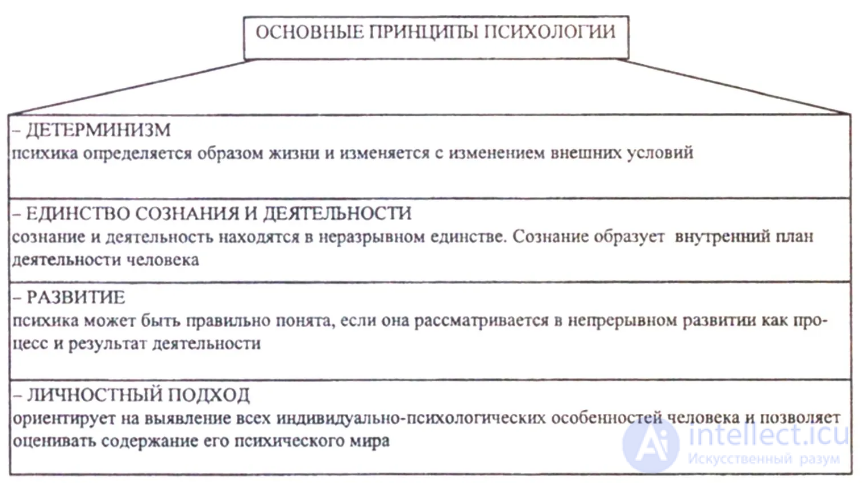

Fig. Principles of General Psychology

Fig. Principles of Clinical Psychology
All the main principles of psychology named above constitute a system in which each element reveals one facet or another of the psychic. Therefore, disregarding the requirements of even one of these principles reduces the possibility of understanding and changing the psyche of a person or a social group.
It is important to grasp the basic requirements of the leading principles of domestic psychology, and the distinctive ways of implementing these requirements in professional activity.
The professional activity of a specialist in any field will be more successful if they constantly study and understand the distinctive psychology of their colleagues and take its peculiarities into account when solving professional tasks. To do this, they can use the appropriate means and methods for studying personality and psychic phenomena and processes within a work collective.
1. What is the principle of geohomeostasis? (choose 1 incorrect answer)
2) The ethical principles of psychodiagnostics include:
3) Match the following.
a) development; b) the unity of consciousness and activity; c) determinism
4) The causal conditionality of psychic phenomena constitutes the essence of:
5) Invariability, the constancy of something under changing conditions—this is the principle of:
6) The principle asserting that any psychic phenomenon must be considered in constant change and motion:
7). An individual approach to a person as a personality, understood as a reflecting system that determines all other psychic phenomena, constitutes the essence of:
[[b84]]

Comments