
Lecture
Conflictology is an interdisciplinary field of knowledge and a science that studies the patterns of the emergence, occurrence, development, resolution, and conclusion of conflicts of any level .
Solving a certain range of problems that give rise to conflict can help overcome the difficulties already identified in connection with defining the essence of conflict, and the object and subject of conflictology.
One of the founders of the general theory of conflict was Karl Marx, who developed the doctrine of contradiction and elaborated a model of revolutionary class and social change. Later, the main tenets of his theory of conflict were formulated by the American sociologist J. Turner.
However, as a science, conflictology originates in the mid-20th century with the book by the German-American sociologist Lewis Coser, "The Functions of Social Conflict" , which based its conclusions on the findings of the early 20th-century German philosopher Georg Simmel, and with the work of the German-British sociologist Ralf Dahrendorf .
The main conclusion of Simmel that Lewis Coser highlighted is that conflict is a form of socialization. "Conflict, like cooperation, has social functions. A certain level of conflict is by no means necessarily dysfunctional, but is an essential component both of the process of a group's formation and of its stable existence" .
Georg Simmel wrote: "Only philistines could believe that conflicts and problems exist in order to be resolved. Both have, in everyday life and in the history of life, still other tasks that they perform independently of their own resolution. And no conflict has ever existed in vain, if time does not resolve it but replaces it, in form and content, with another" . Thus, he advanced the concept of conflict as a "safety valve": conflict serves as a valve that releases feelings of hostility which, without this outlet, would blow up the relationship between antagonists . Conflict is not always dysfunctional in relation to the system in which it arises; often conflict is necessary for its preservation. Conflict serves to establish and maintain the self-identity and boundaries of societies and groups. According to Coser, the function of conflict lies in establishing and maintaining group identity, and conflict with other groups helps to strengthen the group's identity and preserve its boundaries in relation to the surrounding society. That is, conflict performs a group-preserving function to the extent that it regulates systems of relations .
Grounds for conflict exist in any society, but social structures differ in the permitted ways of expressing antagonistic demands. "Perhaps conflict is the father of all things, that is, the driving force of change, but conflict must not be war, and it must not be civil war," wrote Ralf Dahrendorf. In Dahrendorf's view, conflicts can be more or less intense and more or less violent, but their regulation is a decisive means of reducing violence; the regulation of conflicts makes them controllable, "and their creative force is put to the service of the gradual development of social structures" .
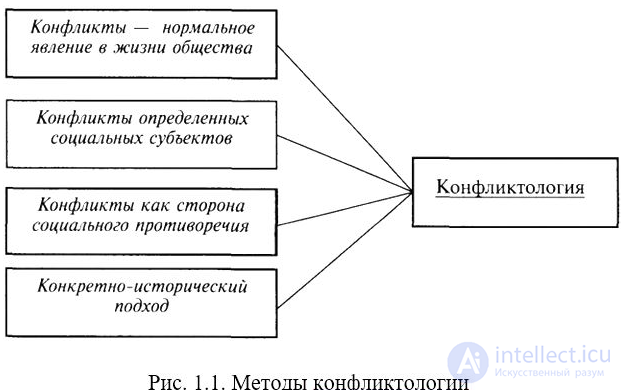
There are two most common approaches to understanding conflict. In the first, conflict is defined very broadly as a clash of sides, opinions, or forces. Under this approach, conflicts are possible even in inanimate nature. The concepts of "conflict" and "contradiction" effectively become comparable in scope. The second approach consists in understanding conflict as a clash of oppositely directed goals, interests, positions, opinions, or views of opponents or subjects of interaction. Here it is assumed that the subject of conflict interaction may be either a single person or people and groups of people.
Social conflict is understood as the most acute way of developing and concluding significant contradictions that arise in the process of social interaction, consisting in the opposition of the parties to the conflict and accompanied by negative emotions toward each other. If the parties to a social conflict oppose one another but do not experience negative emotions in doing so (for example, in the course of a discussion or a sporting contest), or conversely, experience negative emotions but do not outwardly display them and do not oppose one another, such situations are considered pre-conflict. Opposition between the parties to a conflict can unfold in three spheres: communication, behavior, and activity. Opposition consists of communication or actions aimed at expressing disagreement with the opponent, blocking their activity, or inflicting material (or moral) damage on them.
Intrapersonal conflict is understood as a pronounced negative experience caused by a protracted struggle among the structures of a person's inner world, reflecting contradictory ties with the social environment and delaying decision-making. At the root of any conflict lies a contradiction, which plays a structuring role both for various types of conflict and for various levels of their study.
Today, research into conflict is conducted within the framework of military science, art history, history, mathematics, pedagogy, political science, jurisprudence, psychology, sociobiology, sociology, philosophy, and several others (for example, psychiatry and economics). People and governing bodies deal with whole, real conflicts, not with their separate psychological, legal, philosophical, sociological, and other aspects.
These considerations justify the need to distinguish an independent science — conflictology. The object of its comprehensive study is conflicts as a whole, while the subject is the general patterns of their emergence, development, and conclusion. Conflictology should be concerned with two types of conflicts: those involving humans (intrapersonal and social) and zoo-conflicts (conflicts among animals). The main types of social conflict include: interpersonal conflicts, "individual versus group" conflicts, conflicts between small, medium, and large social groups, and international conflicts between individual states and their coalitions. The central object of conflictology is social conflict, and its core is interpersonal conflict. The study of interpersonal conflicts, which are less complex than other social conflicts, can reveal the main causes of conflict interaction. Social conflicts are closely linked to intrapersonal conflicts. Therefore, understanding the motives of social conflicts is difficult without studying the processes that occur in the psyche and precede a person's conflict behavior. Each of the eleven specialized conflictological sciences has its own subject within the object common to all these sciences. This is the part, aspect, or level of the object that a given science investigates. However, conflictology itself is not capable of describing and explaining conflicts in their full complexity.
Conflicts are an inexhaustible object of knowledge, about which it is impossible to know absolutely everything. Therefore, the subject of conflictology consists of those patterns, aspects, and characteristics of conflicts that science is capable of investigating at its current stage of development. The object of conflictology is a much more conservative formation compared to its subject. The object may change as a result of its own development; moreover, its boundaries may be refined in connection with science's deeper penetration into the essence of the phenomena under study. The object of conflictology — social, intrapersonal, and animal conflicts — is unlikely to undergo significant changes in the foreseeable future .
Conflictogenesis is the process of the emergence and development of the modern conflict forms of society, which leave their mark on, and often directly determine, the direction and content of evolution as a whole. Conflictogenesis represents a continuous dialectical process of the birth, development, and modernization of existing social reality through its core — conflict[10].
The Unified Theory of Conflict (UTC) is a branch of the theory of conflict analysis and resolution that has been intensively developed by the St. Petersburg researcher, Doctor of Philosophy V. A. Svetlov, since the beginning of the current century[11].
The main motive behind the development of the UTC was the fact that contemporary conflictology fails to satisfy a single requirement placed on scientific theories. It is divided into numerous specialized conflictologies (political, economic, legal, etc.) that are not connected to one another by anything but a common name; it lacks universal laws, a precisely defined range of problems to be solved, and specialized methods for solving them. It employs a concept of conflict based on common sense; its conclusions are speculative and for the most part not universally valid. It is confined exclusively to conducting negotiations and mediation, without any serious theoretical grounding for this type of activity. It ignores the existence of socio-psychological concepts that analyze conflicts in their own specialized terms — F. Heider's theory of cognitive balance, L. Festinger's theory of cognitive dissonance, F. Harary's theory of structural balance, and their numerous modifications and updates, which have now merged into a single overarching field, "social network analysis." Finally, it neglects not only the mathematical justification of its conclusions but also the methods and computer programs, adapted for mass application, for modeling and analyzing conflicts — classical game theory and its modifications, K. Hipel's theory of conflict analysis and that of his group, and N. Howard's drama theory and that of his associates.
The mathematical basis of the UTC consists of the concepts, methods, and theorems of the theories necessary for constructing and analyzing a working (research) model of conflict. First and foremost, these are the concepts, methods, and theorems of graph theory, probability theory, propositional logic, and game theory (and its various modifications). Expanding the scope of application of the UTC generally leads to an expansion of its mathematical basis.
The theoretical basis of the UTC is formed by a universal model of conflict — a definition of conflict that generalizes all types of non-logical contradictions, together with a set of theorems about its properties and the properties of its alternatives: synergism and antagonism. Combining the universal model of conflict with the mathematical basis produces the unified theory of conflict in the proper sense: UTC = MB u UMC, where MB is the mathematical basis and UMC is the universal model of conflict.
Depending on the goals of the research, the UTC makes it possible to select and construct the necessary working model of conflict, and to use it to identify and assess the structural, network, dynamic, game-theoretic, and other features of the emergence, development, and resolution of the conflict being analyzed. At this stage, the main function of the UTC is to provide the researcher with effective assistance in constructing a working model of conflict, assessing its validity, determining its explanatory and predictive capabilities, developing strategies for managing conflict resolution, and empirically testing the theoretical conclusions obtained
The resolution of a conflict in a situation of disagreement over a particular issue is typically carried out between two (or more) conflicting parties with the involvement of a person, or a group, considered neutral on the matter under discussion. It often happens that this latter condition turns out not to be essential, when the mediator is a group or person who is respected by all the opposing sides. Conflict resolution can include reconciliation, mediation, arbitration, or litigation.
All these methods require the intervention of a third party. The method of resolution that takes place directly between the parties to the disputed process is called negotiation. The negotiation process can be compared to a traditional form of haggling, in which the parties' interests negate the working relationship that exists between them. Principled negotiations give importance to both mutual interests and the business relationship.
It is possible to avoid a conflict without actually resolving it, by getting the parties to mutually recognize that their opinions differ, but that there is no need at this point in time to take further action. In some cases — in democracies, for instance — a difference of opinion may even be the desired outcome, thereby exposing the problem and thus giving others the opportunity to form their own point of view: in such a case, the parties may agree to disagree.
Types of intergroup conflicts: 1. Economic conflicts; 2. Political conflicts; 3. National (ethnic) conflicts.
It is also possible to deal with a conflict without avoiding it, but also without actively resolving it — see conflict management.
The social life of animals is complex and varied. Humans still know very little about the patterns governing animal interaction. Intraspecific conflicts also display great diversity. However, three types of conflict occur far more often than others. Let us briefly review their features.
The existence of an individual animal, an animal family, or another community depends decisively on their being provided with life resources. The main life resources include territory, food, a source of water, and others. When a life resource is scarce or its ownership is being determined, conflicts can arise between animals connected with the struggle for possession of the scarce resource. In ethology, the greatest number of studies has been devoted to animals' struggle for possession of a particular territory. This struggle is often called territorial behavior in animals.
Most animal species divide living space among themselves, mark the boundaries of their territory, and defend them. Territorial behavior in animals is a system of various forms of animal activity aimed at appropriating and using a particular space (land, water, air) that ensures the performance of all, or the main, life functions. If territorial boundaries are violated and an animal ends up on "someone else's" territory, a conflict may arise between the "owner" of the territory and the "intruder."
Territorial plots may be individual or group-owned, belonging to a community of animals — a family, pack, or herd. Accordingly, territorial conflicts can occur either between two animals or between their groups. The "owner" announces occupancy of a plot of territory through voice, a demonstrative display of itself, and, in mammals, also by leaving scent marks on conspicuous objects. This helps prevent territorial conflicts.
There are often strips of "no man's" space between the boundaries of territories. The width of these border strips varies among different animal species. The main territorial conflicts between animals occur, above all, at the borders of territory and in the "no man's" space. Matters rarely come to actual fighting. Among most titmice, for example, if one male encounters another on his territory, he immediately attacks it, and the other flees. However, if the "victor," carried away in the heat of the chase, ends up on his neighbor's territory, their roles are reversed. Now the former fugitive — the rightful owner of his territory — attacks, while his pursuer flies away from him[13]. The territories of mated pairs of harriers are separated by corridors through which all other harriers, including the neighbors themselves, can fly freely without risk of being attacked by the territory's owners. Members of each animal community organize and structure their habitat environment. First comes individual appropriation of territory and of certain objects located on it. Second comes the communal personalization of the environment[14].
Hyenas have no individual territory; it belongs to the pack. Nor are there border zones between the territories of neighboring packs. The entire pack jealously defends its territory against encroachment by relatives belonging to another clan. A situation of conflict was observed in which a hyena belonging to neither of the conflicting packs was forced to sit for some time in the middle of a shallow pond in order to avoid attack from members of both clans. The boundary between the territories of these hyena packs ran precisely through the center of the pond. Only by staying in the middle of the pond did the outsider hyena avoid provoking a territorial conflict with representatives of either pack. This hyena remained in the water in the border zone until both packs of hyenas, having concluded their conflict, withdrew deeper into their own territories.
A second typical conflict among animals connected with the struggle for life resources is food competition. In a community of predators, the division of caught prey occurs according to the hierarchical rank held by an individual within the group. When pack members of lower rank attempt to get ahead of predators of higher rank, conflicts arise between them that are both food-related and hierarchical in nature.
The extreme form of the struggle for food is cannibalism, that is, animals eating members of their own species. A study of cannibalism among tailless amphibians showed that it serves as a key link in the intrapopulation mechanism whose action is directed at maintaining the optimal size of the population and preserving its genetic diversity. Cannibalism involves nine different types of aggressive behavior. An amphibian attacks a member of its own species with the aim of eating it if the victim's body length does not exceed 63.5% of the aggressor's body length (S. Pisarenko).
Among mammals, cases of animals attacking members of their own species that end in the animal's death are quite rare. In such situations, the victim is usually a sick, wounded, or weakened animal.
This (third) type of intraspecific conflict in animals is also quite widespread and manifests itself in various forms: • conflicts between males connected with the struggle for a female. There are also conflicts between females competing over a male; • conflicts between males and females during the period of mating behavior and offspring rearing; • conflicts with fellow members of the species connected with defending offspring from possible aggression by outsiders; • intrapsychic conflicts in animals caused by the struggle between tendencies toward aggressive or sexual behavior during the mating period.
Conflicts between males, caused by the struggle for females, perform the important function of selecting the strongest and giving precisely him the opportunity to continue the line. They are usually ritualized in nature. The content of the ritual of struggle between males is aimed at revealing which of them is truly the stronger, without inflicting serious injury on either rival. Males display the impressiveness of their size, and test their strength against each other until the power, speed, and endurance of one of them has been proven to the other. The weaker rival usually leaves the site of the contest in order to try his luck, after some time, in a struggle with another male from the animal community.
Conflicts between males and females during the period of mating behavior are caused by the ambiguity of an animal's reaction to the proximity of an individual of the opposite sex. The approach of a fellow member of the species may signal not only an intention to mate but also conceal the danger of aggression. Therefore, a female may not only demonstrate readiness for sexual behavior but may also flee (fly away) or attack the male. An example is the behavior of the bird known as the greenfinch. Of 102 "hovering approaches" by the male, indicating his readiness to mate, only 25 ended in success. In seven situations, the female responded to the male's advances with aggression.
Most animals defend their offspring by entering into conflicts with fellow members of the species from whom a real or potential threat to their young originates. In some animal species, such as bears, danger to the young may come even from their own father. Conflicts connected with parents defending their offspring tend to be more intense in character than conflicts between males caused by the struggle for a female, or hierarchical conflicts. Small aquarium fish, defending their recently hatched fry, fearlessly attack larger fish approaching the fry and bite their fins. The larger fish belong to a different species and exceed the attacking parent fish in weight by more than 30–40 times.
Intrapsychic conflicts in animals that arise in connection with their activity aimed at reproducing offspring have been studied to a lesser extent than conflicts between animals. They are caused by clashes between an animal's instinct for self-preservation and the necessity of entering into a struggle to defend its offspring or its mate. Other kinds of intrapsychic conflicts are also possible.
The social life of animals is far more complex and varied than the notions of it common among conflictologists. The reason for this lies in the fact that conflictologists are mostly scholars in the humanities, whose training does not include the study of ethology — the science of animal behavior.
One of the most important aspects of the social interaction of animals is the hierarchical structure of their communities. Dominance systems are regarded by ethologists as the central pillars on which the organization of an animal community rests. It has been hypothesized that subordination is a consequence of differences in social roles to a far greater extent than it is a consequence of high or low aggressiveness. The structure of an animal community is not a rigid hierarchy of individuals but a relatively fluid system of various roles. Among these, the roles of dominant or subordinate animal are not the only ones.
The status of a particular individual depends mainly on its age and its capacity for reproduction. On these grounds, all animals in a community can be conditionally divided into five groups: • young that need parental care; • juveniles who are under parental control but are already capable of independent existence; • young animals leading an independent life, free of their parents and often living outside the family, but still incapable of reproduction; • adult animals capable of reproduction but for some reason not participating in it; • adult animals participating in the reproduction of offspring.
Within each of these groups there is also a certain structure of roles performed by the animals. Interaction between two animals representing different groups and playing different roles within the community is governed by certain rules. All animals observe these rules, since this ensures the preservation of the community's integrity. Violation of the rules leads to the emergence of conflicts.
The struggle for a higher hierarchical position within a group, like aggression in general, performs a function that promotes the survival of the animal community. The stronger and more developed the leader at the head of a community, the more optimal its interaction with the environment and with other communities. Other dominant animals within the group also influence the community's survival. Over time, dominant animals, owing to aging and other causes, inevitably cease to meet the requirements of the role they play within the group. Over the course of evolution, social mechanisms have developed by virtue of which animals occupying a lower hierarchical position within a group periodically "test" the extent to which dominant animals still correspond to the "places" they occupy. The main method of such "testing" is hierarchical conflict. In such conflict, the animal's strength, endurance, and intelligence are assessed. If a young animal, as a result of its development, has surpassed the dominant individual in its qualities, the challenger wins the conflict and takes a new, higher, hierarchical position. The loser is displaced downward on the hierarchical ladder.
Ethologists have studied the features of the development of hierarchical interaction in various animal species. In particular, in house mice it has been established that the aggressiveness of young animals increases after they are kept for a long time with older males. It has been proven that, under experimental destabilization of the intragroup hierarchical structure, there is a sharp decrease in the differences in behavior between dominant and subordinate animals. This is explained mainly by a marked increase in the activity of individuals who occupied low and middle positions in the hierarchy (S. Novikov, 1979). The cause of this increased activity is apparently the individual's striving to occupy a higher hierarchical position without entering into conflict over it with the dominant animal. Indeed, as a result of the destabilization of the group's hierarchical structure, the unambiguous correspondence between specific animals and specific dominant roles turns out to be disrupted. A hierarchical structure of the animal group exists in all their communities. At the same time, the system of hierarchical positions and roles itself is fairly rigid and only slightly variable. The specific animals occupying any given hierarchical status, however, always do so temporarily. The relative nature of hierarchical inequality among animals is unconsciously reflected in status conflicts, or is one of their causes (Yu. Plyusnin, 1994). The struggle for the highest hierarchical position in a group is usually ritualized in nature.

Comments