
Lecture
Spaced repetition is a memory-retention technique that involves reviewing learned material at specific, ever-increasing intervals . Although this principle can be applied to memorizing any kind of information, it has become most widespread in foreign language learning. Spaced repetition does not require rote memorization without understanding (though it does not exclude it either), and it is not opposed to mnemonics.
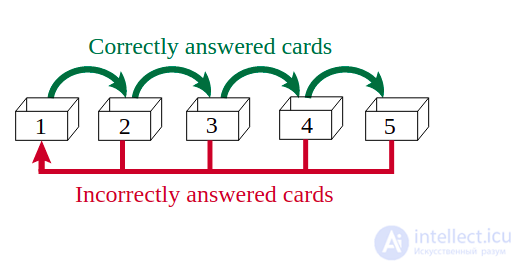
In the Leitner system, cards answered correctly move on to the next, less frequently reviewed box, while cards answered incorrectly return to the first box for more intensive review and repetition.
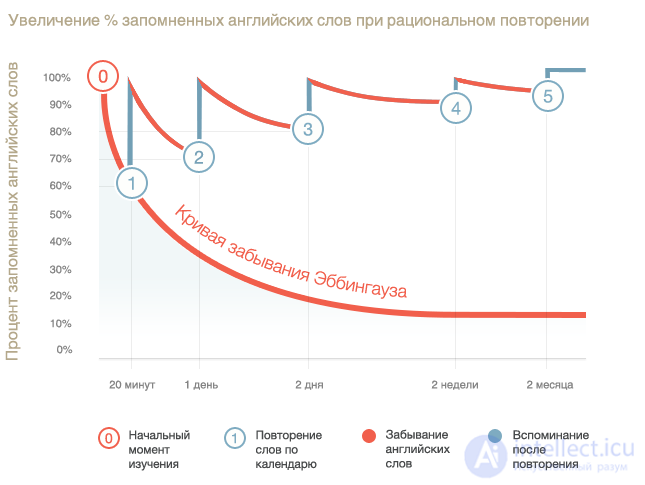
The Spaced Repetition Formula Y=2X+1, where Y is the day on which the information will start to be forgotten (forgetting proceeds gradually and equals Y days), and X is the day of the last repetition after learning. The potential interval is infinite. Some words and phrases may be remembered better than others. Spaced repetition is most often used together with a flashcard system.
The idea that spaced repetition could be used to improve the learning process was first proposed in the book "Psychology of Study" (Psychology of Study), written by Professor Alec Mace in 1932. In 1939, Spitzer tested the effect of the method on students in Iowa. Spitzer studied the method on more than 3,600 students and proved its effectiveness. However, this early work went largely unnoticed until the late 1960s, when cognitive psychologists, in particular Landauer & Bjork and Melton, investigated manipulating the repetition interval as a way to improve memorization. Around the same time, Pimsleur pioneered the practical application of spaced repetition theory to language learning, and in 1973 Sebastian Leitner devised the "Leitner System," a universal flashcard-based learning system.

Most spaced repetition programs and websites require manual entry of material by creating question-and-answer flashcards; when the time comes for review, one side of the card (the "question") is shown, and the user must check how well they know it. Afterward, they look at the "answer" and assess themselves, indicating to the program, via a rating, how well they remembered that card. The program then adjusts the repetition interval according to the algorithm it uses.
The functionality of such programs often includes:
The most well-known programs and websites include: Rocka, Anki, Brainscape, Cerego, Course Hero, Lingvist, Memorizer, Memrise, Mnemosyne, Pleco Software, Quizlet, Skritter, SuperMemo, Synap, WaniKani.
The Law of the Accumulation and Distribution of Repetitions (Jost's Law) is one of the laws of memory discovered within classical psychology of consciousness. According to this law, for a fixed number of repetitions, repetitions distributed over time turn out to be more effective than simultaneous ones.
The law was discovered by Hermann Ebbinghaus but was finally formulated only by Adolf Jost, which is why it received its alternative name. In the literature one can find references not to "Jost's Law" but to "Jost's Laws," since, in addition to the law of the accumulation and distribution of repetitions, A. Jost drew a number of conclusions from his experiments about the specifics of memorization under different repetition schedules — in particular, the conclusion that when there are two associations equal in strength but different in age, the older association will be more valuable upon repetition and will be forgotten more slowly than the newer one. Some of these conclusions can be regarded as an alternative formulation of the law of the accumulation and distribution of repetitions. The results obtained by Jost largely confirmed the results of H. Ebbinghaus's research, described in his monograph "On Memory."
H. Ebbinghaus was the first psychologist to undertake experimental research on memory. The results he obtained became the basis for numerous subsequent studies in this same field, but they also repeatedly gave rise to disputes and criticism: for example, Georg E. Müller and Friedrich Schumann pointed to the influence of the subject's fatigue on the results. Jost, who was a student of Müller, attempted in his work to avoid such difficulties and to increase the precision of the nonsense-syllable method originally used by Ebbinghaus.
In one of Jost's experiments, subjects learned 12 syllables under various repetition conditions: 8 repetitions per day over 3 days, 4 repetitions per day over 6 days, and 2 repetitions per day over 12 days. Jost wanted to compare the different ways of distributing repetitions over time based on the final results of recalling the memorized material. Memorization effectiveness was measured by the number of correct answers on the memory test and the response latency.
According to the results, in the second distribution schedule (6 days of 4 repetitions), the number of correct answers was higher and the response latency was lower than in the first distribution schedule (3 days of 8 repetitions). Similarly, the third distribution schedule (12 days of 2 repetitions) proved more effective than the previous two.
Thus a law was formulated stating that repeating material at longer intervals over a more extended period is more effective than many repetitions in quick succession. This is also linked to the fact that distributed repetition activates older associations, while concentrated repetition activates newer ones, which establishes a relationship with Jost's other laws.

Comments