
Lecture
Referentometry is a method for measuring the evaluative relationships among group members, expressed in the modalities of "authority – non-authority."
There are two types of referentometric experiment:
- intragroup referentometry;
- extragroup referentometry;
Intragroup referentometry aims to identify the referential status of each individual within the group.
The methodology includes the following procedures:
- at the preliminary stage, a questionnaire is used to identify each group member's positions, opinions, and assessments regarding a significant
object, event, or person (a conflict within the group; a certain person's action; attitude toward current fashion trends…)
- at the second stage, several days later, an individual (confidential) survey of group members is conducted: "Whose point of view regarding
this or that event (person, object) would you like to become acquainted with?"
In other words, the second procedure identifies the individuals whose positions, as reflected in the questionnaires, are of the greatest interest to other members
of the group. It is precisely this that compels the subject to display a high degree of selectivity toward those individuals whose position is
most significant to them.
A referentometric table is drawn up, which is identical in form to a sociometric matrix, with the sole difference that
the ordinal number of the chosen person must be noted: "+" 1; "+" 2; "+" 3.
Diagnostic indicators:
1. List of the group's referential core;
2. Referential status of each individual;
3. Inter-individual referential status.
An important aspect of referentometry is the profound motivation behind the subject's behavior, absorbed as they are by the opportunity to become acquainted with the position of a person who is a reference figure for them. The degree of referential status of group members is determined by the number of expressions of interest in their position and can be represented by referentometric index (R) scores, as well as graphically.
Formula for calculating the referential status of each group member:
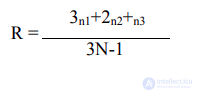
where: n1 – number of 1st-place choices
n2 – number of 2nd-place choices
n3 – number of 3rd-place choices
N – total number of group members
That is, we obtain a final table with an R score for each group member, and based on its value, we carry out the interpretation:
1. Highly referential group members,
2. Low-referential group members,
3. The referential core of the group,
4. The degree of mutual referential status among group members.
Extragroup referentometry. In modern psychology, the concept of a reference group has long
since been distinguished as an independent and important notion –
the circle of significant others whose opinion is decisive for
the individual and with whom he or she – both in direct context,
A reference group is the circle of significant others whose opinions are decisive for an individual and against whom that individual – both in direct contact and mentally – measures their own assessments, actions, and deeds. Determining a person's reference circle is highly important for gathering information about relationships that are significant to that person.
The technique is designed to identify a person's reference figures. To this end, respondents are presented with 10 question-situations (1-A) and a list of the people around them (1-B).
"For each question-situation, choose at least two people; the second person should be someone of lesser significance than the first."
1-A
1-B
Once the choices have been made, the respondent should be asked to set aside list 1-B and rate each of the chosen individuals on a five-point scale (5,4,3,2,1).
Next, all the mentioned individuals are entered onto a separate list without repetition, and the "ratings" given to these individuals are recorded on the list and summed for each of them. After comparison, the two or three individuals with the highest total scores are written out on a separate sheet in decreasing order of score. These people constitute the reference group of the given respondent.
In the technique presented below, we propose to identify reference figures.
For
this purpose, respondents are presented with 10 question-situations (1-A) and a list
of the people around them (1-B).
Instructions: "For each question-situation, you must choose at least
two
people; the second person should be someone of lesser
significance than the first."
1-A
1. Who would you travel with (on a business trip) to another city?
2. Something unpleasant has happened to you. Whom would you tell?
3. You want to celebrate your birthday. Whom would you spend it with?
4. Is there a person with whom you try to spend more
time?
5. Who can point out your shortcomings, whom would you listen to more?
6. You met someone you liked. Who can help you
assess them correctly?
7. You want to change your life. Whom would you consult about it?
8. Who could serve as an example for you in life?
9. Whom would you most like to impress?
10. With whom are you the most candid?
1-B
1. Parents (father, mother).
2. Relatives (grandfather, grandmother, uncle, aunt).
3. Brother, sister.
4. An adult acquaintance.
5. An acquaintance of your parents.
6. Friends.
7. Best friend.
8. A group of companions, pals.
9. A girl or young man you know
10. Fellow students or coworkers.
11. Fellow members of a club, sports section, studio, etc.
A variant of extragroup referentometry for children may be as follows:
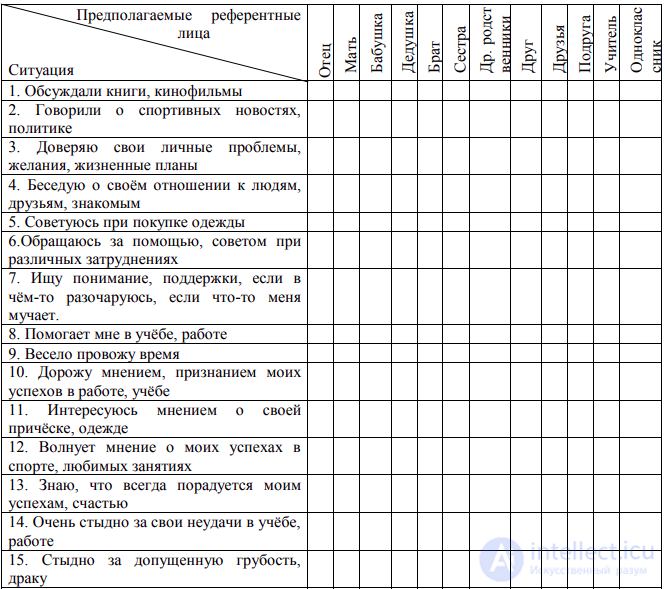

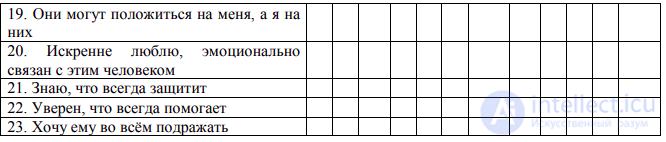
reference group

Comments