Examples of Cognitive Biases and Cognitive Prejudices

Lecture


In cognitive science, cognitive biases are understood as systematic errors in thinking, or patterned deviations, that arise from dysfunctional beliefs embedded in cognitive schemas and are readily detected through the analysis of automatic thoughts . The existence of most cognitive biases has been described by researchers, and many have been demonstrated in psychological experiments .A cognitive bias is a systematic pattern of deviation from norm or rationality in judgment.

Cognitive biases are an example of evolutionarily developed behavior. Some of them serve an adaptive function, since they promote more effective actions or faster decision-making. Others appear to arise from a lack of appropriate thinking skills, or from the inappropriate application of skills that were adaptive in other conditions.

The development and application of methods for correcting cognitive biases that cause problems of an emotional, personal or social nature is the subject of various fields of psychotherapy, in particular cognitive psychotherapy.

People create their own “subjective reality” based on their perception of input. A person’s construction of reality, rather than objective input, may dictate their behavior in the world. Thus, cognitive biases can sometimes lead to distorted perception, inaccurate judgment, illogical interpretation, or what is broadly called irrationality .

Although such misconceptions might seem to be aberrations, biases can help people find commonalities and shortcuts that aid in navigating common life situations.

Some cognitive biases are presumably adaptive. Cognitive biases may lead to more effective actions in a given context. In addition, admitting cognitive biases allows for faster decisions, which may be desirable when timeliness is more important than accuracy, as shown in heuristics . Other cognitive biases are a “by-product” of the limitations of human processing arising from the lack of appropriate mental mechanisms ( bounded rationality ), the influence of a person’s constitution and biological state (see embodied cognition ), or simply from the limited capacity to process information .

A constantly growing list of cognitive biases has been identified over the past six decades of research into human judgment and decision-making in cognitive science, social psychology and behavioral economics . Daniel Kahneman and Tversky (1996) argue that cognitive biases have effective practical significance for such fields as clinical judgment, entrepreneurship, finance and management.

The concept of cognitive biases was introduced by Amos Tversky and Daniel Kahneman in 1972 and grew out of their experience with people’s innumeracy , or their inability to reason intuitively with large orders of magnitude . Tversky, Kahneman and their colleagues demonstrated several reproducible ways in which human judgments and decisions differ from rational choice theory . Tversky and Kahneman explained differences in human judgment and decision-making in terms of heuristics. Heuristics involve mental shortcuts that allow for a quick estimate of the probability of uncertain events. Heuristics are easy for the brain to compute, but they sometimes lead to “severe and systematic errors”.

For example, the representativeness heuristic is defined as the “tendency to assess the frequency or probability” of an event by the degree to which the event “resembles a typical case”.

The “Linda problem” illustrates the representativeness heuristic (Tversky & Kahneman, 1983). Participants were given a description of “Linda” that suggests Linda may well be a feminist (for example, she is concerned about discrimination and social justice issues). They were then asked whether they thought Linda was more likely to be (a) “a bank teller” or (b) “a bank teller and active in the feminist movement”. Most chose answer (b). This error (mathematically, answer (b) cannot be more probable than answer (a)) is an example of the “ conjunction fallacy ”; Tversky and Kahneman argued that respondents chose option (b) because it seemed more “representative”, or typical, of people who might fit Linda’s description. The representativeness heuristic can lead to errors such as stereotype activation and inaccurate judgments of others (Haselton et al., 2005, p. 726).

Critics of Kahneman and Tversky, such as Gerd Gigerenzer , have also argued that heuristics should not lead us to think that human reasoning is riddled with irrational cognitive biases. Rather, they should regard rationality as an adaptive tool, not identical to the rules of formal logic or the probability calculus . Nevertheless, experiments such as the “Linda problem” grew into research programs on heuristics and biases that spread beyond academic psychology into other disciplines, including medicine and political science.

Cognitive biases are systematic patterns of deviation from norm and / or rationality of judgment. They are often studied in psychology and behavioral economics .

Although the reality of most of these biases is confirmed by reproducible research, there is often debate about how to classify these biases or how to explain them. Several theoretical causes are known for some cognitive biases , which makes it possible to classify biases by their common generative mechanism (e.g., noisy information processing). Gerd Gigerenzer criticized the notion of cognitive biases as errors in judgment and supports interpreting them as the result of rational deviations from logical reasoning.

Explanations include information-processing rules (i.e. mental shortcuts), called heuristics , that the brain uses to produce decisions or judgments. Biases take many forms and manifest as cognitive (“cold”) biases, such as mental noise, or motivational (“hot”) biases, for example when beliefs are distorted by wishful thinking . Both effects can be present at the same time.

There is also disagreement about some of these biases as to whether they are considered useless or irrational , or whether they lead to useful attitudes or behavior. For example, when getting to know other people, people tend to ask leading questions that seem biased toward confirming their assumptions about the person. However, this kind of confirmation bias is also considered an example of a social skill ; a way of connecting with another person.

Although this research mainly involves humans, some findings demonstrating bias have also been found in non-human animals. For example, loss aversion has been demonstrated in monkeys, and hyperbolic discounting in rats, pigeons and monkeys.

Types

Biases can be distinguished along a number of dimensions. For a more complete list, see the list of cognitive biases . Examples of cognitive biases include:

  • Biases specific to groups (e.g. risky shift ), as opposed to biases at the individual level.
  • Biases affecting decision-making where the desirability of options must be taken into account (e.g. the sunk cost fallacy ).
  • Biases, such as illusory correlation , that affect judgment about how likely something is, or whether one thing causes another.
  • Biases affecting memory , such as consistency bias (recalling one’s past attitudes and behavior as more similar to the present than they were).
  • Biases that reflect the subject’s motivation , for example a drive for a positive self-image leading to egocentric bias and avoidance of unpleasant cognitive dissonance .

Other biases arise from how the brain perceives, forms memories and makes judgments. This distinction is sometimes described as “hot cognition” versus “cold cognition”, since motivated reasoning can involve a state of arousal . Among the “cold” biases

  • some arise from ignoring relevant information (e.g. neglect of probability ),
  • some involve a decision or judgment being influenced by irrelevant information (e.g. the framing effect, where the same problem is given different answers depending on how it is described; or distinction bias, where options presented together yield different outcomes than those presented separately), and
  • others place excessive weight on an unimportant but salient element of the problem (e.g. anchoring ).

The fact that some biases reflect motivation, in particular the motivation to hold a positive attitude toward oneself, accounts for the fact that many biases are self-serving or self-directed (e.g. the illusion of asymmetric insight , self-serving bias ). There are also biases in how subjects evaluate their own or other groups; evaluating in-groups as more diverse and “better” in many respects, even when these groups are arbitrarily defined ( in-group bias , out-group homogeneity bias ).

Some cognitive biases belong to the subgroup of attentional biases , which involve paying increased attention to certain stimuli. For example, it has been shown that people dependent on alcohol and other drugs pay more attention to drug-related stimuli. Common psychological tests for measuring these biases are the Stroop task and the dot-probe task .

People’s susceptibility to some types of cognitive biases can be measured using the cognitive reflection test (CRT), developed by Shane Frederick (2005).
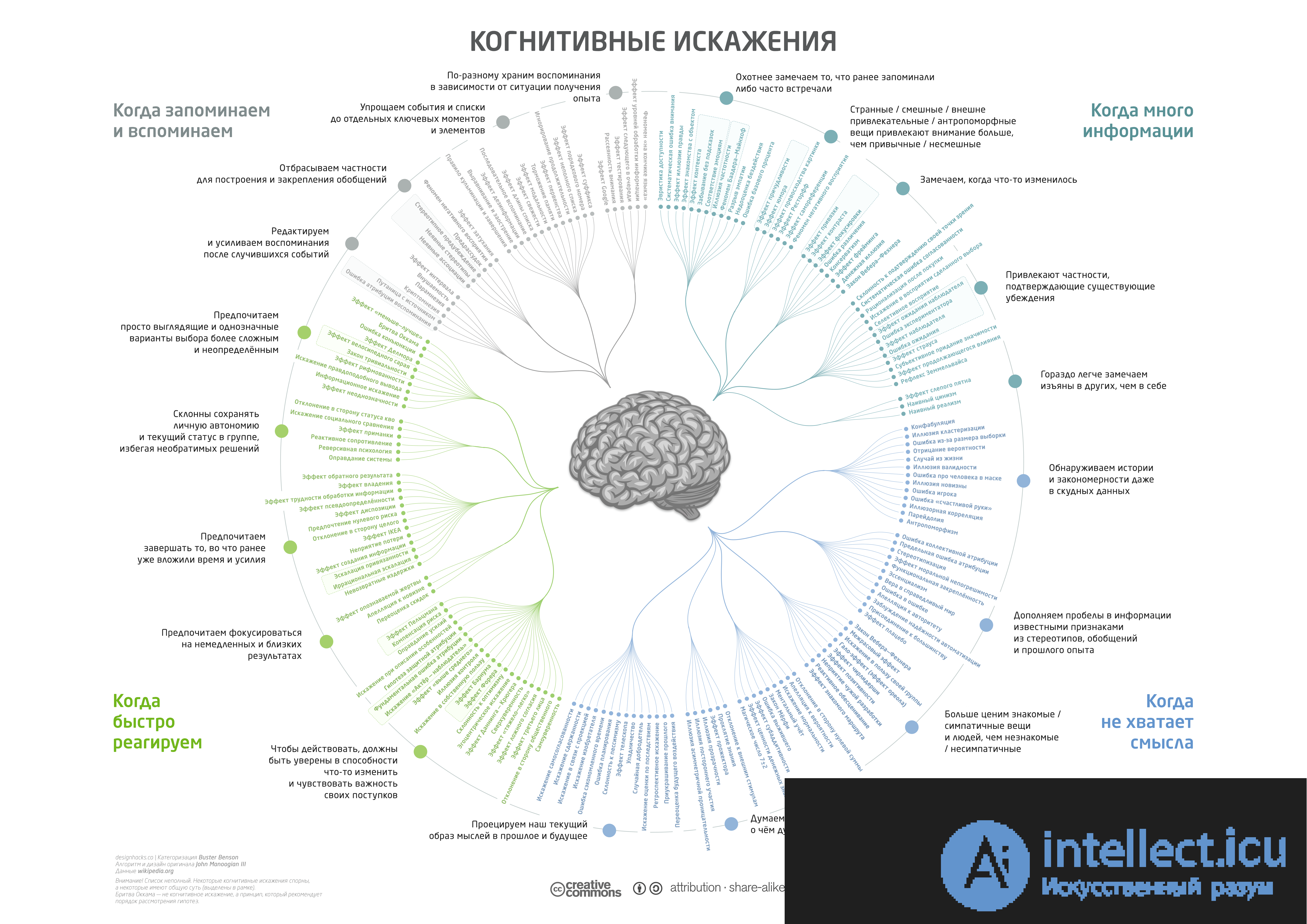
Examples of Cognitive Biases and Cognitive Prejudices

Biases related to behavior and decision-making

Excessive concern for success

  • Amplification — investing more effort into achieving a goal than necessary, an attempt to “kill a fly with a sledgehammer”. A variant is excessively detailed planning under conditions of insufficient source data and the presence of uncertain or random factors with a strong influence on the outcome.
  • Acceleration — carrying out work at a speed greater than necessary or even permissible. In the extreme case, both literally and figuratively: running across a minefield.
  • Pre-emption — an unjustifiably early start to actions aimed at achieving a goal.
  • Bias toward information seeking — the tendency to seek information even when it has no effect on actions or outcome.

Overestimating the likelihood of individual cases

  • Overgeneralization of individual cases — the groundless extension of the characteristics of particular or even single cases onto broad sets of them. There are many varieties of this cognitive bias; the classic example is conspiracy theory.
  • Contrast effect — the amplification or diminishment of the significance of one item when it is compared with a contrasting object just encountered. For example, a person is glad to have bought an inexpensive item at a store, but stops being glad after discovering another, little-known store where the same item costs twice as little.
  • Baader–Meinhof phenomenon , or frequency illusion — recently learned information that reappears again after a short period of time is perceived as occurring unusually often.

Overestimating the significance of individual cases

  • Outcome bias — the tendency to judge decisions by their final results, rather than assessing the quality of decisions by the circumstances of the moment when they were made (“winners are not judged”).
  • Impact bias — people’s tendency to overestimate the duration or intensity of the impact of some event on their future experiences.
  • Focusing effect — an error in predictions that occurs when people pay too much attention to one aspect of a phenomenon; it causes errors in correctly predicting the utility of a future outcome. For example, focusing attention on who is to blame for a possible nuclear war distracts attention from the fact that everyone would suffer in it.

Overestimating one’s own abilities

  • Overconfidence effect — the tendency to overestimate one’s own abilities.
  • Illusion of control — the tendency of people to believe that they can control, or at least influence, outcomes of events that they in fact cannot influence .
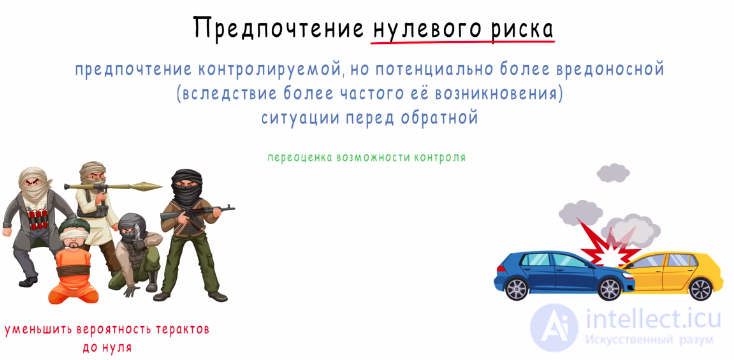
  • Zero-risk bias — a preference for a controllable but potentially more harmful (due to its more frequent occurrence) situation over the opposite one, owing to an overestimation of the possibility of control. That is, a person, for their part, believes that they are completely getting rid of the risk (while not actually having full control), while from a statistical point of view this is merely a reduction of a single, not the largest, risk to zero. For example, most people would prefer to reduce the probability of terrorist attacks to zero rather than reduce road accident rates, even if the second effect would save more lives . Another common example is iatrophobia: many people fear the complications of medical interventions more than the diseases and deaths resulting from those diseases that arise from a lack of treatment (for example, anti-vaccination sentiment).

Examples of Cognitive Biases and Cognitive Prejudices

  • Dunning — Kruger effect — people with a low level of competence draw erroneous conclusions, make poor decisions, and at the same time are unable to recognize their own mistakes because of their low level of competence.

Overestimating the significance of one’s own opinion/position/choice

  • Choice-supportive bias — excessive persistence, attachment to one’s own choice, perceiving it as more correct than it actually is, followed by justifying it further. For example, attempts to find non-obvious advantages in a purchase and thereby justify it when another, more suitable product existed that for some reason was not bought.
  • Perception of choice — it has been noted that we first make a choice and only then does the brain try to justify it, and the more meaningless
    the choice, the more we defend it. As an example, one can cite attempts to find non-obvious advantages in a purchase and thereby
    justify it when another, more suitable product existed that for some reason was not bought.
    This is exactly the principle on which destructive cults and various financial pyramid schemes operate. To some extent this effect resembles Stockholm syndrome — when the victim justifies the aggressor
  • Mere-exposure effect — people’s tendency to express unwarranted liking for some object merely because they are familiar with it (patriotism, the effect of having been involved in creating an item). Perhaps all advertising that exists in the world
    works on this effect of thinking; the point is that among several unfamiliar objects we will inevitably give preference to the one we know at least something about — for example, if you need a hand cream, coming into a store you will almost certainly take the cream that you have at least once
    heard about somewhere, for example in an advertisement, over one you know nothing about at all.
  • Irrational escalation — the tendency to remember one’s choice as more correct than it actually was.
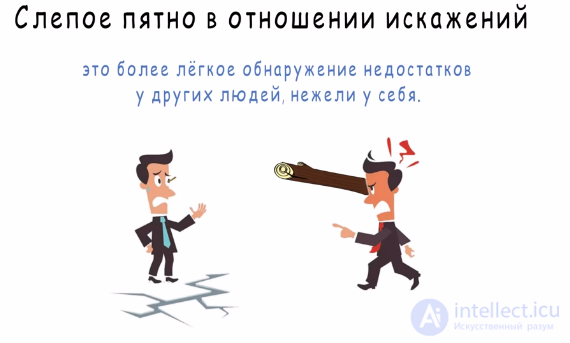
  • Bias blind spot — it is easier to detect flaws in other people than in oneself.

Examples of Cognitive Biases and Cognitive Prejudices

Methods for defending one’s opinion under such biases are usually:

  • the Texas sharpshooter fallacy — choosing or adjusting a hypothesis to fit the results of measurements;
  • confirmation bias — the tendency to search for or interpret information in a way that confirms pre-existing conceptions;
  • observer-expectancy effect — unconscious manipulation of the course of an experiment in order to detect an expected result (see the Rosenthal effect and the Golem effect);
  • selective perception — taking into account only those facts that are consistent with expectations.
    Selective perception is people’s tendency to pay attention to those elements of the environment that are consistent with their expectations
    and to ignore the rest. In a classic experiment, viewers watched footage of a particularly rough American football match between Princeton University and Dartmouth College; viewers from Princeton noticed almost twice as many infractions committed by the Dartmouth team as viewers from Dartmouth did, and one viewer from Dartmouth did not notice a single infraction by their own team at all. This phenomenon plays a huge role in advertising.
  • Backfire effect — the tendency to become more firmly convinced that one is right in the face of evidence contradicting a person’s original, established belief. Because of the backfire effect, it can be difficult to change an interlocutor’s mind in an argument, even when presenting them with strong evidence refuting their position .

Other biases

  • Resistance — a manifestation of mental inertia, disbelief in a threat, continuation of a previous course of action under conditions of urgent need to switch: when delaying the transition threatens to worsen the situation; when procrastination may lead to the loss of an opportunity to improve the situation; when faced with emergency situations, unexpected opportunities and sudden obstacles.
  • Authority bias — the tendency to attribute a higher rating to the opinion of an authority figure and to rely on that opinion to a greater extent. See the Milgram experiment.
  • Rosy retrospection — the tendency to rate past events more positively than they were perceived at the moment they actually occurred.
  • Attentional bias —the brain tends to notice only what you like or what interests you. for example ,
    if you are a hairdresser, your colleague’s new haircut will immediately be studied in detail, while others won’t even notice it; if you love fashionable brands, any acquaintance’s new bag will catch your interest
    Examples of Cognitive Biases and Cognitive Prejudices
  • “Curse of knowledge” — the difficulty informed people have when trying to consider a problem from the point of view of less informed people.
  • Frequency illusion — the brain does not notice many of the things around us until they catch our interest.
    for example, you need to buy a baby stroller and you settle on some brand; suddenly you find that strollers of that brand have started turning up very often. This is an illusion; in reality you simply started paying attention to them, not that they suddenly became widespread.
  • Illusory truth effect — this is one of the most popular tools of propaganda throughout the world. It has long been known that if
    you repeat a lie long enough, loudly enough, often enough — people will start to believe the lie. If you tell a person a hundred times that they are a pig, by the hundred-and-first time they will oink!
  • Professional deformation — the psychological disorientation of a person’s personality in the course of their professional activity. A tendency to look at things according to the rules generally accepted in one’s profession, discarding a more general point of view.
  • Endowment effect — overvaluing a purchase immediately after acquiring it. Its consequence is loss aversion — the negative utility associated with losing an object turns out to be greater than the utility associated with acquiring it. Knowing the benefit of something they own, people are more upset by its loss than they would have been pleased by finding it, before which they had not thought about the item and accordingly had not factored in its benefit.
  • Need for closure and preference for whole objects — the need to reach closure on an important question, get an answer, and avoid feelings of doubt and uncertainty. Present circumstances (time or social pressure) can amplify this source of errors. The drive for closure is one of the fundamental properties of Gestalt, the central concept of Gestalt psychology, manifesting itself, in particular, in the Zeigarnik effect. Another case is the “less-is-better” effect, in which, in the absence of a direct comparison of objects, preference is given to the one closer to its ideal, despite its value being lower.
  • Regulation — the trap of continuously ordering oneself to do something, instead of sometimes acting impulsively, spontaneously, when this is more appropriate — when seeking something new, while on vacation, or resting.
  • Status quo bias — people’s tendency to want things to remain approximately the same.
  • Bandwagon effect, conformity — the fear of standing out from the crowd, the tendency to do (or believe) things because many other people are doing (or believing) them. Related to groupthink, herd behavior and manias (see, for example, the effect of siding with the winning side ).
  • Procrastination — the systematic, unjustified postponement and delaying of the start of inevitable work.
  • Omission bias — a preference for greater harm resulting from inaction over harm resulting from action, due to a failure to recognize fault in inaction.
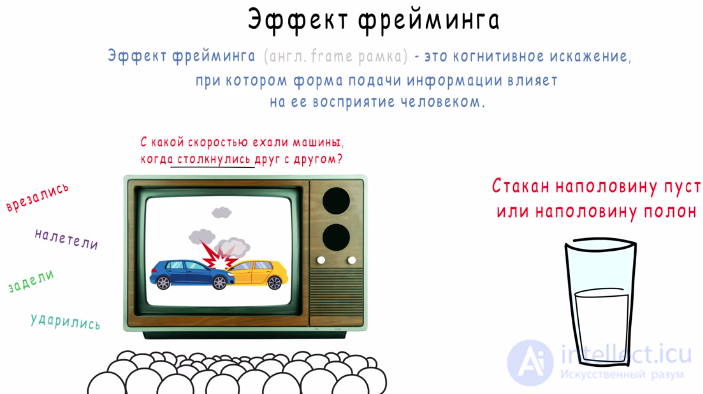
  • Framing effect — the dependence of the choice of a decision option on the form in which the original information is presented. Thus, changing the wording of a question, while its semantic content remains identical, can cause the percentage of positive (negative) answers to change from 20% to 80% or more . Word choice can make up a substantial part of how information is presented. For any formulation of a discount pricing scheme for certain categories of buyers, there exists a financially equivalent presentation of prices with markups for additional categories of buyers; however, using it can lead to a significant drop in revenue and is therefore not applied.

Examples of Cognitive Biases and Cognitive Prejudices

  • Pseudocertainty effect — the tendency to make decisions aimed at avoiding risk when the expected outcome is positive, but to make risky decisions in order to avoid a negative outcome (manifests as part of the framing effect).
  • Division — the attempt to carry out two or more tasks simultaneously that require conscious attention, which is fundamentally indivisible.
  • Articulation — continuous verbalizing of one’s thoughts about what seems to be true.
  • Reversion — the systematic return to thoughts about hypothetical past actions aimed at preventing losses resulting from irreversible events that have occurred, at correcting the uncorrectable, at changing the unchangeable past. Guilt and shame are forms of reversion.
  • Time-saving bias — the human tendency to misjudge the amount of time that can be saved (or lost) as a result of increasing (or decreasing) speed.
  • Planning fallacy — the tendency to underestimate the time needed to complete tasks, and the cost and duration of project implementation, especially for new, complex, large or unique projects. A particular case of the planning fallacy found expression in Murphy’s law: “Every job takes longer than you think.”
  • Reactance — a person’s need to do the opposite of what someone is urging them to do, arising from a need to resist perceived attempts to restrict freedom of choice. Under reactance, an individual often acts to their own detriment.
  • Need for confrontation — deliberately seeking out an interlocutor with a different opinion in order to prove one’s own point to them.
  • Congruence bias — the tendency to test hypotheses exclusively through direct testing, while neglecting or rejecting indirect testing.

Socially conditioned biases

A large group of biases related to behavior and decision-making. Most of them are related to attribution errors.

Self-serving biases

  • End-of-history illusion — according to a large-scale study[10] from 2013, people of any age believe that their personality has changed a great deal in the past, but will change little in the future.
  • Out-group homogeneity bias — people perceive members of their own group as relatively more diverse than members of other groups.
  • In-group favoritism — people’s tendency to give preference to those whom they consider to be members of their own group.
  • Projection bias — the tendency to unconsciously assume that other people share the same thoughts, beliefs, values and positions as oneself.
  • Self-serving bias — the tendency to claim more responsibility for successes than for failures. This can also manifest itself as people’s tendency to present ambiguous information in a way that is favorable to themselves (see In-group favoritism).
  • Trait ascription bias — the tendency for people to view themselves as relatively variable in terms of personality, behaviour and mood, while viewing others as much more predictable. For example, the illusion of transparency — people overestimate others’ ability to understand them, and they also overestimate their own ability to understand others.
  • Fundamental attribution error — the tendency for people to explain other people’s behaviour by their personal traits, underestimating situational factors, while at the same time overestimating the role and power of situational influences on their own behaviour, underestimating the personal aspect.[12]
  • Lake Wobegon effect — the human tendency to report flattering beliefs about oneself and consider oneself above average (see worse-than-average effect and overconfidence effect).
  • False consensus effect — the tendency for people to overestimate the degree to which others agree with them.
  • False uniqueness bias — an individual’s underestimation of the prevalence among others of abilities or of desirable or successful behaviours characteristic of them.
  • Egocentric bias — occurs when people consider themselves more responsible for the outcome of some joint action than an outside observer would.

Other biases

  • The “door-in-the-face” phenomenon — people tend to make a concession and agree to an unattractive proposal if it is offered to them right after they refuse another, more burdensome (onerous) request.
  • The “foot-in-the-door” phenomenon — after complying with an initially minor request, people tend to agree to comply with other, more burdensome demands.
  • The “just-world” phenomenon — the tendency for people to believe that the world is “just” and that, consequently, people get “what they deserve”.[14]
  • The Forer effect (also the Barnum effect) — the tendency to rate the accuracy of descriptions of one’s personality highly, as though they had been written specifically for you, when in fact they are general enough to apply to a very large number of people. For example, horoscopes (generalized astrological characterizations and predictions).[15]
  • Halo effect — occurs in the perception of one person by another and consists in the fact that positive and negative traits of a person “spill over”, from the perceiver’s point of view, from one area of the perceived person’s personality into another (see physical attractiveness stereotype).[16]
  • First-impression effect — the influence of an opinion about a person, formed by the subject in the first minutes of a first meeting, on the further evaluation of that person’s activity and personality. It is also counted among the errors often made by researchers using the observation method, alongside the halo effect and others.[17]
  • Bias related to the formulation of a law — this form of cultural bias is connected with the fact that expressing some law as a mathematical formula creates the illusion of its real existence.
  • Identifiable victim effect — the tendency to give more generous help to a single individual (victim) whose difficult life circumstances can be observed directly, rather than to an indeterminate group of people with similar problems.

Biases related to probability and stereotyping

Many of these cognitive biases are often studied in connection with how they affect business and how they affect experimental research.


Common errors resulting from a misunderstanding of the nature of randomness

  • Primacy effect — the tendency to overweight initial events more than subsequent events.
  • Gambler’s fallacy — the tendency to believe that individual random events are influenced by previous random events.
  • Clustering illusion — the tendency to see patterns where none actually exist.

Overestimating or underestimating the probability of the state a person currently finds themselves in

  • Survivorship bias — the tendency to underestimate data, unavailable to direct observation, on the group of the “dead”.
  • Availability heuristic — assessing as more probable that which is more available in memory, that is, a bias toward what is more vivid, unusual or emotionally charged. This thinking error arises because our brain estimates the frequency or likelihood of an event by the ease with which examples or cases come to mind, that is, by how easily they are recalled. Or, for example, a person estimates the risk of a heart attack among middle-aged people by recalling a similar case among their acquaintances
  • Distribution completeness error — the tendency to believe that the closer a sample mean is to a given value, the narrower the spread of the data set.
  • Stereotyping — expecting a member of a group to have certain characteristics without knowing any additional information about their individuality.
  • Base rate fallacy — ignoring or underusing basic prior information under the influence of the specifics of the case at hand

Examples of Cognitive Biases and Cognitive Prejudices

  • Recency effect (proximity aberration) — the tendency to rate the significance of recent events higher than that of earlier events.

Other biases

  • Placement bias — the tendency to remember oneself as having achieved better results than other individuals in tasks where we rate our own abilities as “above average”; and likewise the tendency to remember oneself as having achieved worse results than other individuals in tasks where we rate our own abilities as “below average”.
  • Selection bias — a bias in experimental data that is related to the way in which the data were collected.
  • Availability cascade — a self-reinforcing process in which a collective belief in something becomes increasingly plausible through its growing repetition in public discourse (“repeat something long enough and it becomes true”).
  • Positive outcome bias — the tendency to overestimate the probability of good things when predicting.
  • Attentional bias — the neglect of relevant information when judging a correlation or association.
  • Ludic fallacy — analyzing problems involving the outcome of chance by means of a narrow set of games.
  • Functional fixedness — using an object in one particular capacity prevents its subsequent use in a different capacity within the same current situation.
  • Hawthorne effect — a phenomenon whereby people being observed during a study temporarily change their behaviour or performance. Example: an increase in labour productivity at a factory when a commission arrives to study labour productivity at that factory.
  • Hindsight bias — sometimes called the “knew-it-all-along” effect — the tendency to perceive past events as predictable.
  • Ambiguity effect — avoiding options where missing information makes the probability “unknown”.
  • Illusory correlation — the perceived phenomenon of an exaggeratedly close relationship between variables which in reality either does not exist or is significantly smaller than assumed.
  • Anchoring effect — a feature of human numerical decision-making that causes irrational shifts in responses toward a number that entered the mind before the decision was made.
  • Context effect - the context effect is used by marketers to provoke you into buying something
    that you do not need at all. That is precisely why the layout of goods in a store is arranged not merely for convenience, but with the deliberate
    use of the context effect. Another example: one property owner managed to sell
    their apartment extremely profitably because before the buyer’s arrival they baked a fragrant sweet bun. Entering the prospective apartment, the client felt warmth and such a pleasant homely aroma that the brain simply could not avoid falling into the context trap.
  • Negativity bias - we subconsciously overrate the significance of negative things. Indeed, it is precisely for
    this reason that bad news will always have a much larger audience than good news, and the offhand words of a journalist
    from a well-known news service — "the newsroom demands blood" — became a meme that is not so far from reality: newsrooms
    really do need more blood, since it guarantees a multiple increase in views
  • Anchoring effect — this feature of evaluating numerical values shifts the estimate toward the initial approximation
    for example, you need to buy a coat, you go into a shop, you find a model that suits you, and after trying it on you find out it costs
    500 dollars, which is expensive for you, and you are already about to leave when suddenly a sales assistant runs up and, having asked whether
    the coat suited you, tells you that this is a unique series consisting of only 80 pieces, and moreover this model is today
    on sale with a 50 percent discount — and this is exactly where the anchoring effect kicks in, the role of the anchor here being played by
    the number 500. In all likelihood, the customer in such a situation will make the purchase without even thinking about the fact that for such
    a coat, even 250 dollars is a high price. Interestingly, the anchoring effect works regardless of whether you
    are aware of it or not. The same thing is observed with the rule of reciprocity.
    Examples of Cognitive Biases and Cognitive Prejudices
  • moral credential effect a person who is known to have no prejudices has in the future
    a greater chance of displaying those very prejudices. In other words, if everyone, including the person themselves, considers them to be sinless
    an illusion arises that any of their actions will likewise be sinless.

Biases related to memory errors

  • Telescoping effect — this effect consists in the fact that recent events seem more distant, while more distant events seem closer in time.
  • Cryptomnesia — a form of misattribution in which a memory is mistakenly taken for a product of the imagination. For example, a person may feel that they themselves invented a joke, when in reality they had already heard it and simply recalled it.[19]
  • Egocentric bias — recalling the past in a self-aggrandizing manner, for example, remembering exam grades as better than they were, and a caught fish as bigger than it was.
  • False memory — memory disturbances expressed in false recollections.[20]
  • Childhood amnesia — the very weak ability of adults to reproduce memories from the period of life before 2—4 years of age[21], which may be explained by the immaturity of brain structures — such as the hippocampus and amygdala — responsible for encoding and retaining memories and which usually develop sufficiently by the age of two[22][23].
  • Apparent constancy — the incorrect recollection of someone’s past positions and behaviour as resembling their present positions and behaviour.
  • Semantic cognitive bias — the essence of which lies in the tendency to believe that one knows the meaning of a word, when in fact one knows only the scope of its application and use.
  • Misinformation effect — occurs when the recall of episodic memories becomes less accurate because of post factum information received[24]. It is a classic example of retroactive interference, which occurs when information received later interferes with the ability to retain previously encoded information[25].
  • Levels-of-processing effect — describes the recall and reproduction of memories about a given stimulus as a function of the depth of mental processing: deeper analysis produces a more reliable, more detailed and longer-lasting trace in memory than shallow analysis[26]. For example, information is remembered better if it is generated by the individual themselves, rather than read or obtained in some other way from outside.[27]
  • Self-reference effect — a phenomenon whereby memories encoded with reference to oneself are recalled better than equivalent information not related to oneself.

Belief, decision-making and behavioural

These biases affect the formation of beliefs, thought processes, business and economic decisions, and human behaviour in general.

Name Type Description
Agent detection False priors The tendency to assume purposeful intervention by an intelligent or rational agent.
Ambiguity effect Prospect theory The tendency to avoid options for which the probability of a favourable outcome is unknown.
Anchoring or focalism Anchoring bias The tendency to rely too heavily, or “anchor”, on one trait or piece of information when making decisions (usually the first piece of information received on the subject).
Anthropocentric thinking Availability bias The tendency to use human analogies as a basis for reasoning about other, less familiar biological phenomena.
Anthropomorphism or
personification
Availability bias The tendency to characterize animals, objects and abstract concepts as possessing human traits, emotions and intentions. The opposite bias — not attributing feelings or thoughts to another person — is dehumanized perception, a kind of objectification.
Attentional bias Availability bias The tendency toward perception through recurring thoughts.
Attribute substitution Occurs when a judgement (about a target attribute) needs to be made that is computationally difficult, and a more easily computed heuristic attribute is substituted for it instead. This substitution is believed to take place in the automatic, intuitive system of judgement rather than in the reflective system with greater self-awareness.
Automation bias False priors The tendency to depend excessively on automated systems, which can lead to erroneous automated information overriding correct decisions.
Availability heuristic Availability bias The tendency to overestimate the likelihood of events with greater “availability” in memory, which may depend on how recent the memories are or how unusual or emotionally charged they may be.
Backfire effect Confirmation bias Reacting to disconfirming evidence by strengthening one’s prior beliefs. Note: the existence of this systematic error as a widespread phenomenon is disputed in empirical studies.
Base rate
fallacy or base rate neglect
Extension neglect The tendency to ignore general information and focus on information relating only to the specific case, even when the general information is more important.
Belief bias Believability An effect whereby someone’s assessment of the logical strength of an argument is biased by the believability of the conclusion.
Berkson’s paradox Logical fallacy The tendency to misinterpret statistical experiments involving conditional probabilities.
Clustering illusion Apophenia The tendency to overestimate the importance of small runs, streaks or clusters in large samples of random data (that is, seeing phantom patterns).
Compassion fade Extension neglect A predisposition to treat a small number of identifiable victims more compassionately than a large number of anonymous ones.
Confirmation bias Confirmation bias The tendency to search for, interpret, focus on and remember information in a way that confirms one’s prior beliefs.
Congruence bias Confirmation bias The tendency to test hypotheses exclusively through direct testing, instead of testing possible alternative hypotheses.
Conjunction fallacy Extension neglect The tendency to assume that specific conditions are more probable than a more general version of the same conditions. For example, participants in one experiment judged the probability that a woman would be simultaneously a bank teller and a feminist as more probable than the probability that she would be a bank teller.
Conservatism bias
(belief revision)
Anchoring bias The tendency to insufficiently revise one’s belief when presented with new evidence.
Continued influence effect Confirmation bias The tendency to believe previously received misinformation even after it has been corrected. The misinformation can still affect conclusions drawn after the correction. cf. Backfire effect
Contrast effect Framing effect The strengthening or weakening of the perception of a given stimulus compared to a recently observed contrasting object.
Curse of knowledge When more informed people find it extremely difficult to think about problems from the point of view of less informed people.
Declinism The tendency to view the past positively (rosy retrospection) and to view the future negatively.
Decoy effect Framing effect Preferences for option A or B shift in favour of option B when option C is presented, which is completely dominated by option B (inferior in every respect) and partially dominated by option A.
Default effect Framing effect When given a choice among several options, the tendency to favour the default option.
Denomination effect Framing effect The tendency to spend more money when it is denominated in small amounts (for example, coins) rather than large ones (for example, banknotes).
Disposition effect Prospect theory The tendency to sell an asset that has increased in value, and reluctance to sell an asset that has fallen in value.
Distinction bias Framing effect The tendency to view two options as more dissimilar when evaluating them simultaneously than when evaluating them separately.
Dread aversion Prospect theory Just as losses carry twice the emotional impact of gains, dread carries twice the emotional impact of enjoyment.
Dunning – Kruger effect The tendency of unskilled people to overestimate their abilities and the tendency of experts to underestimate their abilities.
Duration neglect Extension neglect Neglect of the duration of an episode in determining its value.
Empathy gap The tendency to underestimate the influence or strength of feelings, either in oneself or in others.
End-of-history illusion The age-independent belief that one will change less in the future than one has in the past.
Endowment effect Prospect theory The tendency of people to demand much more for an object than they would be willing to pay to acquire it.
Exaggerated expectation The tendency to expect or predict more extreme outcomes than those that actually occur.
Experimenter’s or
expectation bias
Confirmation bias The tendency of experimenters to believe, confirm and publish data that agree with their expectations for the outcome of an experiment, and to disbelieve, reject or downgrade the corresponding weight for data that appear to contradict those expectations.
Forer effect or
Barnum effect
Egocentric bias The observation that people will rate the accuracy of descriptions of their personality highly, as though the descriptions were created specifically for them, when in fact they are vague and general enough to apply to a wide range of people. This effect may partly explain the widespread acceptance of certain beliefs and practices, such as astrology, fortune-telling, graphology and certain types of personality tests.
Form function attribution bias In human–robot interaction — the tendency of people to make systematic errors when interacting with a robot. People may base their expectations and perception of a robot on its appearance (form) and attribute functions to it that do not necessarily reflect the robot’s true functions.
Framing effect Framing effect Drawing different conclusions from the same information depending on how that information is presented.
Frequency illusion or
Baader – Meinhof phenomenon
Availability bias The frequency illusion consists in the fact that once something has been noticed, every instance of that phenomenon is noticed, leading to the belief that the phenomenon occurs very often (a form of selection bias). The Baader-Meinhof phenomenon is an illusion in which something that has recently caught one’s attention suddenly appears again shortly afterward with improbable frequency. It was named after an instance of the frequency illusion that referenced the Baader – Meinhof group.
Functional fixedness Anchoring bias Limits a person to using an object only in the way it is traditionally used.
Gambler’s fallacy Logical fallacy The tendency to think that future probabilities are altered by past events, although in reality they are not changed. The fallacy arises from a mistaken conception of the law of large numbers. For example, “I have flipped heads on this coin five times in a row, so the probability of getting tails on the sixth flip is much higher than heads.”
Gender bias False priors A widespread set of implicit prejudices that discriminate on the basis of sex. For example, the assumption that women are less suited to work requiring high intellectual ability. Or the assumption that people or animals are male in the absence of any indication of sex. Or the assumption that academia discriminates against women, even though in US colleges and graduate schools there are more women than men, and they receive the majority of bachelor’s and master’s degrees.
Hard – easy effect The tendency to overestimate one’s ability to perform difficult tasks and underestimate one’s ability to perform easy tasks.
Hindsight bias Sometimes called the “knew-it-all-along” effect, the tendency to view past events as predictable at the time they occurred.
Hot-hand fallacy Logical fallacy The “hot-hand fallacy” (also known as the “hot-hand phenomenon” or “hot hand”) is the belief that a person who has succeeded as a result of a random event has a greater chance of further success in additional attempts.
Hyperbolic discounting Extension neglect Discounting is the tendency of people to have a stronger preference for more immediate payoffs compared with later payoffs. Hyperbolic discounting leads to choices that become inconsistent over time — people today make choices that their future selves would prefer not to have made, despite the same reasoning. Also known as present-moment bias, present bias, and related to dynamic inconsistency. A good example of this: a study found that when choosing food for the coming week, 74% of participants chose fruit, whereas when the food choice was for the current day, 70% chose chocolate.
IKEA effect The tendency of people to place a disproportionately high value on items they partially assembled themselves, such as IKEA furniture, regardless of the quality of the finished product.
Illicit transference Logical fallacy Occurs when a term in the distributive (referring to each member of a class) and collective (referring to the class itself as a whole) sense is treated as equivalent. Two variants of this fallacy are the fallacy of composition and the fallacy of division.
Illusion of control Egocentric bias The tendency to overestimate one's influence over other external events.
Illusion of validity Egocentric bias Overestimating the accuracy of one's own judgements, especially when available information is consistent or interrelated.
Illusory correlation Apophenia Inaccurately perceiving a relationship between two unrelated events.
Illusory truth effect Truthiness A tendency to believe that a statement is true if it is easier to process, or if it has been stated multiple times, regardless of its actual veracity. These are specific cases of truthiness.
Impact bias The tendency to overestimate the duration or intensity of the impact of future feeling states.
Implicit association Availability bias The speed with which people can match words depends on how closely associated they are.
Information bias The tendency to seek information even when it cannot affect action.
Insensitivity to sample size Extension neglect The tendency to underestimate variation in small samples.
Interoceptive bias The tendency for sensory input about the body itself to influence judgement about external, unrelated circumstances. (Such as, for example, parole judges who are more lenient when they are fed and rested.)
Irrational escalation or
escalation of commitment
Logical fallacy The phenomenon whereby people justify increased investment in a decision, based on the cumulative prior investment, despite new evidence suggesting that the decision was probably wrong. Also known as the sunk cost fallacy.
Law of the instrument Anchoring bias Excessive reliance on a familiar tool or methods, ignoring or underestimating alternative approaches. “If all you have is a hammer, everything looks like a nail.”
Less-is-better effect Extension neglect The tendency to prefer a smaller set to a larger set that is evaluated separately, but not jointly.
Loss aversion Prospect theory The perceived disutility of giving up an object is greater than the utility associated with acquiring it. (sunk cost effects and the endowment effect).
Mere-exposure effect Familiarity principle The tendency to express undue liking for things merely because of familiarity with them.
Money illusion The tendency to concentrate on the nominal value (face value) of money rather than its value in terms of purchasing power.
Moral credential effect Occurs when someone who does something good allows himself to be less good in the future.
Neglect of probability Extension neglect The tendency to completely disregard probability when making a decision under uncertainty.
Non-adaptive choice switching After an unfavourable outcome of a decision problem, the tendency to avoid the choice made earlier when faced with the same decision problem again, even if that choice was optimal. Also known as “once bitten, twice shy” or the “hot-stove effect”.
Normalcy bias Cognitive dissonance The refusal to plan for, or react to, a disaster which has never happened before.
Observer-expectancy effect Confirmation bias When a researcher expects a given result and therefore unconsciously manipulates an experiment or misinterprets data in order to find it (subject-expectancy effect).
Omission bias The tendency to judge harmful actions (commissions) as worse, or less moral, than equally harmful omissions (inactions).
Optimism bias The tendency to be over-optimistic, underestimating the likelihood of undesirable outcomes and overestimating favourable and pleasing outcomes (wishful thinking, valence effect, positive outcome bias).
Ostrich effect Ignoring an obvious (negative) situation.
Outcome bias The tendency to judge a decision by its final outcome instead of by the quality of the decision at the time it was made.
Overconfidence effect Egocentric bias Excessive confidence in one's own answers to questions. For example, for certain types of questions, answers that people rate as “99% certain” turn out to be wrong 40% of the time.
Pareidolia Apophenia A vague and random stimulus (often an image or sound) is perceived as significant, e.g. seeing images of animals or faces in clouds, the man in the moon, and hearing hidden messages in music played in reverse.
Pessimism bias The tendency for some people, especially those suffering from depression, to overestimate the likelihood of bad things happening to them.
Plan continuation bias Logical fallacy Failure to recognize that the original plan of action is no longer suitable for a changing situation, or for a situation that is different from the one anticipated.
Planning fallacy Egocentric bias The tendency to underestimate the time it will take to complete one's own task.
Present bias The tendency of people to give stronger weight to payoffs that are closer to the present time when considering trade-offs between two future moments.
Plant blindness The tendency to ignore plant species in the surrounding environment, and the inability to recognize and appreciate the importance of plants to life on Earth.
Probability matching Suboptimal matching of the probability of choices with the probability of reward in a stochastic context.
Pro-innovation bias The tendency to

продолжение следует...

Продолжение:


Часть 1 Examples of Cognitive Biases and Cognitive Prejudices
Часть 2 Social - Examples of Cognitive Biases and Cognitive Prejudices

See also

Comments

To leave a comment

If you have any suggestion, idea, thanks or comment, feel free to write. We really value feedback and are glad to hear your opinion.
To reply

Lectures and tutorial on "Psychology of errors and illusions"

Terms: Psychology of errors and illusions