
Lecture
The Person in the Categorical Series: Individual, Subject, Personality, Individuality (a Psychological-Acmeological Analysis)
The problem of personality is central to contemporary psychology and acmeology. And this is no accident. Personality is the fundamental riddle of the human world, its mystery. Let us recall Nikolai Berdyaev's words: "The origins of man can be understood and rationalized only in part. The mystery of personality, of its uniqueness, is never fully understood by anyone. Human personality is more mysterious than the world. It is itself an entire world. Man is a microcosm and contains everything within himself" [4, p. 11]. Carl Jung perceived personality in the same way: "Personality," he wrote, "as the complete realization of the wholeness of our being is an unattainable ideal. But unattainability is no argument against the ideal, for ideals are only guideposts, never the goal itself..." [24, p. 191].
So, personality is, on the one hand, a mystery that captivates the mind and feeling of the reflective person, and on the other, a working concept actively used in the professional language of virtually every occupation and in everyday communication. All this compels us to approach this phenomenon, and to work with the system of concepts in which it is reflected, with both respect and professional rigor.
Let us turn to the categorical series in which the concept of "personality" is embedded. These are, above all, the concepts of "human being" — "individual" — "subject" — "individuality" (Diagram 1).
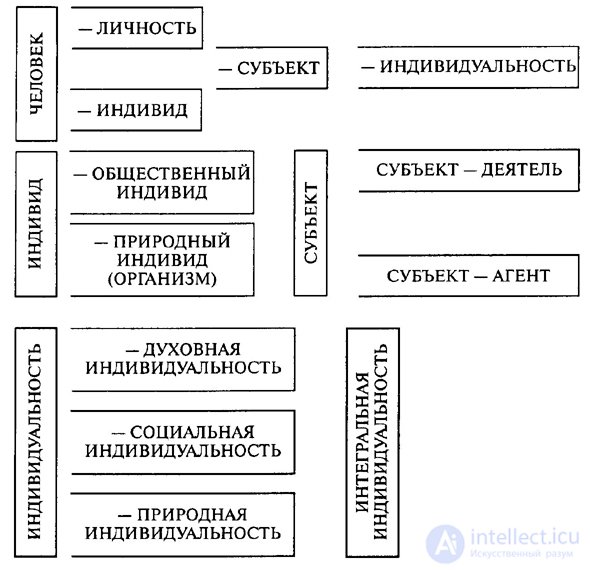
Diagram 1. The system of personality concepts\
The content of these concepts (through which one or another characteristic of personality is revealed) is set out in many textbooks, but, as a rule,
on a general-psychological plane. Let us try, without losing this general-psychological foundation, to bring these concepts to the level of socio-psychological and acmeological analysis. In doing so, we must bear in mind S. L. Rubinstein's position that "the concept of personality is a social, not a psychological, category... Personality as a reality, as a piece of actuality... is the subject of study of various sciences... Psychology is necessarily among these sciences, because there is no personality without a psyche, and moreover without consciousness. At the same time, the psychic aspect of personality is not merely juxtaposed with the others; psychic phenomena are organically woven into the integral life of the personality, since the basic life function of all psychic phenomena and processes consists in the regulation of people's activity. Being conditioned by external influences, psychic processes condition behavior, mediating the dependence of the subject's behavior on objective conditions" [19, pp. 244–245].
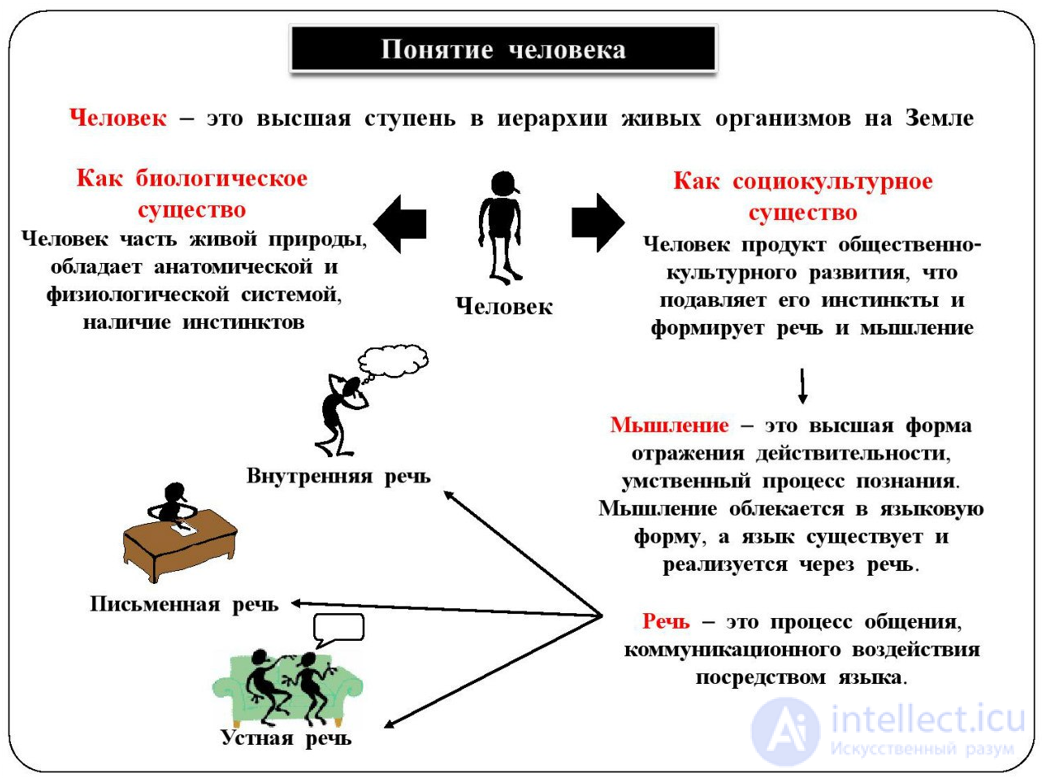
The foundation and starting point of the analysis outlined here is the human being as a socio-natural phenomenon. As a phenomenon, the human being has two vectors of development, and as a concept, two planes of interpretation: the natural and the social.
The natural vector of human development: a species in the biological classification of the evolution of life on earth; a natural being belonging to the class of mammals; order — primates; classificatory categorization — Homo sapiens.
As a being belonging to the natural world, man is included in a chain of natural dependencies. Any deformation of these is a deformation of human life activity. Ecology is, in the final analysis, always human ecology. Man is the reference point for all our interactions with nature.
Man exists in unity with nature and at the same time acts as the leader in this interaction. It is not by chance that philosophy asserts that in man matter arrives at an awareness of itself. These words contain the profoundest programmatic idea of the unity of matter, development, and man. That is why the principle of the civilized naturalness of man, developed in acmeology, is so important (see: [9, pp. 167–171]). Closely related to it is the principle of coevolution — the interconnectedness of the laws of nature and the laws of human activity.
As a being belonging to society, to humanity, man represents humanity within himself, and this is his essence. Humaneness is the principal essential (universally human) trait of man.
Humanity (the human race, the human world) is a special, historically developing social, socio-psychological, and spiritual community, which differs from all other material systems on the planet by its inherent mode of life activity. The principal socio-psychological (and, in principle, acmeological) characteristic of this mode of life activity is the "SELF-..." mechanism.
As is well known, man has no innate, natural program of life activity. The regulator of human life activity is precisely the "SELF-..." mechanism: self-organization, self-cognition, self-awareness, self-regulation, self-development, self-movement, and so on. On the path toward acme, such forms of activity unfold as self-positing, self-potentiation (self-mediation), self-determination, self-actualization and self-questioning, self-evaluation, self-realization (self-affirmation), and so on. This is already culture, the value-and-meaning code of behavior and activity.
Man in himself is neither good nor evil. He is what the being he has created and the place he has accepted in this world make him (the foundation of conscience, choice, and responsibility for the consequences of his presence in the world).
Human nature is contradictory, antinomic (it contains oppositely directed properties and possibilities). Philosophy uses a special term for this: anthropological antinomy. On the one hand, man is created by God "from the dust of the earth," and on the other, "in the image and likeness of God." Man is part of the earthly world, a tiny grain of sand…
But in spirit and reason he proceeds from the universe itself; he can transcend the world, embrace it as a whole, comprehend and understand it from the standpoint of the Absolute (the God-man). Man potentially contains within himself logos (order, rationality) and chaos (up to and including alienation from life); light (good, love) and darkness (evil); creation, construction and destruction; greatness and worthlessness. Humaneness, the human element in man, is precisely the highest form of embodied culture, the self-wrought ascent of humanity and of every individual human being.
Another aspect important for acmeology should be noted.
The methodological significance of the concept "human being" also lies in the fact that the human being, as a phenomenon, serves as the point of origin, the generic starting point, for understanding the world in which we live.
The world in which we live is, in the final analysis, a human world for us. Human-scaledness (human-dimensionality) is laid into the very foundation of this world.
Being human is a generic characteristic of each of us. At the root and above all, each of us is simply a human being. Only afterward are we Russians, Chinese, Japanese, Bashkirs, Udmurts, Jews, and so on. That is why the relation "human being to human being" is generic. "Man has significance because he is a human being, not because he is a Jew, a Catholic, a Protestant, a German, an Italian, and so on and so forth" [7, p. 229]. Hence the concepts of "human rights," "universal human norms and values," "civic responsibility," and so on.
"Human being to human being" is the most difficult relation in people's lives. In the development of this relation there exists a whole series of "barriers": racial — ethnic — national — confessional (religious) — sociocultural. The moral height at which these "barriers" are crossed (the resolution of the contradictions standing behind them) is a serious educational and developmental task of humanity, a goal-oriented task for every society on the planet.
The individual, as a biosocial phenomenon, has two vectors of development: the biological and the social individual — a single representative of the human race in the biological sense, and a unit of society in the social sense (a separate human being).
The natural individual possesses one or another physical constitution, type of nervous system, temperament, dynamic forces of biological needs, affectivity, and other traits which, over the course of ontogenetic development, partly unfold and partly are suppressed... (see: [12, pp. 176–177]).
Individual properties are the substrate of the concrete human being. The biological and psychological features of the individual serve as human resources, as the potential for his development as a personality, as a subject. Individual characteristics are exceptionally important for acmeology. In individual resources the physical, and often the psychic, health of the person is "encoded." Studying (diagnosing) a person's resources as a worker makes it possible to develop an understanding of proportionate and harmful loads on the organism, and to optimize activity on the basis of acmeological criteria of human health.
In this case we are considering the human being as a natural (biological) individual, as an organism. But the individual is always also a social unit of society, i.e., a societal individual. In this sense every individual is social — has undergone socialization, has a definite status in society (even being a child is a social status).
Every individual "enters" one or another sphere of social life activity, and hence a set of norms, requirements, and rules. These requirements are impersonal in the sense that they are addressed to any person living in society.
Each of us is, to a certain extent, a societal individual — an executor of social traditions, norms, and laws. This condition is natural and necessary. But this status also carries the danger of a "mechanical life," of mere performance without the engagement of one's own I ("we are little people," "we are like everyone else"). Therefore, while acknowledging the lawful status of the person as a societal
individual, we note his "intermediate" position. The main thing in a person is the authorial personality.
For acmeology, the most important problem is creativity (social, spiritual), that is, creative capacity. Creativity is grounded in the level of development of rational intelligence (IQ) and in innate inclinations — abilities. But both intelligence and inclinations, as individual properties, are transformed into creative capacity (into qualities of creative activity) only when they are animated by the personality's orientation and achievement motivation.
Personality is a social quality of the human being (of the individual), the individual level of social life activity (the individual as a concrete expression of the social).
In the science of man, personality is traditionally regarded as a stable system of socially significant qualities that characterize the individual as a member of society — a subject of cognition, communication, and activity.
In psychology, personality is most often understood as a certain core that binds together the individual's various psychic processes and lends his behavior the necessary consistency and stability.
The question arises: what should be considered such a core, such an integrating principle within personality itself. According to K. A. Abulkhanova, personality is a person's stable psychic makeup (see: [1, p. 115]). According to K. K. Platonov, personality is the human being as bearer of consciousness (see: [17, pp. 55–62]).
The author of this article defines personality as the individual's capacity to live through his own I, that is, through his life choices and his responsibility for them. The more developed a personality is, the more vividly and distinctly formed and expressed is its core — the I.
The highest personal characteristics of the human being are: consciousness (social thinking); activeness (a practical-effective, functional quality of personality); the capacity for life choice and responsibility for it (the "SELF" mechanism — I myself); the sense of time (the perception and organization of time as the "space and time" of one's own life); the striving for meaning (for the meaning of life); a value-moral behavioral code (and, ultimately, makeup) of personality; and so on.
The human being, precisely as a personality, is a knowing, rational being (one who evaluates and interprets), a free being, that is, one who chooses... and hence a tragic, suffering being. But also a happy, free one. Personality is always situated in an existential subjective situation: of existing and of enacting.
The subject is the personality as agent. In contemporary psychological science there are two points of view on the content of the phenomenon and concept of "subject" ("subjectness").
The first point of view is essentialist: the subject is a form of the social and vital maturity of the personality (the highest form of its development). A person is born outside subjectness and becomes a subject. The principal form of personality development is the capacity to be a subject. In degrading, the personality loses the properties needed to be a subject (K. A. Abulkhanova).
The author is a proponent of the functional point of view on the content of subjectness (see: [14, pp. 66–68]). The subject is an inalienable, attributive characteristic of the human being. A person is born a subject from the very start. This is an innate form of his presence in the world (viability and socio-capability). Otherwise the person would be a "thing in itself" (I. Kant).
A person is born as a subject-agent. The role of the guiding principle is played by adults, above all the parents (a unified subject-system-community "mother — child"). As the individual develops as a personality (the I myself), the formation of the authorial subject (the subject-agent) takes place.
Personality is a social quality of the human being. And a quality has a degree of development: from the minimum of personality (awareness of one's own I...) to the authorial, creative personality. Personality develops through its own activeness-subjectness: the capacity for life choice, social action, and responsibility for it.
The field of subjectness is always a relation between subject and object, the activeness of personality. In the field of subjectness (of the task being solved), there occurs a synthesis of the properties and energetics of the personality-subject and of the object-thing. Therefore the basic qualities of personality and the subjective qualities (subjectness) are related but distinct qualities. This is a problem that has become ripe and awaits its own development.
Personality builds its subjectness out of its own psychic and psychological properties: biogenic, sociogenic, and spiritual resources, correlating them with the content of the task being solved. And out of the resources of the object (the environment and the object of activity). In this case we can speak not only of the activeness of the personality (subject), but also of a distinctive activeness of the object. Nor should we forget that through the object, the laws of the real world "enter" into the field of the personality's subjectness.
Moreover, in subjective space the personality "enters" the system of social relations, becomes a "social fact" (the situation of "non-alibi," according to M. Bakhtin). Personality produces a determining effect, itself becoming a "condition of life for others." This raises the problem of "contributions to others," of "value exchange," but above all of the "acmeological event," the "acmeological fact." This too is a problem awaiting its resolution.
The relation between personality and its subjectness can be denoted as a "layered-level" (stratified) structure of personality [13]. The concept of the stratified structure of personality rests on the assumption that the stable nuclear formation of personality — self-identity — is surrounded, enveloped by a mobile peripheral formation (which, within our conception, is subjectness).
The stratified structure allows us to see how personality continues in action, and how the world "invades" the personality, finding within it its own unique existence.
The field of subjectness, if correlated with the life path, is fundamentally a sequential set of the personality's activities. The personality's status as subject in these activities can be far from unambiguous. Alongside the status of "authorial subject" there exist other statuses as well: "subject-agent," "imposed subjectness," "illusory subjectness," "destructive subjectness." A person may live an altogether "not-his-own" life. Hence, in management (in personnel management), the problem of incompatibility between the personality and the function — essentially, subjectlessness. And hence, too, the managerial task of subjectivizing personnel.
It should also be stressed that between personality as a subject and its subjectness there exist rather complex, at times contradictory (dialectical), relations.
The basic existential forms of subjectness (activeness) that issue from the subjective core of a socially and spiritually mature personality are forms not only of its existence but also of its enactment. To be a subject means to be the initiator of one's own activity (A. V. Brushlinsky). Personality expresses, tests, and realizes itself through this subjectness. An integrated, coherent agent arises — the authorial personality-subject. The highest level of existence: the personality regards its roles and characteristics as part of a single I and experiences the qualitative wholeness of its existence.
But there are also forms of subjectness (the moratorium period in adolescents and youths, new forms of activity in an adult, and so on) in which the personality is present only nominally, "experimentally." It has not yet discovered itself in these life-manifestations, and its identity (within this particular subjectness) bears only an "outline," merely tentative character. Something out of this interaction of the personality with the world may enter into "I-experience," into basic identity. But on the whole this is an "intermediate life-action," one of many attempts to determine (choose) oneself in the world.
It is precisely this that distinguishes identity within subjectness from the basic identity (selfhood) of personality.
A person in reality lives at least twice: once, when life happens to him, and a second time, when the events that occurred are personified by the person, entering his social memory — the memory of the personality, his identity.1
In this interaction (a dialogue with oneself, with one's own life), personality acts as a special subject in relation to its own subjectness (in its reflected form). At the same time, this internal subjectness carries within it a particular quality which, by analogy with the term "value-ness," can be denoted "subjectness-ness" (see: [11; 15, pp. 103–111]). Here we arrive at the problem of the "work of personality" in mastering its own subjectness (activeness).
The phenomenology of the object requires its non-phenomenological grounding (interpretation). In this process forms (connections, and so on) are clarified that are not fixed either in the object or in the subject, but are determined by the relation between the qualities of the object and the subject. And, above all, by the character of the contact between them.
The "work of personality" includes:
We thus distinguish the concept of personality as subject of activity from the concept of personality as the highest unity of the human being (as self-identity).
Personality as subject of activity establishes connections and relations in the world, whereas personality as I (self-identity) binds these interactions into a personal hierarchy. Personality is both immanent to activity and transcendent to it.
At the same time, it should be noted that working with "I-experience" is not a sorting, not a classification, of impressions and memories. It is a process of the personality's self-determination, internal work in choosing oneself.
The result of this work of personality is not a simple increase in self-knowledge, but change, development, a process of new personality formations.
The work of personality is internal spiritual work, as a result of which the genuine acmeological formation of personality takes place.2
Personality and individuality are general concepts and phenomena, but ones possessing qualitative specificity.
Individuality is the level of development and the distinctiveness of personality — "the quality of the quality." Personality is the summit level of human development. Individuality is its depth dimension (see: [3, p. 275]). It is no accident that
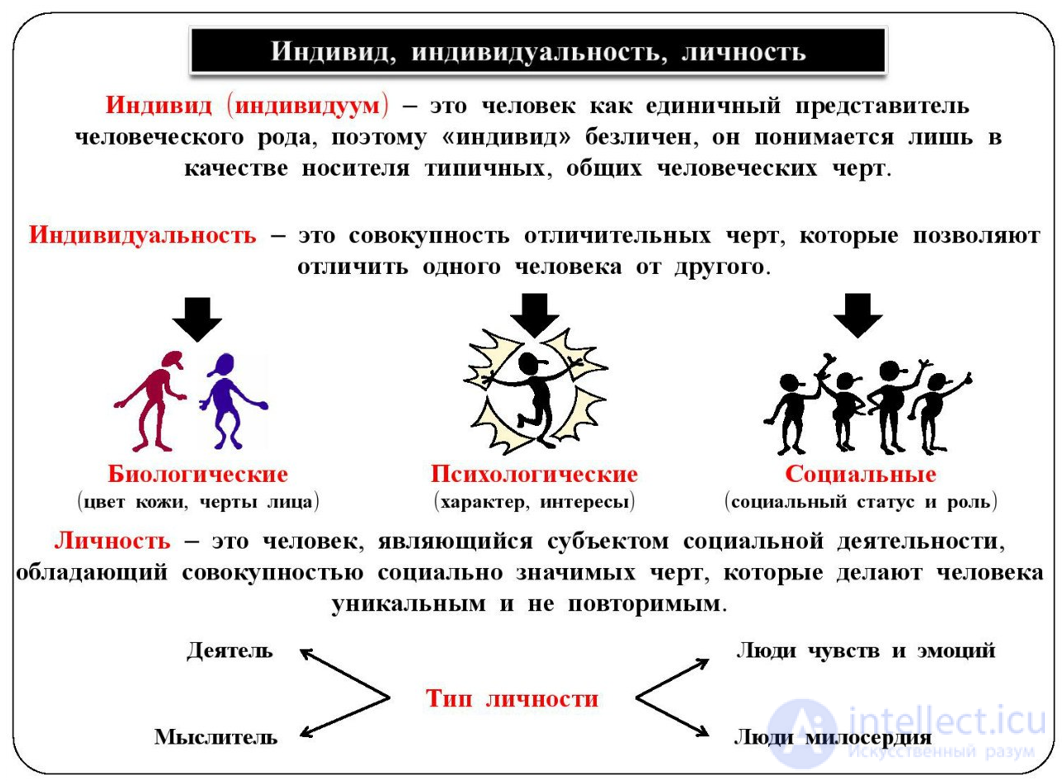
it is said (A. G. Asmolov): one is born an individual, one becomes a personality, and one defends one's natural individuality, one's social individuality, one's spiritual individuality, one's integral individuality.
Individuality signifies something more than merely the position of the individual on a scale of variation of one or another trait or combination of traits. Individuality expresses the uniqueness of the personality. From this point of view, the assertions of A. A. Derkach are justified, as he emphasizes that the concept of "type" cannot be correlated with personality as such (see: [10, p. 60]). Personality cannot be typical. Only its empirical expression (this or that property, quality, state of it) can be typical. Subjective manifestations of personality can be typical. Social types — subjects that have taken shape in a specific society — are an indicator of the development not only of personalities but also of society (the conditions of activeness). Inimitability, uniqueness, irreplaceability — these are the characteristics of personality.
Thus a summarizing conclusion may be drawn.
The human being is a generic entity, a representative of humanity, a socio-natural phenomenon. On the natural side, the human being is a niche in the development of nature; on the social side (from the standpoint of consciousness, thought, feeling), a microcosm, infinite in its diversity and equal in scope to the macrocosm of the World.
The individual is a concrete human being, a biosocial phenomenon. On the biological side, the individual is an organism; on the social side, a unit of society, a bearer of social relations — of normative determination (necessity).
Personality is a psycho-socio-spiritual (meaningful) phenomenon. It is no accident that in Russian classical philosophy the origin of the word "личность" (personality) was linked to "лик" (countenance/visage), and not to "личина," "персона," or "маска" (mask, persona, disguise). Personality as a marvel, as a myth, as a uniqueness... Its development is registered in the maturity of the I (the "I-system," the "I-constructs," the "I-concept").
The subject is the personality as agent.
Individuality is the biological, social, and spiritual (ultimately, integral) uniqueness of personality.
The "I-system"
At the center of the categorical series outlined here stands personality and its existential core — the I. Personality is the source of the supreme meaning-synthesis of the human world. Let us recall that personality is defined as the individual's capacity to live through his own I (through his life choices and his responsibility for them).
Psychologically, the I is the center of self-cognition (self-awareness) and self-regulation. At the basis of the content of the I-system lie social memory and the mechanism of identification (likening, equating). The end result is the discovery of personal meaning in the phenomena of the surrounding reality and a psychological "merging" with them (personification). What a person has experienced as "his own" enters into the content of his I. Hence the conclusion: the I is a social quality of the individual with the psychological status of We.
Therefore one should not exaggerate the contradiction between I and We (at the essential level they are contrived), but should instead concretely work at creating conditions under which no deformations or confrontations arise between the personality's "I-concept" and the "We-concept" of a people, or of some social group.
In the I-system of personality, various "I-constructs" can be distinguished. Among them are the "physical I" (within this construct, in solving specialized problems, one can distinguish a sense of gender: "I-as-woman," "I-as-man"); the "social I" (and here, going deeper, one can distinguish the "familial I"; the "professional I"; the "ethnic I"; the "national I"; the "civic I"); the "reflexive I" (whose core is the "mirror I"); the "spiritual I" (grounded in the "transcendental I," the "moral I," and others).
Their synthesis in the self-awareness of personality finds expression in such integral formations as the "image of the I" and the "I-concept."
Each "I-construct," each integral quality of the I-system, can be examined through modes: the "real I" and the "ideal I."
Crowning the I-system (the entire set of "I-constructs") is the "existential I" — the central, nuclear, conciliar characteristic of personality, the integral expression of self-cognition and self-awareness. In the absolute sense, the I (the I-system) is personality itself. Everything personal coincides with "I-expression." Whatever a person does not identify (does not equate) with his own I (personal meaning) is not, for him, psychologically personal (Diagram 2).
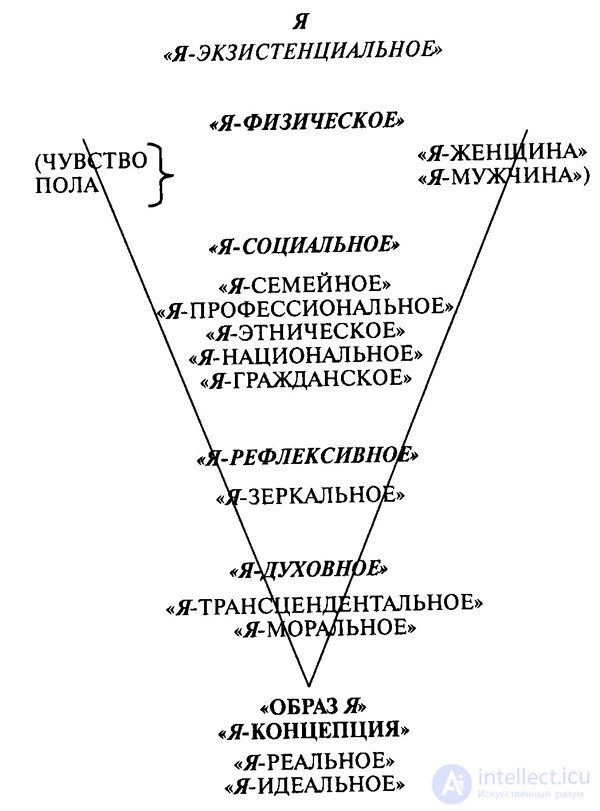
Diagram 2. The "I-system"
Acmeological research shows that workers with a high degree of differentiation and development of all aspects (constructs and modes) of their I tend to use greater and more varied information in the process of solving their professional tasks than those with a poorly developed "I-system." Specialists with a formed, stable "I-system" (an "I-concept") possess a more stable self-esteem and are less dependent on external circumstances, more neutral to the pressure exerted on them (the strength of the I). At the same time, a person who has an acute sense of his own I tends, as a rule, to respect personhood in another person as well.
The acmeological approach to personality is developed within psychological science, relying on the psychological definition of its essence. However, acmeology considers personality in the broader context of a comprehensive approach to the human being (B. G. Ananyev) and of philosophical anthropology (realized within psychology by S. L. Rubinstein). The latter is a philosophical
(in our case, philosophical-psychological) doctrine of the specific nature of human being-in-the-world.
Acmeology, on the one hand, demonstrates continuity with psychology and developmental theory; on the other, it differentiates its subject of study from the psychology of personality.
The first basis for considering the relation between the acmeological and the psychological understanding of personality is the principle of development. In both foreign and domestic psychology, personality development is considered predominantly as the development of the child's personality. The acmeological approach considers development across the whole of a person's life, linking development and the very essence of personality to the scale of time and space of the entire life path.
Psychology considers the immanent properties of personality ("inner," naturally arising needs, possibilities, and motives). Acmeology, on the other hand, is guided by criteria of optimality and optimization. It considers not merely the properties that are present, but the properties that are necessarily called for by the situation of life (of activity). Psychology proceeds from what is given. Acmeology is interested in the relation between the ideal (optimal) and the real path by which a personality achieves an optimum (an ideal).
Acmeology carries out an inversion (a three-dimensional, visualized "turning over") of psychological knowledge.1 In psychology, the main question is: WHAT is the psyche, the personality. In acmeology, the main question is: HOW is the psyche used; how does (or does not — and why?) the personality use its psychological and other resources in activity, in social life.
From this it is evident that acmeology is interested not in the structural-dynamic, or even the systemic-dynamic, but in the functional aspect of personality organization (personality as a functional system).
The problem arises of the psychological provisioning of activity (and of life as a whole) by the personality itself. Thus the central concept for acmeology becomes the concept of the subject (personality as subject of activity and subject of the life path).
Acmeology strives to identify the optimal compositions of the subjective properties of personality according to three criteria:
The desired (optimal) target state, the quality of personality, is projected in acmeology as follows: a model of this quality is built, in accordance with theoretical, methodological, humanistic principles and, simultaneously, with practically set criteria. In doing so, methods of diagnosis, design, modeling, acmeological technologies, and others are applied.
As a result, an acmeological complex (an acmeological integral) of work with the personality arises:
On the basis of this integral, the strategy of the necessary acmeological work (acmeological support) for the personality-subject is determined at the following levels: operational-external; reflexive-internal. The main thing in this process is the personality's own activeness (self-construction).
The acmeological maturity of the personality manifests itself in the conscious direction of one's own behavior, that is, in the capacity to be an adequate and active social subject (a self-sufficient, creative, competitive personality).
This capacity manifests itself:
— in the role of the personality as integrator of its psychic functions, of its resources (the self-construction of its own subjectness);
— in the personality's resolution of internal and external contradictions in the process of working out and realizing a picture (image) of the world, a basic culture, a worldview, a conception (strategies) of life, life values, a personal credo, a life stance, a life path. The main thing here is a shift in behavior from reliance on the environment, from external regulation, to reliance on oneself (to self-regulation); to life choice through self-determination on the basis of freedom and responsibility.
As a result, we arrive at the acmic personality. The acmic personality is a personality whose leading need and dominant life task is the striving "to be a personality." Both the need and the capacity "to be a personality" in the acmeological (acmic) personality have a spiritual and civic orientation. The acmic personality registers a special human-scaled principle in the properties and objects of the surrounding world.
The concept of "individual" is used to denote the human being as a biological organism, a bearer of the general genotypic hereditary properties of the biological species Homo sapiens (we are born as individuals). The concept of "personality" defines the socio-psychological essence of the human being, formed as a result of his assimilation of social forms of consciousness and behavior, of the socio-historical experience of humanity (we become personalities under the influence of life in society, upbringing, education, communication, and interaction).
However, personality is not only an object of social relations; it not only experiences social influences but refracts and transforms them, since gradually the personality begins to act as a set of internal conditions through which the external influences of society are refracted. These
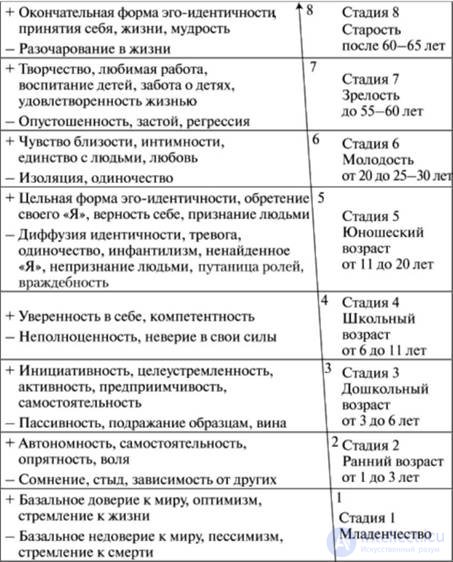
Fig. 2. Erik Erikson's Psychosocial Conception of Personality Development
internal conditions represent a fusion of hereditary-biological properties and socially conditioned qualities that have formed under the influence of prior social influences. As personality forms, the internal conditions become more profound. As a result, one and the same external influence can have a different effect on different people. Thus, personality is not only an object and product of social relations, but also an active subject of activity, communication, consciousness, and self-awareness. The subject is active, is itself a product of its own action, and is capable of altering external influences.
Since the human being lives in three spheres of the world: nature — society — culture, — three types of subject can be distinguished:
The concept of "personality" in the broad sense includes all three types of subject. Personality is not innate but arises as a result of cultural and social development. Moreover, personality is not only goal-directed but also a self-organizing system. The object of its attention and activity is not only the external world but also itself, which is manifested in its sense of "I," which includes a self-image and self-esteem, programs of self-improvement, habitual reactions to the manifestation of certain of its own qualities, and the capacity for self-observation, self-analysis, and self-regulation. To be a personality means to have an active life stance, of which one can say: here I stand, and I cannot do otherwise. To be a personality means to make choices arising from inner necessity, to assess the consequences of the decision taken, and to answer for them before oneself and before the society in which one lives. To be a personality means to possess freedom of choice and to bear its burden.
The concept of "individuality" characterizes a personality distinctive and unlike others in the fullness of its spiritual and physical properties. Individuality is expressed in the possession of different experience, knowledge, skills, and convictions, in differences of character and temperament (we prove and assert our individuality). The principal parameters of individuality are as follows:
The components of individuality are the properties of the individual (the set of natural properties), of personality (the set of social, economic, political, legal relations, etc.), and of the subject of activity (the set of activities and the measure of their productivity). An important indicator of individuality is the activeness of a person's creative, generative activity. The measure of the activeness and intensity of the work of the inner world is precisely the indicator of the spirituality of individuality.
The concept of individuality is most fully developed in the works of B. G. Ananyev.

Comments