
Lecture
The study of individual characteristics of imagination is the process of analyzing and examining how different people use their capacity for imagination and what individual traits they display in this area. Imagination plays an important role in our creativity, our problem-solving ability, and even in our emotional and psychological life. Studying the individual characteristics of imagination can help us better understand a person's strengths and weaknesses in this area and the factors that may influence their imagination.
Here are several aspects that can be studied as part of research into the individual characteristics of imagination:
Capacity for visual imagination: This is the ability to create vivid images in the mind. Research may involve testing a person's ability to visualize things and assessing their capacity to create detailed visual images.
Creative imagination: How does a person use their imagination to generate new ideas and solve problems? This may involve studying the capacity for associative thinking and the generation of unconventional solutions.
Capacity for realizing the imagined: How can a person turn their ideas and visual images into concrete actions and projects? Research into this aspect may involve analyzing the ability to translate the imagined into the real world.
Emotional imagination: How does imagination affect a person's emotional world? Research may involve studying a person's ability to experience and express their emotions through imagination.
The influence of culture and personal experience: How do cultural factors and personal experience affect individual imagination? Research may cover the analysis of differences in imagination among people from different cultural and social contexts.
Various methods can be used to conduct such research, including questionnaires, interviews, neuroimaging, as well as standardized tests and psychometric assessments. Studying the individual characteristics of imagination can be useful for understanding human nature, developing creativity and emotional intelligence, and for applying this knowledge in practical fields such as education, art, and psychology.
The aim of this study is to determine the level of complexity of imagination, the degree of fixedness of mental representations, the flexibility or rigidity of imagination, and the degree of its stereotypy or originality.
Materials and equipment: three sheets of paper, the first showing the outline of a circle 2.5 cm in diameter, the second showing the outline of an equilateral triangle with a side length of 2.5 cm, and the third showing the outline of a square with a side length of 2.5 cm; a pencil and a stopwatch.
The procedure for studying the individual characteristics of imagination is carried out in three stages, each of which involves creating a drawing based on the outline of a geometric shape. This method makes it possible to study how subjects use their imagination under conditions of limited time and minimal task structure. Here is a more detailed description of each stage:
Stage 1: Circle
Stage 2: Triangle
Stage 3: Square
After completing each stage, subjects are asked to assess their impressions and feelings associated with performing the task. This includes questions about whether they liked the task and what emotions they experienced. Such questions can help reveal which emotional and creative aspects of imagination were involved in the drawing process, and can supplement our understanding of the subjects' individual characteristics of imagination.
Questions similar to the following are used: "Did you like the task? What feelings did you experience while performing it?"
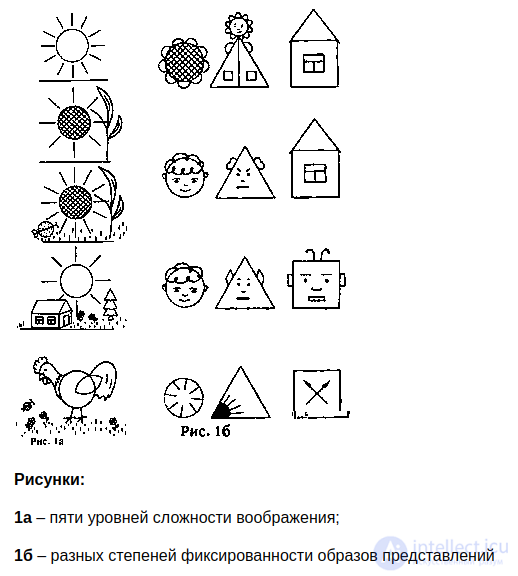
The processing of results and the determination of levels of development of imagination, the degree of fixedness of mental representations, flexibility or rigidity, and originality or stereotypy is carried out by comparing the content and analyzing all three of the subject's drawings.
Various methods and criteria can be used to determine the level of complexity of imagination. Assessing the complexity of imagination is important in the context of research and can be useful when analyzing individual characteristics. Here are some ways of determining the level of complexity of imagination:
Level of detail in the drawings: Assessing the number of details and elements in the drawings produced can serve as an indicator of the complexity of imagination. The more detailed and richly elaborated the drawings, the higher the level of complexity.
Use of symbolic elements: Analyzing whether the subject uses symbolic elements (such as arrows, letters, or numbers) to further interpret the outline of the geometric shape can indicate a higher level of complexity.
Conceptual complexity: Assessing how abstract and complex the ideas or concepts embodied in the drawings are can serve as an indicator of the complexity of imagination. For example, creating abstract scenes or drawings that require interpretation may be more complex than drawing simple objects.
Variability of the drawings: Examining the diversity of the drawings produced by the subject can help determine the level of complexity of imagination. If the drawings at different stages differ significantly and contain many variations, this may indicate a higher level of complexity.
Time taken to complete the task: The amount of time the subject spends creating a drawing can also serve as an approximate indicator of the complexity of imagination. If the subject spends a lot of time creating a single drawing, this may suggest a higher level of complexity.
Subject's self-report: After completing the task, the subject can be asked to assess the difficulty of the task from their own point of view. This provides additional information that can help interpret the results.
Comparison with other subjects: Comparing a subject's results with the results of other participants in the study can also help assess the level of complexity of imagination. For example, if a subject's drawings are more complex or varied than those of most other participants, this may indicate a higher level of complexity on their part.
The level of complexity of imagination can be a useful indicator when studying creativity, psychological characteristics, and individual differences in imaginative ability among different people.
The complexity of imagination is established based on the most complex of the three drawings. A scale can be used that allows for the establishment of five levels of complexity.
First level: the outline of the geometric shape is used as a detail of the drawing; the drawing itself is simple, without additions, and represents a single figure.
Second level: the outline is used as the main detail, but the drawing itself has additional parts.
Third level: the outline is used as the main detail, and the drawing represents a scene, with additional details possibly introduced.
Fourth level: the outline of the geometric shape continues to be the main detail, but the drawing is now a complex scene with the addition of figures and details.
Fifth level: the drawing represents a complex scene in which the outline of the geometric shape is used as just one of the details.
Determining the flexibility of imagination and the degree of fixedness of images and mental representations can be accomplished using various methods and approaches. Flexibility of imagination reflects a person's ability to change, adapt, and transform their visual images and ideas, while fixedness indicates the extent to which a person tends to retain stable images and representations. Here are several ways of assessing these characteristics:
Tests of flexible thinking: Such tests present subjects with tasks that require flexibility of imagination and the ability to see different ways of solving a problem. For example, analogy tests or tests involving the continuation of drawings. Subjects are offered several alternative response options, and researchers can analyze how often subjects choose alternatives that differ from the standard ones.
A method of problem-solving using images: This method involves presenting subjects with tasks that require considering various aspects of images. For example, a task could be proposed in which the subject must come up with different ways of using an ordinary object (such as a pencil) in unusual contexts.
Tasks involving the creation of alternative drawings: Similar to the procedure described above, a series of tasks can be conducted in which subjects are given outlines of geometric shapes and asked to create a variety of drawings based on these outlines. Analyzing the diversity and variability of the drawings can provide insight into the flexibility of the subjects' imagination.
Questionnaires and surveys: Using questionnaires and surveys in which subjects assess their own flexibility of imagination and the degree of fixedness of their representations can provide a subjective assessment of this characteristic.
Neurophysiological studies: Using neurophysiological methods such as functional magnetic resonance imaging (fMRI) or electroencephalography (EEG), it is possible to study brain activity while performing tasks related to imagination. These methods can help identify which areas of the brain are activated during flexible thinking and the transformation of images.
The combined use of various methods and approaches can provide a more complete picture of the flexibility of imagination and the degree of fixedness of images and representations in a particular individual. These assessments can be useful for understanding individual differences in creativity, adaptability, and problem-solving ability.
The flexibility of imagination depends on the fixedness of mental representations. The degree of fixedness of images is determined by the number of drawings that contain the same subject matter.
Imagination is flexible when the fixedness of images in the mental representation is not reflected in the drawings — that is, when all the drawings depict different subjects and cover both the interior and exterior parts of the geometric shape's outline.
Fixedness of representations is weak and flexibility of imagination is average if two of the drawings share the same subject.
Strong fixedness of images in the mental representation and inflexibility or rigidity of imagination is characterized by drawings on the same subject regardless of the level of complexity — this is rigid imagination.
Rigidity of imagination can also occur in the absence of, or with weak, fixation of images in the mental representation — namely, when the drawings are made strictly within the outlines of the geometric shape. In this case, attention is fixed on the interior space of the outline.
Stereotypy is determined based on the content of the drawings. If the content of a drawing is typical, then the imagination, like the drawing itself, is considered stereotyped; if it is untypical and original, it is considered creative.
Typical drawings include drawings on the following subjects.
Drawings with a circle outline: the sun, a flower, a person, a human or rabbit face, a clock face and clock, a wheel, a globe, a snowman.
Drawings with a triangle outline: a triangle and a prism, a house roof and a house, a pyramid, a person with a triangular head or body, a letter, a road sign.
Drawings with a square outline: a person with a square head and body, a robot, a television, a house, a window, a geometric square shape or cube supplemented in some way, an aquarium, a napkin, a letter.
The degree of stereotypy of imagination can be differentiated by levels. A high degree of stereotypy is established when all the drawings are on a typical subject.
A drawing is considered original, and the imagination creative, in the absence of stereotypy, when all the drawings made by the subject are on untypical subjects.
The results obtained should be compared with the characteristics of the subject's involvement in the research process and their attitudes. Self-report data are used for this purpose.
First of all, attention should be paid to subjects with rigidity of imagination. This may be a consequence of stresses and emotional shocks experienced in the past.
Subjects with the fifth level of complexity of imagination, an absence of stereotypy, and high-quality execution of drawings are usually capable of artistic activity (graphic art, painting, sculpture, etc.). Those inclined toward technical sciences, drafting, or logic and philosophy tend to depict certain abstractions or geometric shapes. In contrast, individuals with a humanities orientation favor subjects related to human activity, drawing people and their faces.

Comments