
Lecture
The Gestalt method is an approach to psychological work based on the concept of "gestalt" — a German word that translates as "form," "structure," or "image." The essence of this method lies in working with the images and representations that exist in the client's mind. The key property of the Gestalt method is a striving toward completion.
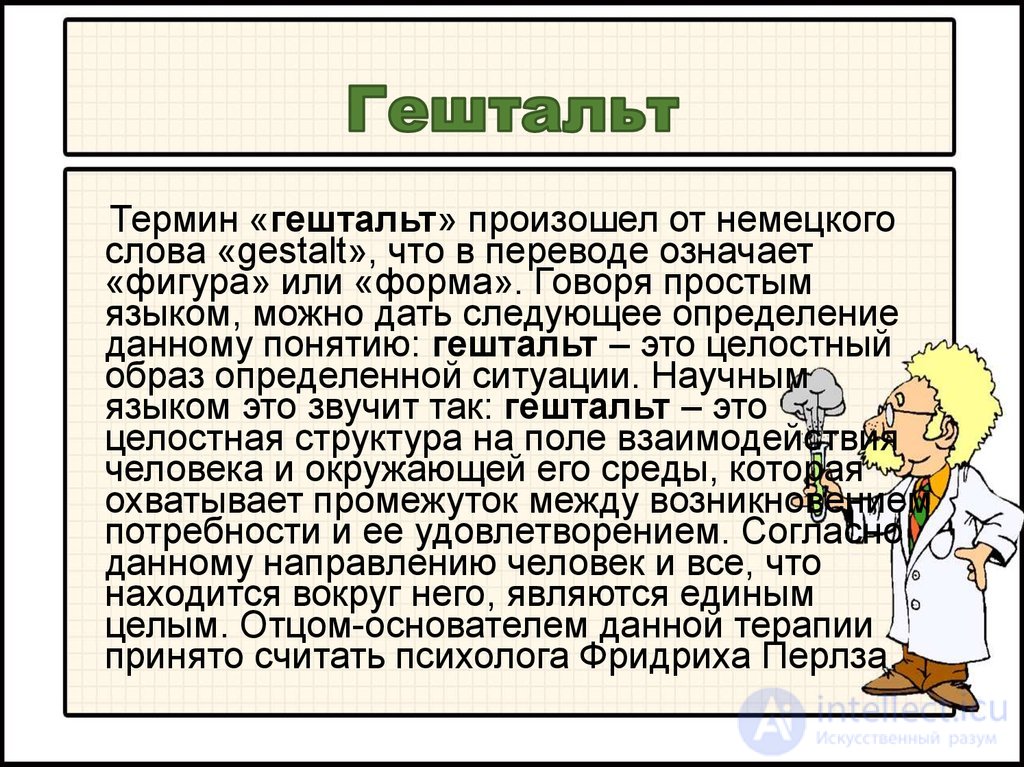
The term "gestalt" comes from the German word "Gestalt," which translates as "figure" or "form." In simple terms, this concept can be defined as follows: a gestalt is a holistic image of a particular situation. In more scientific language, it sounds like this: a gestalt is a holistic structure in the field of interaction between a person and their surrounding environment, which spans the interval between the emergence of a need and its satisfaction. According to this approach, a person and everything around them form a single whole. The founding father of this type of therapy is generally considered to be the psychologist Fritz Perls.
So, the main idea of the Gestalt method is to explore and work with the images and structures that form within the human mind. A Gestalt therapist, or specialist in this method, helps the client understand how these images influence their emotions, thoughts, and behavior.
One of the key aspects of working with gestalts is completion. This means that gestalts — that is, these images or structures — tend toward completion or resolution. When a gestalt remains unfinished, it can cause tension, conflict, or even psychological problems for the client. That is why Gestalt therapy places great emphasis on the process of completing gestalts, in order to help the client resolve conflicts and achieve psychological balance.
However, not everyone manages to close their gestalts. This can be due to various factors, including an unwillingness or inability to recognize and resolve one's inner conflicts. Gestalt therapists work with clients to help them find ways of completing gestalts and resolving inner conflicts.
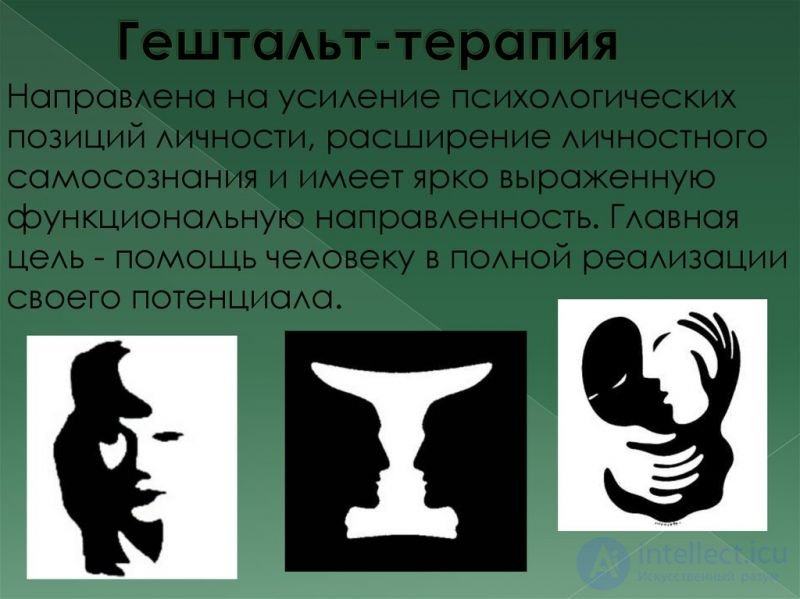
Thus, the Gestalt method is an approach to psychological work that focuses on working with the images and structures in a client's mind, and its main property lies in a striving toward the completion of gestalts in order to achieve psychological balance.
An unclosed gestalt is a concept that refers to unresolved situations, unfulfilled desires, and unfinished conversations that keep returning to a person's mind. If you have thoughts that keep coming back about some particular situation or conversation (whether it was an argument, a talk with someone, and so on), if you carry on internal dialogues with yourself on this subject, then that is an unclosed gestalt. Unfulfilled dreams and desires also fall into this category.
An unfinished situation or conversation makes a person keep returning to it in their mind. This can drain a great deal of energy and strength. In addition, it can cause feelings of anxiety, guilt, anger, shame, or disappointment.
When a person feels satisfaction with how a situation was resolved — even if that satisfaction was achieved only in their imagination — the gestalt can be considered closed.
To close unclosed gestalts, you can take the following steps:
Describe the problematic situation or conversation on paper, paying particular attention to your emotions and feelings.
Imagine the situation and try to picture how it could have ended differently.
Immerse yourself deeply in your feelings, name them, and give them an outlet.
Replay the situation in your mind with an ending that satisfies you.
These steps can help you resolve unfinished gestalts and free yourself from the burden of ongoing inner conflicts and distress.
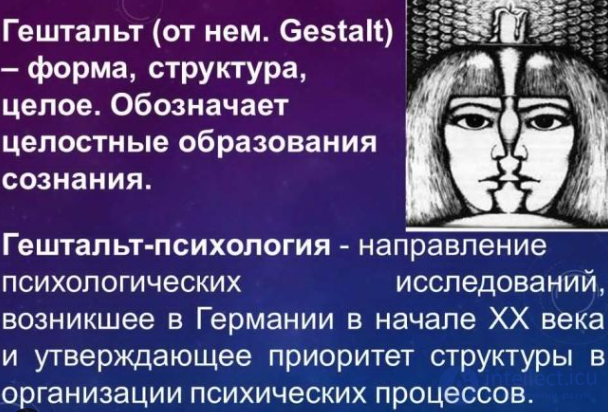
Gestalt psychology (from German Gestalt, "personality; image, form") is a general psychological school of thought associated with attempts to explain perception, thinking, and personality above all else. As its main explanatory principle, Gestalt psychology puts forward the principle of holism. It was founded by Max Wertheimer, Wolfgang Köhler, and Kurt Koffka in 1912.
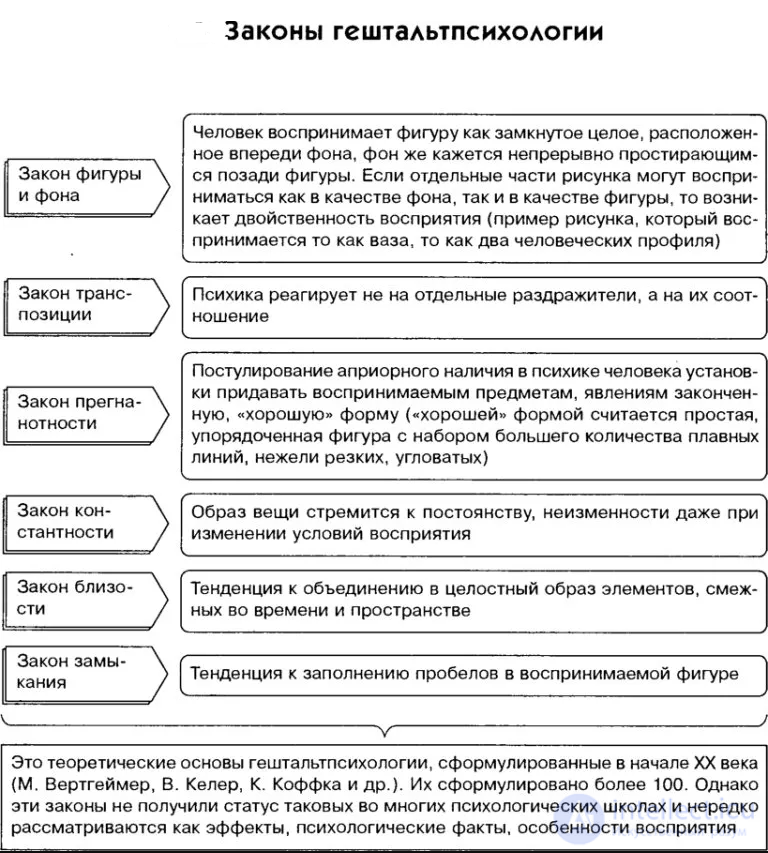
the laws of Gestalt psychology
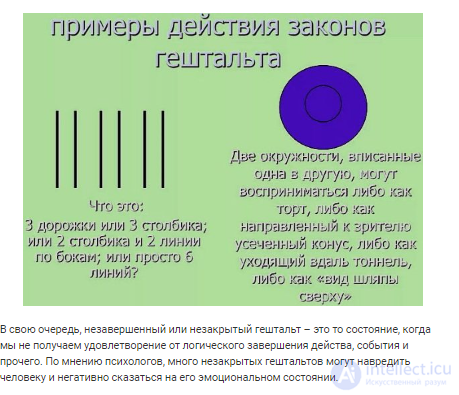
examples of how the laws of gestalt work
Gestalt psychology owes its emergence to the German psychologists Max Wertheimer, Kurt Koffka, and Wolfgang Köhler, who put forward a program for studying the psyche from the standpoint of holistic structures — gestalts.
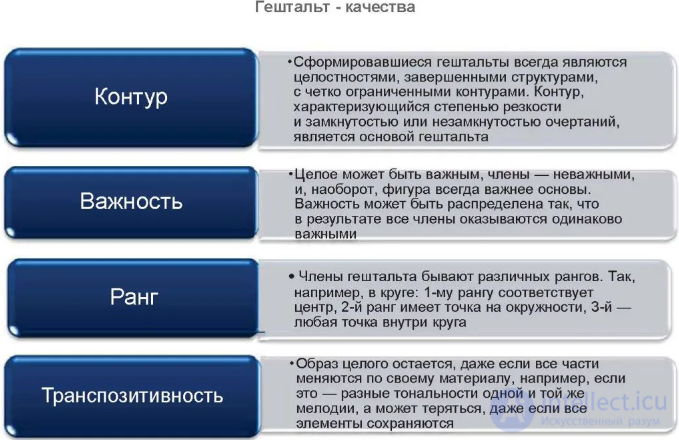
gestalt qualities
The founding of the school is usually traced to 1912 and the publication of Max Wertheimer's seminal article on the perception of motion. Opposing the principle, put forward by psychology at the time, of breaking consciousness down into elements and building complex mental phenomena out of them, they proposed the idea of the wholeness of an image and the irreducibility of its properties to the sum of the properties of its elements. In the view of these theorists, the objects that make up our surroundings are perceived by the senses not as separate objects but as organized forms. Perception is not reducible to the sum of sensations, and the properties of a figure cannot be described through the properties of its parts. A gestalt, as such, is a functional structure that organizes a multitude of separate phenomena.
The primary data of psychology are holistic structures (gestalts), which in principle cannot be derived from the components that make them up. Gestalts have their own characteristics and laws, in particular the "law of grouping" and the "law of relation" (figure/ground).
Later, the principles of gestalt were applied to motivation, social psychology, and personality, in particular by Kurt Lewin, as well as to aesthetics and economic behavior. The traditions of Gestalt psychology were continued in perceptual research undertaken by Rudolf Arnheim and Hans Wallach in the United States.
The forerunners of Gestalt psychology were the German poet Johann Wolfgang von Goethe (1749–1832), the Austrian physicist, philosopher, and psychologist Ernst Mach (1838–1916), and especially the Austrian philosopher Christian von Ehrenfels (1859–1932).
Christian von Ehrenfels, one of the forerunners of Gestalt psychology, emphasized as early as the beginning of the 20th century that "the whole is a certain reality distinct from the sum of its parts." A gestalt (German Gestalt — form, image, structure) is the spatially perceptible form of perceived objects, whose essential properties cannot be understood by summing the properties of their parts. One vivid example of this, according to Köhler, is a melody, which is recognized even when transposed into other keys. When we hear a melody a second time, we recognize it thanks to memory. But even if its key changes, we still recognize it as the same melody.
If the similarity between two phenomena (or physiological processes) is determined by the number of identical elements and is proportional to it, then we are dealing with sums. If there is no correlation between the number of identical elements and the degree of similarity, and the similarity is instead determined by the functional structures of the two phenomena as wholes in themselves, then we are dealing with a gestalt.
— Karl Duncker.
Gestalt psychology arose from research into perception. At its center is the characteristic tendency of the mind to organize experience into a comprehensible whole. For example, when perceiving letters with "holes" (missing parts), the mind strives to fill in the gap, and we recognize the whole letter.
All of the perceptual properties listed above — constancy, figure, ground — enter into relationships with one another and give rise to a new property. This is the gestalt, the quality of form. The wholeness of perception and its orderliness are achieved through the following principles:
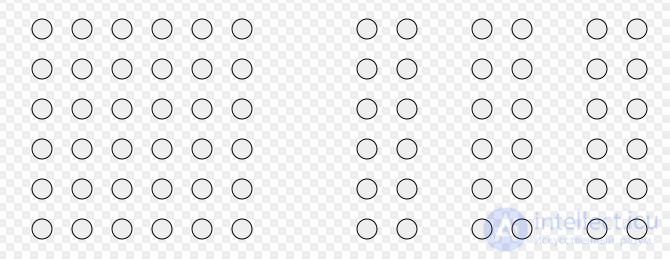
The principle of proximity. The right-hand part of the image is perceived as three columns.
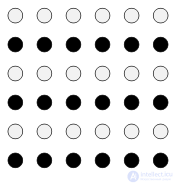
The principle of similarity. The image is perceived as rows rather than columns.
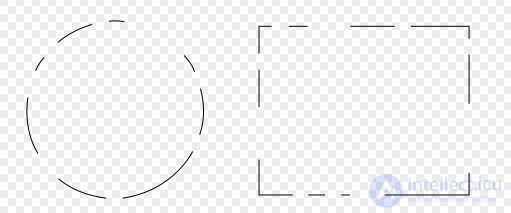
The principle of closure. The image is perceived not as separate segments but as a circle and a rectangle.
Formed gestalts are always wholes — completed structures with clearly bounded contours. The contour, characterized by its degree of sharpness and by the closed or open nature of its outline, is the foundation of a gestalt. One of the fundamental properties of a gestalt is a striving toward completeness, manifested in particular through the Zeigarnik effect.
In describing a gestalt, the concept of importance is also used. The whole can be important while its members are unimportant, and vice versa. The figure is always more important than the background. Importance can also be distributed so that, as a result, all members turn out to be equally important (this is a rare case, found for example in certain ornamental patterns).
The members of a gestalt can have different ranks. For example, in a circle: the center corresponds to the first rank, a point on the circumference has the second rank, and any point inside the circle has the third rank. Every gestalt has its own center of gravity, which functions either as a center of mass (for example, the middle of a disk), or as a point of attachment, or as a point of origin (creating the impression that this point serves as the starting point for building the whole, for example the base of a column), or as a directional point (for example, the tip of an arrow).
The quality of "transposability" is shown by the fact that the image of the whole remains even when all its parts change in material — for example, different keys of the same melody — but it can be lost even when all the elements are preserved, as in the paintings of Picasso (for example, Picasso's drawing "Cat").
The law of Prägnanz was put forward as the main law governing the grouping of individual elements. Prägnanz (from Latin praegnans — pregnant, meaningful, rich) is one of the key concepts of Gestalt psychology, referring to the completeness of gestalts that have achieved a balanced state, a "good form." Pregnant gestalts have the following properties: closed, clearly defined boundaries, symmetry, and an internal structure that takes on the form of a figure. In this connection, factors were identified that promote the grouping of elements into holistic gestalts, such as the "factor of proximity," the "factor of similarity," the "factor of good continuation," and the "factor of common fate."
The law of the "good" gestalt, proclaimed by Metzger (1941), states: "Consciousness is always predisposed, given a set of perceptions occurring together, to perceive predominantly the simplest, most unified, closed, symmetrical form that fits into the main spatial axis." Deviations from "good" gestalts are not noticed immediately, but only under intensive scrutiny (for example, an approximately equilateral triangle is perceived as equilateral, and an almost right angle as a right angle).
Size constancy consists in the fact that the perceived size of an object remains constant regardless of changes in the size of its image on the retina. The perception of simple things may seem natural or innate. In most cases, however, it is formed through personal experience. For instance, in 1961, Colin Turnbull took a pygmy who had lived in the dense African jungle out into the vast African savanna. The pygmy, who had never seen objects at a great distance, perceived herds of buffalo as swarms of insects until he was brought closer to the animals.
Shape constancy consists in the fact that the perceived shape of an object remains constant even as its shape on the retina changes. It is enough to look at this page first straight on and then at an angle. Despite the change in the "picture" of the page, the perception of its shape remains unchanged.
Brightness constancy consists in the fact that the perceived brightness of an object remains constant under changing lighting conditions — naturally, provided the object and background remain the same.
The simplest act of forming a perception consists in singling out, within visual perception, an object as a figure set against a background. Separating the figure from the ground and holding it as the object of perception involves psychophysiological mechanisms. Brain cells receiving visual information respond more actively when looking at a figure than when looking at the background (Lamme, 1995). The figure is always pushed forward, the ground pushed back; the figure is richer in content than the ground and stands out more vividly against it. And a person thinks about the figure, not the ground. However, their role and place in perception are determined by personal and social factors. This is what makes possible the phenomenon of the reversible figure, in which, for example, during prolonged viewing, the figure and ground switch places.
By the 1920s, Gestalt psychology had established a fairly solid position in Germany. But politics stood in the way of its further development. In 1933, Adolf Hitler's government expelled all Jews working at German universities. Max Wertheimer and Kurt Koffka were Jewish, and together with the other leading Gestalt psychologists they emigrated to the United States. In the US at that time, however, behaviorism dominated, adhering to a completely different approach, and Gestalt psychology was unable to gain the same prominent standing there that it had achieved in Germany. As a result, Gestalt psychology ceased to exist as a separate scientific school in the 1960s, coinciding with the death of Wolfgang Köhler.
Gestalt psychology held that the whole cannot be derived from the sum of the properties and functions of its parts (the properties of the whole are not equal to the sum of the properties of its parts), but exists at a qualitatively higher level. Gestalt psychology changed the earlier view of consciousness, arguing that its analysis should deal not with separate elements but with holistic mental images. Gestalt psychology opposed associationist psychology, which broke consciousness down into elements. Together with phenomenology and psychoanalysis, Gestalt psychology formed the foundation of the Gestalt therapy of F. Perls, who carried the ideas of the Gestalt psychologists from the level of cognitive processes to the level of one's overall worldview.
Abraham Maslow, one of the founders of humanistic and transpersonal psychology, drew on the figure of Max Wertheimer when developing his theory of self-actualization, regarding him as one of the models of a self-actualized personality.
Akriti (Devanagari अकृति, IAST: akṛti, from the root kṛ, "to manifest," with the prefix ā) is the observable individual form of a thing — its configuration, silhouette, outline, contour (compare the "eidos" of Greek philosophy and the modern concept of "gestalt"). The term is used in discussions of the meaning of a word, its relation to the object, and to ritual action.

Comments