
Lecture
Well-being is a general mental indicator of our bodily and spiritual state at any given moment; it consists of specific sensations and general feelings. For instance, one state of well-being - the feeling of hunger - consists of a local sensation in the stomach area and a general, indefinite sensation throughout the body. Well-being is closely connected with an individual's self-preservation: it reminds the organism of its needs and points out threatening dangers to it.
In economics, this term is used for one or more quantitative measures aimed at assessing the quality of life of a community, for example, in potential and the economics of happiness. How wealth and related rules relate to overall welfare in a country, and the sources of the economy can be opposed by the state through its policies or dogmas that hinder economic development. The study of well-being is divided into subjective well-being and objective well-being.
A person's overall state of well-being depends on well-being itself. Although there is no precise definition of the actions and conditions for creating well-being, they can be defined as "a special case for a relationship". This definition serves two purposes for well-being: developing and testing a [systematic] theory of the structure [of relationships] among the varieties of well-being, and integrating the theory of well-being with an ongoing, comprehensive theory of development in the field of relevant relational research." One's own well-being develops through the assessment of one's environment and the emotions it evokes, after which an interpretation of one's own personal self-determination develops, forming one's state of well-being. There are two distinct types of well-being: cognitive and affective.
Cognitive well-being develops through the assessment of one's interactions with the environment and other people. "Welfare economics ultimately deals with cognitive concepts such as: welfare, happiness, and pleasure. These relate to concepts such as: aspiration and needs, abundance and frustration." People tend to evaluate their aspirations favorably based on the social classes present in their community. Communities with a wide range of social statuses are less prone to comparing their lifestyle with those of a higher class and instead evaluate what they do rather than what they have, which can genuinely lead to a higher level of well-being. Whenever someone interprets their needs and desires as being satisfied or not, this subsequently develops their cognitive well-being.
Various levels of different factors influence emotional well-being: "high negative affect involving anxiety and [hostility], low negative affect involving calm and relaxation, high positive affect represented by a state of pleasant arousal, enthusiasm, and a range of positive factors that influence the representation of each state by unpleasantness and low arousal (sadness, fatigue)." Emotional well-being is most usefully viewed as a dynamic process that gives people a sense of what their life will be like, through the interaction between their circumstances, activities, and psychological resources, or "psychological capital." Or, "It can be said that this is a state of complete well-being that produces a good sense of well-being."
The correlation between overall well-being and positive psychology has been proven by many sociologists, in order for a person to be strong and positive. According to McNulty (2012): "Positive psychology, at the subjective level, values subjective experiences." Well-being is an important factor in this subjective experience, along with abundance, pleasure in the past, optimism for the future, and happiness in the present. People experience positive psychology more often if they accept only the good things in every experience or situation. Even in the past, if a person focuses only on the negative, the brain will only be able to recognize negative feelings. The more access the brain has to negativity, the more easily negativity arises, because it is more memorable. Positive memories require more effort for the brain to recall, because they are usually smaller actions and experiences related to positivity. James McNulty (2012), a researcher, looks at this idea a bit more closely. He argues that "well-being is determined not only by the psychological characteristics of individuals, but is instead determined jointly through the interaction between these characteristics and the qualities of peoples in the social environment." When people have well-being, they experience a sense of emotional freedom - a good sense of well-being. There is nothing negative that can hold back the feeling of positive emotions. This holds true if a person is in a particular setting, since it has been shown in past research that a certain setting can hold many memories for a person simply because of what was felt in the past and what it means to that person. Therefore, "well-being (a good sense of well-being) is often identified with the experience of pleasure and/or the absence of [pain] over time." The less psychological pain an individual experiences, the more he or she will feel a sense of well-being.
When someone has positive well-being, they also experience some other things. These include a sense of: self-actualization, which is the feeling of those who are happy and content because they do everything to fully use their abilities and talents (Merriam-Webster). The feeling of having a purpose in life and connection with others also fits into the idea of well-being. When people feel as though they have a [purpose] in the world they feel like they belong; they feel like they matter.
When it comes to the school education system, the idea of the well-being of a child or adolescent becomes a bit murky. It is argued that school should be solely for teaching and education, but children also learn a great deal of social skills for themselves at school. When a child feels that they belong, they are more likely to do better at school. In addition to receiving an education, they must learn to believe in themselves and set goals for themselves. If the well-being that creates a positive state of well-being is established in children at a young age, it is likely to play a certain role in their lives later on, as they grow older.
John White (in 2013) looked at the history of state schools in the United Kingdom, both now and in the past. Previously, schools focused solely on knowledge and education, but Britain has now shifted toward a broader range of school activities. They launched an initiative program called "Every Child Matters," aimed at improving children's well-being across the full range of a child's life at school. [10] Thus, schools focused not only on acquiring knowledge or skills, but also on: comfortable conditions for the child, favorable relationships, social training and activities, a broad approach to learning and locations for educational activities - improve the child's well-being.
Subjective well-being "is based on the idea that everything each person thinks and feels about their life matters." [11] This idea is developed specifically within a person's [culture]. People base their own well-being on their relationship to the environment and the lives of other people around them. Well-being is also subjective, in that how a person feels about others in their environment, viewing them in a positive or negative light. Well-being is also subjective to pleasure and depends on whether basic human needs are met, although one's needs and desires can never be fully satisfied. The quality of life of a person and of society depends on the amount of happiness and satisfaction, as well as a person's health. Whether something/someone is subjective across all cultures depends on whether their culture is truly based on the culture it promotes. "Collective cultures are more likely to use norms and the social evaluation of others in assessing their subjective well-being, while individualistic societies are more likely to be heavily influenced by each individual's internal beliefs about their own happiness, which is precisely what gives them a sense of well-being." [12]
Ethnic identity plays a crucial role in one's cognitive well-being. Research shows that "both socio-psychological and developmental perspectives suggest that a strong, secure ethnic identity makes a positive contribution to cognitive well-being." [13] Those in multicultural societies who are able to feel more equal as human beings within their culture achieve better well-being. This is also an important aspect in adapting to a new society.
To a large extent, and sometimes primarily, a person's well-being is influenced by their sexual and gender identity and sexual orientation, including due to discrimination against the individual on the basis of sex or gender, sexual characteristics, or the absence of negative discriminatory factors [14].
Individual roles play a certain part in cognitive well-being, in achieving a good sense of well-being. Not only do social connections exist that improve cognitive well-being, but they also improve psychological health. [15] Having multiple identities and roles helps people live in society and provides an opportunity to contribute more, since they increase the number of their roles, thereby creating better cognitive well-being. The diversity of social roles in society directly affects an individual's personal well-being. Restrictions on social and gender roles, conversely, worsen the well-being of all individuals in society [16].
Each role occupies its own place in a hierarchy. Character or characteristic is "the subjective importance that a person assigns to each identity." [15] Different roles of a person have different governing factors for their well-being. In this hierarchy, higher roles offer greater sources of well-being and are defined by greater meaningfulness in the person's overall role in society. Thus, the physical contacts of individuals, through each person's personal roles, improve overall well-being [17].
According to (Bloodworth and Colleagues, 2012), sport and physical activity [18] are key factors in the development of general public welfare and well-being. Sport has a major influence on welfare and well-being, which can be conceptualized within general frameworks. But such frameworks include inconsistency, their hedonic dimension, and epistemological inadequacy. Arguments arise from the fact that "the value of sport must be asserted consistently in order for people to flourish" [19]. But there may be problems with the very study of sport's effect on well-being, since most developed societies and others are unable to engage in sport regularly, let alone compel citizens to engage in sport. Not to mention that most people do not have the opportunity to engage in sport, some due to physical limitations, health conditions, biological constraints, and the like. There is a shortage of research into this kind of phenomenon. [20]
The following are fundamental for preserving health and increasing the length of a person's healthy life:
A person's physiological state is greatly influenced by their psycho-emotional state. Therefore, some authors also additionally highlight the following aspects of a healthy lifestyle:
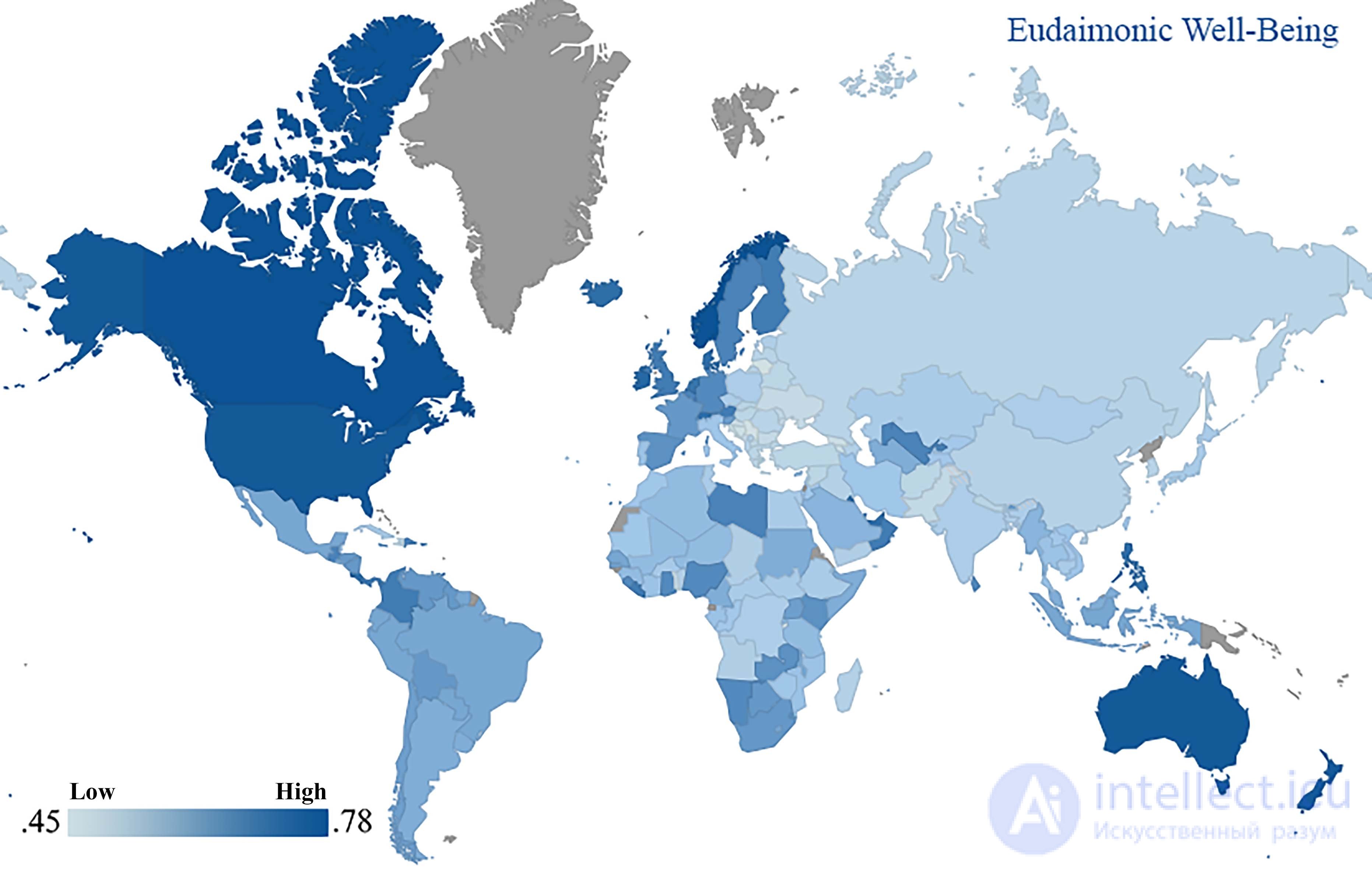
Results of well-being in 166 countries according to the Gallup World Poll
Research on positive psychology, well-being, eudaemonia, and happiness, as well as the theories of Diener, Ryff, Keyes, and Seligman, cover a wide range of levels and topics, including "biological, personal, relational, institutional, cultural, and global dimensions of life." [38] The "World Happiness Report" series publishes updated data annually on the global status of subjective well-being. [39] A global study using data from 166 countries provided a country ranking of psychosocial well-being. [40] The latest research has shown that subjective well-being and psychosocial well-being (e.g., eudaemonia) measures encompass different constructs, and both are necessary for a comprehensive understanding of mental well-being.

Comments